Part I — The Smile
The first mistake Officer Tyler Griggs made wasn't accusing me.
It was smiling.
Not a nervous smile. Not the polite expression people use when they want to lower the temperature in a disagreement. This one carried satisfaction. It crossed his face at the exact moment the tow truck turned into the parking lot, and when I saw it, I understood something important.
He believed the matter was finished.
In his mind, I had already lost.
The old Marine with the cane, the accessible van, the handicap placard, the Purple Heart plates—none of it mattered anymore. He had decided what I was before he'd checked a single document, and now a diesel engine was coming to make his decision permanent.
The tow truck moved slowly between rows of parked cars outside the Phoenix VA Medical Center, its engine rumbling through the warm Arizona morning.
People began to notice.
A man in a ball cap stopped halfway to the entrance.
Two women in medical scrubs slowed near the sidewalk.
Three older veterans standing beneath the shade of an awning turned toward the sound.
Griggs heard it too.
His smile widened.
I stood beside my van with my left hand wrapped around the top of my cane and my right hand resting against the open driver's door.
At seventy-six, balance was something I negotiated with instead of possessed.
My right knee carried more metal than cartilage. My left hip had been reconstructed twice. Some mornings my lower back announced the weather before the forecast did.
I had learned not to resent any of it.
Resentment is expensive. It asks for energy and gives nothing back.
Still, there were things I refused to surrender.
That van was one of them.
It wasn't impressive. Gray paint. Sliding side door. Ramp mechanism. Hand controls installed after my legs stopped cooperating with ordinary pedals. A few scratches along the rear bumper from years of parking garages and tight clinic spaces.
To somebody else, it was transportation.
To me, it was the line between independence and dependence.
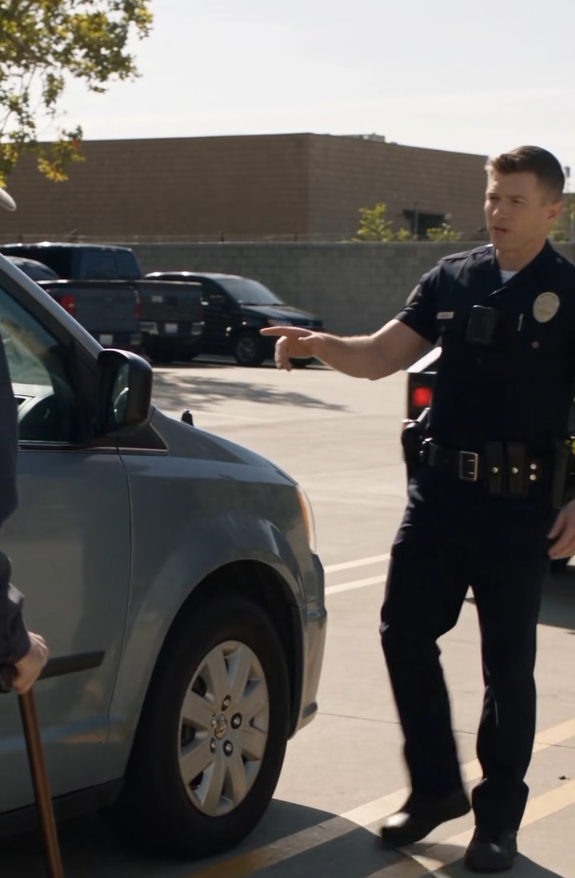
Griggs pointed at it.
"You've got one last chance."
His tone was louder now because people were listening.
"Move it."
I looked at him.
"The placard is valid."
"You've said that."
"So run it."
"I've told you what I think."
I almost smiled at that.
Not because anything was funny.
Because in one sentence he'd admitted the entire problem.
What he thought.
Not what the registration showed.
Not what the placard database would show.
Not what my VA appointment records would show.
What he thought.
I had been alive long enough to know that arguing with certainty usually made certainty louder.
So I kept my voice level.
"What you think isn't the same as what you verified."
His jaw shifted.
"Careful."
There it was.
A warning without a charge.
An order without a reason.
For nearly six decades, I had watched men use tone when facts stopped helping them.
The tow truck came closer.
The driver was visible now through the windshield. Middle-aged. Work shirt. Sunglasses. One hand high on the wheel.
He looked from Griggs to me, then to the van.
He slowed.
That interested me.
Griggs stepped away from me and waved him forward.
"Right here."
The driver pulled in behind my van and stopped.
The diesel engine stayed running.
Its vibration traveled through the pavement and up the cane into my palm.
By then, maybe twenty people were watching.
Nobody was shouting.
Nobody was crowding Griggs.
That mattered.
The veterans nearby understood instinctively that the worst thing they could do for me was give him a second problem to point at.
One of them, an older Marine wearing a faded red Corps cap, stood with his arms loose at his sides.
He'd been the first to speak earlier.
"Back off," he'd muttered when Griggs stepped too close to me.
Griggs had ignored him.
Now the Marine met my eyes.
I gave him the smallest shake of my head.
Don't.
He understood.
The driver climbed out of the truck.
Griggs walked toward him.
"He's refusing to move."
The driver glanced at me.
Then at the handicap placard hanging plainly from my rearview mirror.
Then at the Purple Heart plates.
His face changed just enough for me to notice.
He didn't challenge Griggs.
He simply asked, "Vehicle cleared?"
Griggs turned toward me.
"He's illegally parked."
The driver waited.
"Cleared?"
For the first time, Griggs looked irritated with someone besides me.
"I'm the officer requesting the tow."
The driver lifted both hands slightly.
"Just asking."
"Then stop asking."
The driver said nothing else.
He walked toward the rear of my van.
That was when I reached into my pocket for my phone.
My hand trembled once.
Griggs noticed.
His eyes dropped to it.
"Who are you calling?"
I didn't answer.
He gave a short laugh.
"You calling your lawyer?"
Still nothing.
"You people always think you know somebody."
I looked at him then.
There are sentences that tell you everything about a man because they weren't meant to.
You people.
He hadn't said veterans.
He hadn't said disabled drivers.
He hadn't said patients.
Maybe even he didn't know exactly who he meant.
But whatever category he'd placed me in, it was one he believed deserved less credibility than he did.
I unlocked the phone.
For years, there had been a number I never deleted.
I had never needed to call it.
Not when my first hip surgery went wrong.
Not when my wife died.
Not when the ramp motor failed outside a grocery store in July and I sat in the heat for two hours waiting for roadside assistance.
Pride can disguise itself as independence if you let it.
The contact was still there.
Robert Kincaid.
I stared at the name.
We hadn't spoken in years.
Not because of a falling-out. Life does that to people. Decades compress. Men retire. Families scatter. Christmas cards stop. Phones get replaced. One year becomes five before anybody notices.
But there are relationships time doesn't erase.
Only quiets.
I pressed the number.
One ring.
Two.
Then:
"Kincaid."
His voice had aged.
The authority in it hadn't.
For a second, I couldn't speak.
"Hank?"
He knew the number.
That nearly undid me more than Griggs had.
I closed my eyes.
"Sir."
The parking lot disappeared for half a heartbeat.
Not literally.
But memory can make the present feel thin.
Kincaid had always hated being called sir outside official business.
Years ago, he would have corrected me.
This time he didn't.
"What happened?"
I opened my eyes.
Griggs had folded his arms.
The tow driver was standing beside the rear wheel, waiting.
People watched from the sidewalk.
"I need help."
Kincaid's response came immediately.
"What kind?"
"Officer says my placard is fake. Won't run it. Tow truck's here."
A pause.
Not confusion.
Calculation.
"Where are you?"
"VA medical center."
"Are you inside the vehicle?"
"No."
"Is the officer touching you?"
"No."
"Are you touching him?"
"No."
His voice sharpened.
"Good. Listen carefully, Hank."
I waited.
"Don't move."
Griggs tilted his head, trying to hear.
"Don't argue."
I looked at the officer.
Kincaid continued.
"Don't touch him."
Another pause.
Then four words.
"Help is coming."