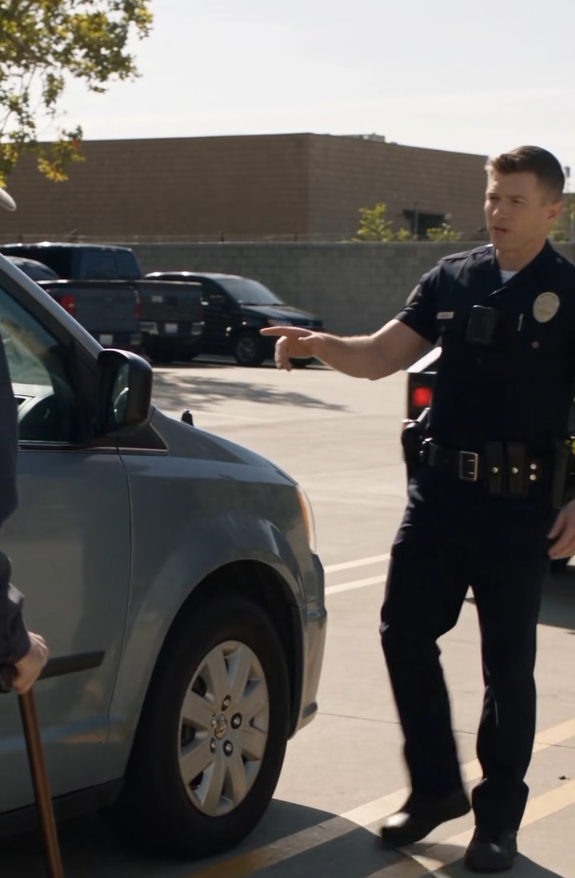
The line went quiet.
I lowered the phone.
Griggs smirked.
"Done?"
"Yes."
"Good."
He turned to the driver.
"Hook it."
The driver didn't move.
"I need him clear of the vehicle first."
Griggs looked at me.
"You heard him."
I tightened my grip on the cane.
"This van is how I get home."
"You can arrange another ride."
"It carries my mobility equipment."
"Not my problem."
Something shifted behind him.
Not movement exactly.
Attention.
The people watching had heard that.
Griggs heard the change too.
His posture stiffened.
I looked directly at him.
"If you tow this van, you're towing my legs."
His face remained blank.
For a fraction of a second I wondered whether I had finally reached him.
Then he smiled again.
"Noted."
He turned away.
And that was the moment I stopped hoping he would correct himself.
The most dangerous point in any confrontation isn't when someone becomes angry.
It's when they become invested.
Once pride attaches itself to a decision, backing down starts feeling like defeat.
Griggs wasn't trying to determine whether I belonged in that space anymore.
He was trying to prove that he had been right to challenge me.
Those are different jobs.
Only one of them requires evidence.
The tow driver crouched near the rear wheel but still hadn't attached anything.
I checked the time.
9:28.
My appointment had been eighteen minutes ago.
I almost laughed.
That was why I'd come.
A routine appointment.
Blood work.
Physical therapy evaluation.
Nothing dramatic.
I had woken before seven, eaten half a piece of toast, taken my medication, driven through traffic, and worried about whether the clinic would make me do another balance assessment.
An ordinary morning.
There ought to be a warning before ordinary mornings become important.
There never is.
Griggs pointed toward the sidewalk.
"Move away from the van."
"No."
The crowd stirred.
His eyes narrowed.
"What did you say?"
"I said no."
I kept my voice quiet.
"I'm not interfering with the driver. I'm not touching you. I'm standing beside my vehicle."
"I'm giving you a lawful instruction."
"Then tell me what law requires me to abandon my mobility vehicle while you're refusing to verify legal documents."
That landed.
Not because it changed his mind.
Because it gave him a question he couldn't answer quickly.
A few people exchanged glances.
The Marine in the faded cap looked down, hiding what might have been a smile.
Griggs stepped closer.
"Don't play games with me."
"I'm not."
"You think because you've got some plates and a cane everybody has to take your side?"
"No."
"Then what exactly do you think is happening here?"
I looked toward the tow truck.
Then at the people watching.
Then back at him.
"I think you decided who I was before you asked."
His expression hardened.
"That's enough."
"No," I said. "It should've been enough ten minutes ago."
He reached toward his radio.
The tow driver stood up.
For the first time, the driver spoke directly to me.
"Sir, is there medication in the vehicle?"
Griggs snapped toward him.
"Why does that matter?"
The driver kept looking at me.
"Anything medical that needs to come out before transport?"
"Mobility equipment. Medication bag. Ramp chair."
The driver's mouth tightened.
He looked at Griggs.
"I'm not moving it until that's sorted."
Griggs stared at him.
"I told you to tow it."
"And I heard you."
"Then do your job."
The driver's voice stayed flat.
"I am."
Nobody moved.
A hot breeze crossed the lot, carrying dust and exhaust.
Somewhere behind us, an automatic door opened and closed.
A cart rattled across concrete.
Normal sounds.
Normal morning.
But the space around us had narrowed until every small choice mattered.
Griggs raised his radio.
"Unit requesting supervisor response."
I watched him.
That was the first sensible thing he'd done.
He probably didn't know it.
Part II — Pressure
The supervisor arrived before whatever help Kincaid had set in motion.
A marked vehicle pulled into the lane and stopped behind the tow truck.
Griggs straightened.
The older veterans shifted slightly but kept their distance.
The tow driver stepped away from my van.
A uniformed supervisor got out.
No dramatic entrance. No raised voice. No rush.
He took in the scene the way experienced people do—first the officer, then me, then the tow truck, then the audience.
His eyes rested briefly on my plates.
Then the placard.
Then the cane.
"What's going on?"
Griggs answered first.
"Suspected fraudulent placard. Driver refusing lawful direction. Tow requested."
The supervisor looked at me.
"Sir?"
I held out the documents I'd been trying to show Griggs.
"Registration. Placard authorization. Appointment confirmation."
He took them.
Actually took them.
That simple act nearly felt revolutionary.
He examined the placard paperwork.
Then the registration.
Then my driver's license.
"Mr. Delaney?"
"Yes."
"You've been asked to move the vehicle?"
"I've been accused of using a fake placard. I asked Officer Griggs to verify it. He declined."
The supervisor glanced at Griggs.
"Declined?"
Griggs spoke quickly.
"The paperwork can be fabricated."
"Did you run the plate?"
"I was handling the contact."
"Did you run the plate?"
A beat.
"No."
The supervisor's eyes lingered on him.
Then he raised his radio.
"Run this for me."
He read the plate number.
Griggs shifted his weight.
The crowd remained quiet.
That quiet had become a presence of its own.
People often think witnesses matter because of what they say.
Sometimes they matter because they prevent everybody else from rewriting what happened.
A voice came over the radio.
The plate returned to me.
The registration matched.
The supervisor gave my license information.
Another response.
Valid.
Then the placard.
We waited.
Griggs looked toward the clinic entrance, as if distracted by something.
The dispatcher came back.
Placard valid.
Issued to Harold Delaney.
No discrepancy.
The supervisor lowered his radio.
For the first time that morning, Griggs didn't seem to know what expression to wear.
I expected satisfaction.
I felt none.
That surprised me.
I'd imagined, during those first ugly minutes, how good it would feel to watch reality corner him.
Instead I felt tired.
Not physically.
Something deeper.
Because the facts had been available from the beginning.
We had spent nearly half an hour turning verification into confrontation.
The supervisor returned my documents.
"Mr. Delaney, your placard checks out."
"I know."
He nodded.
"I understand."
Griggs spoke from behind him.
"That doesn't mean the initial suspicion was unreasonable."
The supervisor turned slowly.
Nobody said anything.
Griggs continued.
"The placard looked inconsistent."
I glanced at it hanging from the mirror.
It looked exactly the way it had looked every day since the state issued it.
The supervisor asked, "What was inconsistent?"
Griggs gestured vaguely.
"The print. The way it was displayed."
"It was hanging from the mirror."
"After he parked."
The supervisor looked at me.
"Was it displayed when Officer Griggs approached?"
"Yes."
Griggs shook his head.
"I didn't say it wasn't."
The older Marine in the faded cap finally spoke.
"It was there."
Griggs looked at him.
"I didn't ask you."
The supervisor's gaze snapped toward Griggs.
"Officer."
One word.
Enough.
The Marine said nothing else.
The supervisor rubbed the bridge of his nose.
"Tow is canceled."
The driver nodded immediately.