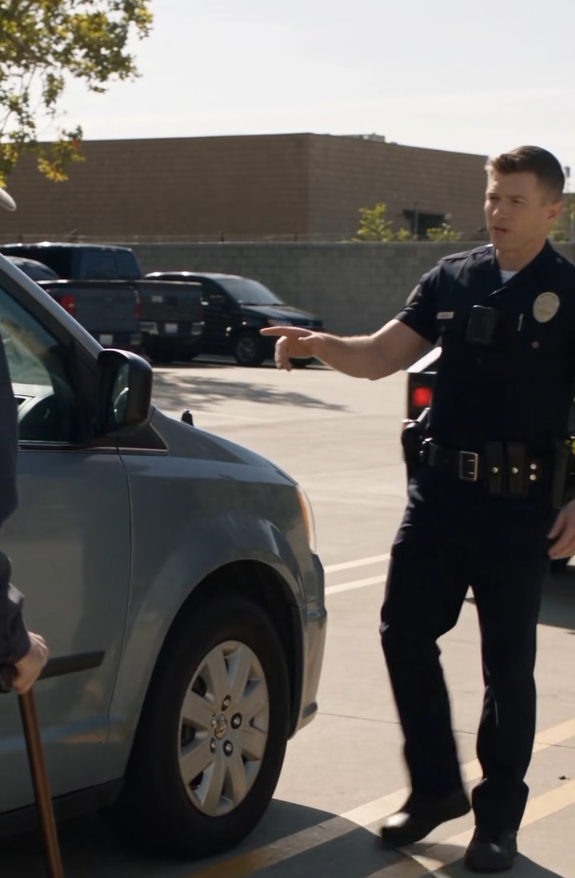
"Morning, sir."
"Morning."
He glanced toward the dashboard.
"Just letting you know your placard's turned sideways. The expiration date's hard to see from the lane."
I looked.
He was right.
It had rotated on the hook.
I straightened it.
"Better?"
He looked.
"Perfect."
"Anything else?"
"No, sir."
He started away.
Then stopped.
"Actually—are you headed to the main entrance?"
"Yes."
"The east doors are closed for maintenance. Use the center doors."
I looked toward the building.
"Appreciate it."
"Have a good one."
He walked away.
That was all.
No applause.
No witnesses.
No lesson delivered in a speech.
Just an ordinary interaction between two strangers who both did exactly enough.
I stood beside the van for a moment.
Then I heard someone behind me.
"Looking for trouble again?"
I turned.
Robert Kincaid stood ten feet away holding two cups of coffee.
I stared at him.
"What are you doing here?"
"You told me your follow-up was today."
"I did not."
"You did at dinner."
"I was probably tired."
"You repeated it twice."
"That sounds unlike me."
He handed me a cup.
I smelled it.
"Still terrible?"
"Bought it somewhere else."
I took a cautious sip.
Better.
Not good.
Better.
We started toward the clinic.
I used my cane.
He matched my pace without making a show of slowing down.
Halfway across the lot, I looked back at the van.
Sunlight reflected off the windshield.
The placard hung straight.
The Purple Heart plates were visible.
Nothing about the scene looked important.
That pleased me.
Kincaid noticed I'd stopped.
"What?"
"Nothing."
He followed my gaze.
"The parking spot?"
"Yeah."
He waited.
I thought about Griggs's smile.
About the tow truck arriving.
About the phone trembling in my hand.
About how badly I'd wanted one person with authority to simply look at the evidence.
I thought about what had happened afterward.
The complaint.
The camera.
The other cases.
The meeting.
The apology.
The policy change.
For weeks, people had told me I had won.
I never liked that word.
A win implied there had needed to be a loser.
I hadn't wanted Tyler Griggs destroyed.
I had wanted him stopped.
Then I had wanted the truth recorded.
After that, I wanted the next person in my situation to have an easier morning.
That was enough.
Kincaid took a drink of coffee.
"You know what your problem is?"
"I can think of several."
"You always need things to mean something."
I looked at him.
"That's rich coming from you."
"I'm serious."
"So am I."
I started walking again.
He followed.
At the curb, my foot caught slightly.
Kincaid's hand moved on instinct.
He stopped himself before touching me.
I steadied myself with the cane.
Then I looked at him.
He looked embarrassed.
I held out my arm.
"Go ahead."
He offered his forearm.
I took it.
Just for the curb.
Nothing more.
We reached the sidewalk.
I released him.
"Don't get used to it."
"Wouldn't dream of it."
The automatic doors opened ahead of us.
Cold air drifted from the lobby.
Patients moved in and out.
A volunteer pushed a wheelchair past us.
Somebody laughed near the reception desk.
Phones rang.
Shoes squeaked against polished floors.
An ordinary day.
I paused before stepping inside.
Kincaid looked at me.
"What now?"
I smiled.
Not Griggs's smile.
Not satisfaction.
Not victory.
Something quieter.
"I was thinking about the call."
"What call?"
"The one I made to you."
He nodded.
"I spent years thinking the hardest words a Marine could say were 'I'm afraid.'"
Kincaid waited.
"I was wrong."
"What are they?"
I looked through the open doors, then back toward the parking lot one final time.
"I need help."
He said nothing.
He didn't need to.
We walked inside together.
And for the first time in a very long while, accepting an offered arm did not feel like surrender.
It felt like freedom.