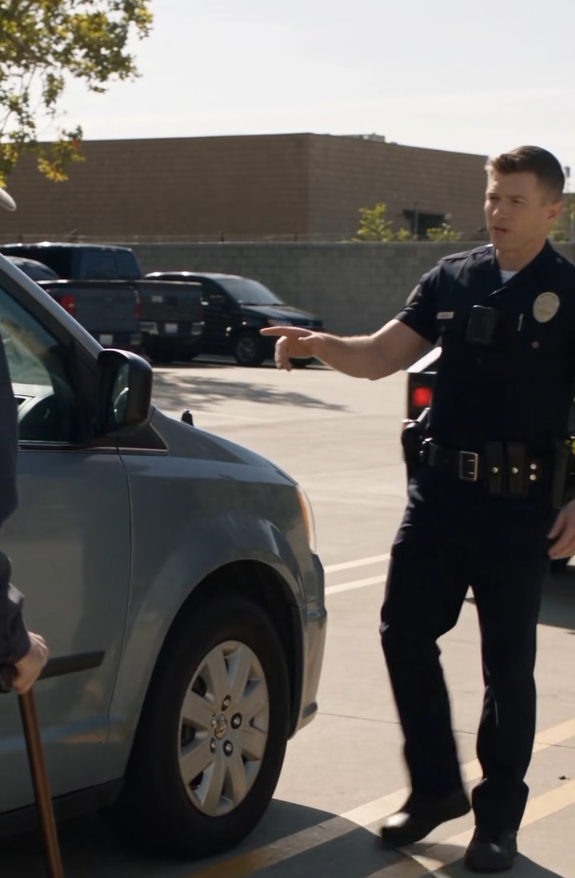
He closed his eyes briefly.
"I remember."
"Good."
I leaned forward.
"Remember that part."
He looked at me.
"Not the colonel."
His expression shifted.
"Not the crowd."
"Okay."
"Not the investigation."
He nodded.
"Remember that you had enough information to stop, and you chose not to because stopping would've embarrassed you."
He swallowed.
"Okay."
"That's the lesson."
He looked down.
The mediator gave the silence room.
Then Griggs said, "I'm sorry."
No speech.
No excuse attached.
Just two words.
I believed he meant them in that moment.
That did not mean everything was fixed.
An apology isn't a time machine.
It cannot uncall the tow truck.
Cannot remove the humiliation.
Cannot erase prior complaints.
Cannot restore trust by itself.
But truth doesn't need to do everything to matter.
I nodded once.
"All right."
Griggs seemed confused.
"That's it?"
"What were you expecting?"
"I don't know."
"Forgiveness?"
He looked uncomfortable.
"Maybe."
I considered him.
"I don't know you well enough to forgive you."
He stared at me.
"I know what you did. That's not the same thing."
The mediator glanced toward the clock.
Griggs leaned forward.
"If they fire me, are you okay with that?"
There it was.
The harder choice.
Maybe he thought I had power over the outcome.
Maybe he needed to know whether I wanted his career.
I thought about the parking lot.
About the old Marine telling him to back off.
About the tow driver refusing to move too quickly.
About Kincaid telling me not to touch him.
About the other complaints.
The ones I would never see.
People whose names I didn't know.
I could have told Griggs I wanted mercy.
That would have made me feel generous.
I could have told him I wanted him fired.
That might have felt like justice.
Both answers would have put me somewhere I did not belong.
"I don't decide that."
"You filed the complaint."
"I told the truth."
"But if you asked them—"
"No."
My answer came hard enough to stop him.
"I'm not doing that for you."
His face tightened.
I continued.
"And I'm not doing it against you either."
He looked at me.
"What does that mean?"
"It means I won't ask them to save your job because you apologized to me."
He breathed out slowly.
"And I won't ask them to take it because you humiliated me."
The mediator watched closely.
"The department has your record. Your camera. Your prior complaints. Your training. Your explanation. They can decide whether you should wear that badge."
Griggs looked toward the door.
"So your apology doesn't matter?"
"It matters to me."
His eyes returned.
"But consequences aren't mine to erase."
That landed.
Maybe harder than anger would have.
He nodded.
Once.
Then again.
The meeting ended.
Outside, Kincaid was waiting with two coffees.
He handed me one.
I took a sip.
Terrible.
"How was it?" he asked.
"Coffee's awful."
"I meant the meeting."
"I know."
We walked toward the parking lot.
Halfway there he stopped.
"Hank."
I turned.
"What?"
"I heard the review is concluding tomorrow."
I stared at him.
"How'd you hear that?"
"I know people."
"That's exactly the kind of sentence I told you not to say."
He ignored me.
"Do you want to know what they're considering?"
"No."
He studied my face.
"You sure?"
"Yes."
"Why?"
"Because I meant what I told him."
"What was that?"
"I told the truth. The rest belongs to them."
Kincaid looked toward the glass doors.
Then he smiled.
"Still stubborn."
"Still older than me."
"Eleven months."
"Ancient."
We continued walking.
At my van, he looked at the Purple Heart plates.
"You know what bothered me most?"
"What?"
"The call."
I frowned.
"What call?"
"When you called me."
"That bothered you?"
"You said, 'I need help' like it hurt."
I looked away.
He waited.
Eventually I said, "It did."
"Why?"
"Because I spent a long time believing needing help meant I'd reached the part of life where I stopped being useful."
Kincaid said nothing.
I looked at my hands.
"Then that parking lot filled up with people who didn't treat me like I was useless."
The tow driver.
The older Marine.
The nurse.
The supervisor.
Kincaid.
Even the liaison with his careful questions.
Nobody had fought for me because I was helpless.
They had stood with me while I stayed responsible for myself.
There was a difference.
Kincaid opened the driver's door for me.
I gave him a look.
He stepped back.
"Sorry."
"Learning."
"Slowly."
I climbed in without assistance.
It hurt.
I did it anyway.
Before closing the door, I looked at him.
"You coming by for dinner?"
His eyebrows rose.
"Is that another request for help?"
"Don't ruin it."
He grinned.
"I'll bring something."
"Not coffee."
"Fair."
I drove home before he could say anything sentimental.
Part VI — Aftermath
The letter arrived two weeks later.
Paper.
Not email.
I appreciated that.
Some decisions deserve weight in your hand.
The department's review sustained multiple findings related to failure to verify available information, improper conduct during a public contact, inaccurate characterization of my behavior, and departures from procedure.
The letter did not describe every consequence.
Personnel law protected some of that.
I later learned Griggs would not return to field duty in the role he'd held that morning.
Beyond that, I did not ask.
I had meant what I said.
The department would own its decision.
I would own mine.
More important to me was the second half of the letter.
The facility was changing its response procedure for suspected misuse of accessible parking credentials.
Verification first, when feasible.
Mobility needs assessed before any tow involving adaptive equipment.
Supervisor review required before removal of a vehicle displaying disabled-veteran plates when documentation was disputed.
Not because disabled veterans deserved special truth.
Because no patient should be stranded by an assumption that could have been checked in sixty seconds.
The change applied to everyone.
That mattered.
A month later, I returned to the medical center.
Same appointment time.
Same van.
Same parking area.
I almost chose a different space.
That annoyed me.
I sat behind the wheel with the engine running, staring through the windshield.
There were three open accessible spaces.
Mine—the one from that morning—was closest to the entrance.
I could have parked farther away.
Avoided the memory.
Avoided whoever might be on duty.
Avoided becoming a story again.
Then I heard my wife's voice in my head.
Not literally.
Memory.
She used to catch me doing this—giving up something reasonable just to avoid inconveniencing somebody else's opinion.
"You don't get points for making your life harder," she'd say.
So I parked in the same space.
Turned off the engine.
The van clicked softly as it cooled.
For several seconds, I sat there.
Same sound.
Same dashboard.
Same cane beside the seat.
Different morning.
I reached up and checked the placard.
Still there.
Still valid.
Still just plastic and ink.
I opened the door.
Planted the cane.
Shifted my weight.
Stood.
A uniformed officer was walking across the lot.
I noticed him immediately.
Old instincts.
He noticed the plates.
Then the placard.
Then me.
For half a second, my body prepared itself.
Not fear.
Memory.
The officer approached.