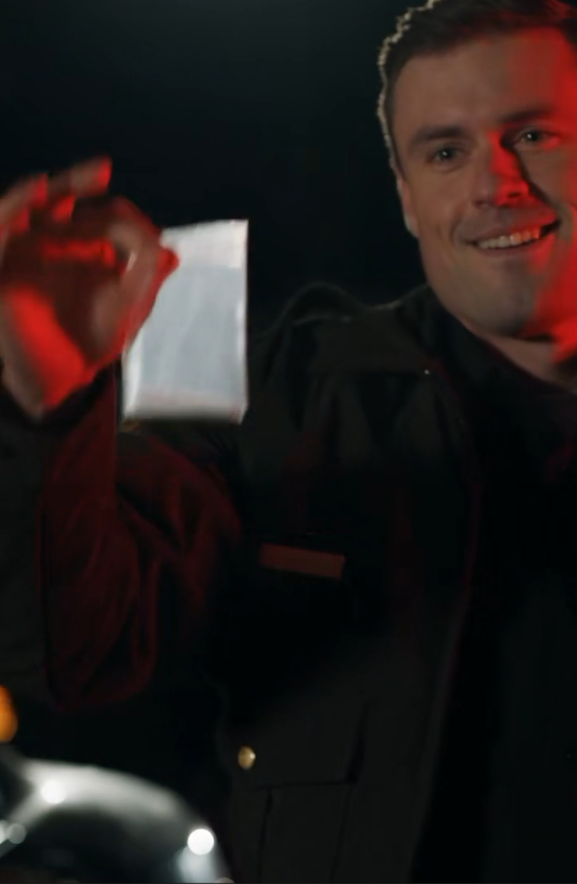
The bag of white powder was tested.
The substance itself mattered less than Keller had believed.
The crime was not what the bag contained.
The crime was where he intended people to believe it had been found.
Part VI — Aftermath
Three weeks later, Claire returned to the road where Keller had stopped her.
Not for closure.
She disliked the word when people used it about investigations.
Cases closed.
Paperwork closed.
People rarely did.
She returned because the traffic division had asked her to confirm the exact position of the vehicles for a reconstruction.
It was late afternoon this time.
No flashing lights.
No crowds.
No black sky reflecting off glass.
Just ordinary traffic and pale sun on the shoulder.
Claire stood where her sedan had been.
The scene seemed smaller in daylight.
Most frightening places did.
The second officer arrived ten minutes later with an investigator.
He was still cooperating.
Still under review himself.
Claire had not spoken to him privately since the night of the stop.
He stopped several feet away.
“Ms. Moreau.”
“Officer.”
His status remained unresolved.
He had preserved the recording.
He had also admitted staying silent during earlier incidents that had troubled him.
Both facts were true at the same time.
Claire had no interest in simplifying him into hero or coward.
Reality did not improve when people were reduced to one useful label.
The investigator asked them to identify positions.
Claire pointed.
“My car was there.”
The officer indicated the cruiser.
“About twenty feet back.”
“Passenger door?”
“Open.”
“Where were you standing?”
He walked to the spot.
Claire watched.
That was where the green light on his camera had been visible.
The investigator finished measurements.
The second officer lingered.
Claire started toward her car.
He said, “Can I ask you something?”
She turned.
“Depends.”
“Did you know my camera was running when you confronted him?”
Claire considered.
“Yes.”
His eyebrows lifted.
“You saw the light?”
“Yes.”
“So that’s why you stayed calm.”
Claire almost laughed.
“No.”
He looked embarrassed.
“What, then?”
She glanced toward the shoulder.
“I stayed calm because he wanted me not to.”
The officer absorbed that.
Claire added, “The camera helped.”
He nodded.
Then said, “I keep thinking if I’d turned it off…”
“You didn’t.”
“But if I had.”
Claire looked at him.
“You’re going to make yourself crazy with imaginary versions.”
“I should’ve said something months ago.”
“Yes.”
He looked surprised by the blunt answer.
Claire continued.
“And you should remember that the next time silence feels easier.”
He nodded.
No absolution.
No cruelty.
Just the truth.
She turned toward her car.
The formal review of the corruption dossier continued for months.
Several prior complaints were reopened.
Some allegations were substantiated.
Others were not.
Claire insisted on both outcomes being treated seriously.
A corruption investigation could become corrupt itself if investigators began treating every accusation as confirmation.
Keller faced criminal proceedings and termination review.
The details would take time.
His formal cooperation led investigators toward additional misconduct, but every claim he made had to be corroborated independently.
Claire demanded that standard even when colleagues complained it slowed them down.
Especially then.
Page 47 became an internal training example.
Not because it proved guilt.
Because it demonstrated how data could be misread when investigators entered the evidence with the wrong theory.
Claire had first seen multiple names and assumed coordination.
Keller had seen the same page and recognized exposure.
The truth turned out to be more complicated than either interpretation.
Some officers had participated actively.
Some had looked away.
Some had been careless.
Some records reflected ordinary errors that happened to resemble misconduct.
Sorting those categories became the real work.
The sealed roadside copy of the dossier was never used for the review.
It remained evidence in the investigation into unauthorized access.
Forensic examination found that the lower seal had indeed been lifted and reapplied.
Someone had opened it before Claire ever placed it in her handbag.
The breach occurred during final document handling.
That discovery identified how Keller learned the page number and delivery schedule.
The person responsible had not invented the corruption scheme.
They had simply believed warning Keller was loyalty.
That choice was enough.
Claire learned the result in the same secure office where she had written her supplemental statement.
The supervisor placed the report in front of her.
“You were right about the seal.”
Claire read it.
“I wish I wasn’t.”
“You usually enjoy being right more than this.”
She looked up.
“Do I?”
He considered.
“Maybe not.”
She returned to the report.
The leak had been mundane.
No elaborate conspiracy.
No hidden mastermind.
A person with legitimate access had seen the package, opened it, read portions, then warned someone they considered a friend.
The entire investigation had nearly been compromised by something painfully ordinary.
Misplaced loyalty.
That bothered Claire more than a grand conspiracy would have.
Conspiracies required planning.
This required only one person deciding that rules mattered less than relationships.
The same reasoning Keller had described in another form.
Procedure is inconvenient.
I know who deserves protection.
I know what the right outcome should be.
So I am allowed to bend the process.
Claire closed the report.
The supervisor leaned against the desk.
“You okay?”
“Yes.”
“That answer becoming automatic?”
“Probably.”
He nodded toward the window.
“Keller’s final internal hearing is next week.”
“I know.”
“You attending?”
“No.”
“Why not?”
“My evidence is submitted.”
“You don’t want to see the result?”
“I’ll read it.”
He gave her a small smile.
“You really hate drama.”
Claire thought of Keller holding the bag under the streetlight.
“No. I hate confusing drama with proof.”
Months later, Claire received a copy of the final disposition.
She read it at her desk near the end of the day.
Keller had been dismissed.
Criminal charges connected to the roadside incident and earlier evidence fabrication remained pending through the courts.
Several prior cases had been referred for independent review.
The second officer received discipline for earlier failures to report misconduct but remained employed after completing required cooperation and review.
The supervisor received criticism for procedural delays on the night of the stop but was cleared of involvement in the underlying misconduct.
The person who breached the dossier lost access privileges and faced separate consequences.
No single result felt large enough compared with the six months Claire had spent assembling the investigation.
That was another thing people misunderstood about accountability.
It rarely arrived with music.
It arrived in letters.
Findings.
Reopened cases.
Corrected records.
Apologies that came years late.
Sometimes money.
Sometimes nothing.
Sometimes a person simply learned that the official story written about them was no longer the only story preserved.
Claire placed the disposition in a file drawer.
Then she opened the original notebook from the investigation.
Most pages were full.
The boxed phrase remained near the middle.
You should think about your situation.
She stared at it.
Then drew one line through the sentence.
Not because it had become unimportant.
Because it had been answered.
A knock sounded against her open door.
The second officer stood there in civilian clothes.
Claire looked at him.
“I thought you were done with interviews.”
“I am.”
“Then what?”
He held a thin envelope.
“One of the reopened cases.”
Claire did not reach for it.
“What about it?”
“The driver wrote something.”
“To me?”
“To both of us.”
He placed the envelope on her desk.
Then he left.
Claire waited until he was gone before opening it.
The letter was short.
The writer was the man whose complaint contained the phrase Keller had later repeated to Claire.
His case had been reopened.
The old report now carried a formal notation identifying serious credibility concerns in the original evidence.
The final paragraph contained no gratitude toward the department.
Claire was glad.
Gratitude was not owed for correcting a failure.
Instead he had written:
For years, the hardest part wasn’t what happened. It was knowing that the official version said it didn’t happen.
Claire read the line twice.
Then folded the letter.
Outside her office window, evening settled over the parking lot.
Cars moved through the last pale light.
For a moment she saw the roadside again.
The black sedan.
The patrol lights.
Keller reaching into the cruiser.
The transparent bag catching the streetlight.
That tiny smile.
He had believed the bag would decide what everyone else saw.
He had believed an object placed in the right location, followed by the right report, could replace reality.
Sometimes it had.
That was the part Claire would remember.
Not because he succeeded that night.
Because before that night, he probably had.
Claire put the letter inside the notebook and closed it.
Her phone buzzed with a routine message about another case.
Nothing urgent.
Nothing dramatic.
She stood, put on the same brown leather jacket she had worn during the stop, and turned off the office light.
At the door, she paused.
The jacket still had a faint crease at the sleeve from where she had held her arms rigidly at her sides while Keller told her to turn around.
She smoothed it once.
Then stopped.
Some marks did not need removing.
Claire walked down the hallway and out into the evening.
Behind her, locked inside an evidence archive, the plastic bag Keller had once held like a trophy remained sealed and labeled.
It no longer proved what he had intended it to prove.
It proved something else entirely.
The evidence he had brought to destroy Claire’s credibility had become the clearest evidence against his own.