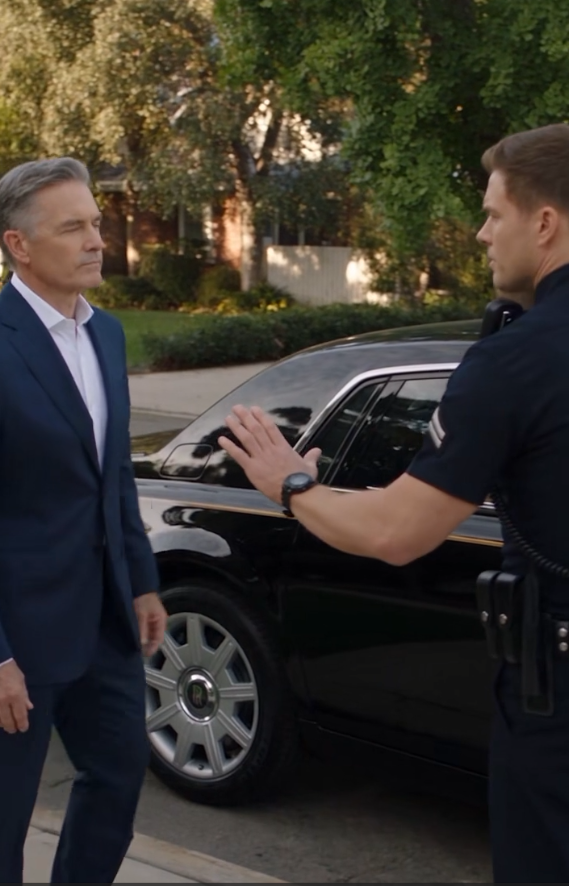
Part I — The Stop
The first thing Judge Terrence R. Hayes noticed was not the flashing blue lights.
It was the way Officer Brent Callaway looked at him before asking a single question.
Terrence had spent more than three decades watching people enter courtrooms carrying versions of themselves they hoped would survive examination. Some arrived angry. Some frightened. Some rehearsed. Some smiled too much. Others mistook certainty for credibility.
Callaway had that last look.
He stepped out of the patrol cruiser as if the important part of the encounter had already happened somewhere inside his own head.
Terrence had barely moved three steps from his black sedan.
The afternoon was quiet enough that he could hear a sprinkler ticking across a lawn two houses down. The neighborhood was an older suburban pocket of broad trees, clean sidewalks, and houses set back behind clipped hedges. Nothing about it suggested trouble. Terrence and his wife, Monica, had driven there to visit an old family friend who had recently returned home after several difficult months. They had brought a bottle of wine and a paper bag containing the almond cookies their friend liked.
The bag was still on the rear seat.
Monica remained in the passenger seat, checking a message on her phone.
Terrence had just closed the driver’s door when the cruiser rolled in behind them.
Now Callaway stood six yards away with one hand near his belt.
“What are you doing here?”
No greeting.
No explanation.
Terrence glanced toward the house they had come to visit, then back at the officer.
“I’m here to see a friend.”
Callaway’s gaze moved over the sedan, Terrence’s suit, his shoes, then back to his face.
“Identification.”
Terrence did not move.
At fifty-eight, he had learned that silence could reveal more than argument. In federal court, he used it carefully. People often rushed to fill a pause with something useful.
Callaway did not.
Terrence asked, “Officer, is there a reason you need to see my identification?”
The officer’s mouth tightened.
“I’m the one asking the questions.”
Inside the sedan, Monica lifted her head.
Terrence saw it in the windshield reflection.
He also noticed a man across the street slowing with a garden hose in his hand. A woman pushing a stroller had stopped at the corner. A teenager on a bicycle looked over his shoulder.
Terrence kept his tone neutral.
“I understand you’re asking questions. I’m asking why I’ve been stopped.”
“Identification.”
Terrence exhaled once through his nose.
He had no interest in turning an unnecessary encounter into a confrontation. He had spent enough years around prosecutors, defense attorneys, agents, officers, witnesses, defendants, clerks, jurors, and frightened families to know how quickly pride could become momentum.
“All right.”
He moved his right hand slowly toward the inside pocket of his charcoal jacket.
Callaway crossed the distance between them.
His hand closed around Terrence’s forearm.
The grip was not enough to injure him.
It was enough to change everything.
Terrence stopped moving.
“Officer,” he said, “take your hand off me.”
Callaway pulled his arm outward.
Terrence’s shoulder turned.
Then Callaway guided him backward with a hard shove of pressure until the front of Terrence’s thighs struck the sedan.
His palms landed on the hood.
The metal was warm from the afternoon sun.
Behind him, the passenger door opened.
“Excuse me,” Monica called.
Callaway looked toward her.
“Stay in the vehicle.”
Monica stepped one foot onto the pavement.
“I’m his wife.”
“I said stay in the vehicle.”
Terrence turned his head slightly.
“Monica.”
She looked at him.
He gave the smallest shake of his head.
Not because Callaway was right.
Because every additional person in a bad encounter gave a bad decision more directions to travel.
Monica understood.
She did not sit back down, but she stopped advancing.
Callaway pressed a hand near Terrence’s shoulder blade.
“Hands where I can see them.”
“They are where you put them.”
“Don’t get smart.”
Terrence looked down at his own reflection in the sedan’s polished hood.
A calm face.
Gray at the temples.
A man who had sentenced people to prison.
A man who had overturned unlawful searches.
A man who had spent years reminding lawyers that constitutional protections did not depend on whether an individual was likable, cooperative, respectable, educated, poor, wealthy, frightened, rude, or calm.
None of that mattered if the person applying authority believed nobody would question him afterward.
Callaway began searching Terrence’s jacket.
Terrence felt fingers move over the outside pockets, then inside.
Wallet.
Phone.
Keys.
Nothing else.
Callaway checked his waistband and trouser pockets.
Across the street, the teenager had taken out a phone.
The woman with the stroller had moved farther onto the sidewalk and was now holding hers upright as well.
“What are you looking for?” Terrence asked.
“Anything I need to know about.”
“That isn’t an answer.”
Callaway removed Terrence’s wallet and opened it.
Terrence watched him pause at the identification.
Not long.
Half a second, perhaps.
But long enough.
The officer looked at the name.
Terrence R. Hayes.
Then at Terrence.
Then back at the card.
He closed the wallet.
“You match a description.”
Terrence turned his head as far as Callaway’s position allowed.
“A description of what?”
Callaway hesitated.
“Suspicious activity.”
“What activity?”
“Someone called.”
“What did they report?”
Callaway’s jaw shifted.
“You ask a lot of questions.”
“I’m trying to understand why you put your hands on me.”
From near the passenger door, Monica said, “Officer, you should answer him.”
Callaway pointed without looking at her.
“Ma’am, back in the car.”
Monica’s face had gone still.
Terrence knew that expression.
He had seen it across a breakfast table when she was preparing for a difficult deposition. He had seen it outside a courtroom after opposing counsel made the mistake of assuming politeness meant uncertainty.
Monica was a respected attorney for a reason.
She knew when not to waste words.
She reached into the sedan, retrieved her phone, and began typing.
Callaway noticed.
“What are you doing?”
“Sending a message.”
“To who?”
“That is none of your concern.”
Callaway took one step toward her.
Terrence immediately straightened.
Callaway turned back.
“Stay against the car.”
“Then stay focused on me.”
For the first time, irritation sharpened into something more visible in the officer’s expression.
“You want to make this harder than it needs to be?”
“No,” Terrence said. “I want you to explain why it is happening at all.”
The man across the street had turned off his hose.
Now there were no ordinary neighborhood sounds between Terrence and the officer.
Only the distant hum of traffic.
A dog barking from behind a fence.
And the faint electronic chirp from Callaway’s body camera.
Terrence glanced toward it.
Callaway followed his eyes.
Something like a smile appeared.
“Problem?”
“No.”
Terrence’s voice stayed even.
“In fact, I’m glad it’s recording.”
The smile narrowed.
“What’s your badge number?”
Callaway gave a short laugh.
“Why do you need that?”
Terrence turned enough to meet his eyes.
“So I can remember exactly who made this choice.”