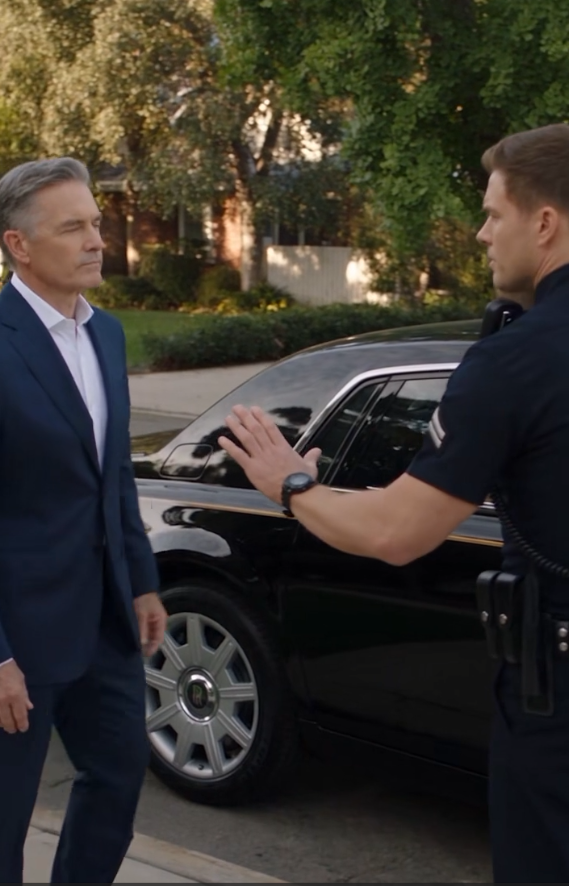
The words changed the air.
Not because Terrence raised his voice.
Because he didn’t.
Callaway leaned closer.
“You threatening me?”
“No.”
“Sounded like one.”
“It was a statement.”
Callaway studied him.
Terrence studied him back.
He had watched witnesses unravel under aggressive questioning. Callaway had the opposite problem. Each time the encounter failed to produce the submission he seemed to expect, he increased his pressure.
Not because the situation required it.
Because his self-image did.
Terrence understood the difference.
He also understood that explaining it now would accomplish nothing.
So he said the simplest thing available.
“I am a federal judge.”
Across the street, the teenager lowered his phone slightly.
Monica closed her eyes for half a second.
Callaway stared.
Then laughed.
Not loudly.
That somehow made it worse.
“Of course you are.”
Terrence did not react.
Callaway tilted his head.
“You got a courthouse in the glove compartment too?”
Monica stepped fully out of the sedan.
“Officer.”
Terrence’s voice stopped her.
“Monica.”
She looked at him again.
He could see how much effort it cost her to stand still.
Callaway shook his head.
“Federal judge.”
Terrence said, “Yes.”
“Sure.”
“You already looked at my identification.”
“Plenty of people have names.”
Terrence held his gaze.
“Before the sun goes down, you are going to understand exactly what you have just done.”
For the first time, Callaway’s confidence flickered.
Then he recovered.
“Turn around.”
Terrence did not move.
“For what purpose?”
“You’re under arrest.”
Monica crossed the distance before Terrence could stop her.
“On what charge?”
Callaway reached for Terrence’s wrist.
“Interfering.”
“With what?”
“Ma’am, step away.”
“You stopped him without explaining why, searched him, found nothing, and now you’re arresting him for asking questions.”
“Last warning.”
Monica’s voice dropped.
“You are making an extremely serious mistake.”
Callaway pulled one wrist behind Terrence’s back.
The cuff closed with a metallic click.
Terrence did not resist.
The second cuff followed.
Callaway guided him away from the sedan.
The witnesses kept recording.
Terrence looked once toward Monica.
Her phone was now at her ear.
He did not need to ask whom she was calling.
He had spent his entire career insisting that process mattered most when emotions argued otherwise.
Now he intended to rely on it.
Callaway opened the cruiser door.
Terrence paused before getting inside.
“Officer.”
Callaway looked at him.
Terrence nodded toward the body camera.
“Do not lose that recording.”
Callaway’s face hardened.
Then he pushed the door closed.
Part II — The Precinct
The holding cell smelled faintly of disinfectant, old concrete, and coffee drifting from somewhere beyond the corridor.
Terrence sat on the narrow bench with his jacket folded beside him.
His cuffs had been removed.
His watch had not.
Twenty-three minutes had passed since Callaway brought him through the rear entrance.
He knew because counting time gave the mind something clean to do.
Outside the cell, voices moved in and out of range.
A printer.
A chair scraping.
A burst of laughter from the front desk.
No urgency.
No concern.
To the people in the room beyond the corridor, he was paperwork.
Terrence did not resent that.
Institutions required routine.
Routine was often what prevented arbitrary treatment.
The problem began when people used routine to avoid seeing what was directly in front of them.
At the booking desk, Callaway had written his report with the confidence of a man transcribing an event rather than constructing a defense for his own decisions.
Terrence had watched through the open doorway.
Callaway spoke briefly with Sergeant Miller, a broad-shouldered supervisor in his early fifties with close-cropped gray hair and the tired posture of someone who had spent years solving problems created by other people.
Miller had glanced toward Terrence once.
Not curiously.
Administratively.
“Any weapons?” Miller had asked.
“No.”
“Drugs?”
“No.”
“Outstanding warrants?”
Callaway had looked at the computer.
“No.”
“What’s the charge?”
“Obstruction. Failure to comply.”
Miller’s eyes had lifted.
“Failure to comply with what?”
Callaway’s pen paused.
“Investigation.”
“What investigation?”
Callaway said, “Suspicious person call.”
Terrence had seen Miller’s expression change slightly then.
Not alarm.
A question.
But the phone at the front desk rang before he asked it.
Another officer answered.
Miller moved away.
Callaway kept writing.
Now, sitting behind the holding cell bars, Terrence heard footsteps.
Miller appeared.
He stopped outside.
“Mr. Hayes.”
“Judge Hayes will do.”
Miller stared through the bars.
Terrence watched the moment the title landed differently now than it had when Callaway laughed at it.
“You’re claiming you’re a federal judge?”
“I’m not claiming anything.”
Miller’s mouth tightened.
“I need a straight answer.”
“You have one.”
Miller looked back toward the booking area.
“Callaway said you refused identification.”
“That is false.”
“He said you became argumentative during a lawful stop.”
“Also false.”
“He said you interfered with his investigation.”
“What investigation?”
Miller exhaled.
“That’s what I’m trying to figure out.”
Terrence stood.
“Then begin with the body camera.”
Miller’s eyes returned to him.
Terrence continued.
“And the witnesses across the street. Several were recording.”
“He said you threatened him.”
Terrence almost smiled.
“With what?”
“He wrote that you said he would ‘understand what he had done before sunset.’”
“That is accurate.”
“You don’t consider that threatening?”
“No.”
“What did you mean?”
“That his conduct was being recorded and would be reviewed by people who understand what lawful authority requires.”
Miller rubbed his jaw.
“Why didn’t you just cooperate?”
The question came automatically.
Terrence heard it often in court, usually dressed in more formal language.
He answered carefully.
“I did cooperate. Cooperation does not require surrendering the right to ask why government authority is being exercised against you.”
Miller said nothing.
Terrence nodded toward the booking area.
“He searched me before articulating any specific offense. He found nothing. He had my identification in his hand. He mocked my position after I told him who I was. He then arrested me when my wife questioned him.”
“I haven’t reviewed the footage.”
“You should.”
Miller stared at him another moment.
Then he turned away.
Terrence sat again.
Five minutes later, the desk phone rang.
He could not see it from the cell.
He could hear it.
One ring.
Two.
A chair moved.
“Precinct desk, Sergeant Miller.”
Silence.
Then:
“Yes.”
Another pause.
Terrence heard the faint scrape of paper.
“What did you just say?”
The corridor changed.
Not visibly from where Terrence sat.
Audibly.
The printer stopped.
Someone who had been speaking stopped halfway through a sentence.
Miller’s voice lowered.
“Yes, he’s here.”
Pause.
“No, he has not been released.”
Longer pause.
“No, sir.”
The word sir moved through the station like a dropped glass.
Terrence stood again.
Miller appeared at the corridor entrance holding the receiver away from his ear.
His face had lost color.
He looked across the booking room.
“Who arrested Terrence Hayes?”
Callaway glanced up from his report.
“I did.”
Miller stared at him.
Callaway frowned.
“Why?”
Miller swallowed.
Then said the sentence that emptied the room of sound.
“The United States Marshal Service is on the line.”
Callaway did not speak.
Miller put the receiver back to his ear.