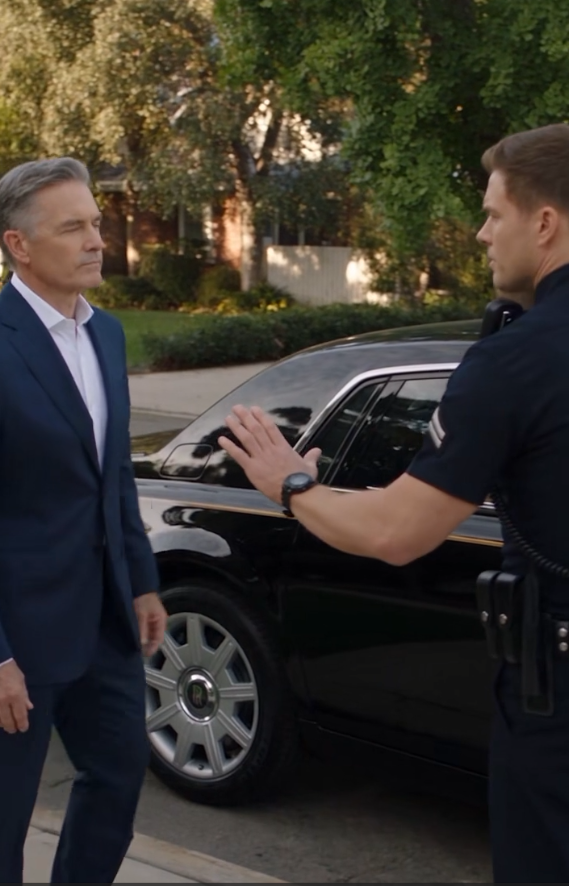
Because the facts had become too clear to continue pretending.
Terrence put his wallet in his pocket.
Monica slipped her arm through his.
They walked toward the exit.
Behind them, Miller said, “Callaway, conference room. Now.”
Terrence did not turn around.
Outside, afternoon sunlight had shifted lower across the parking lot.
The day was no longer quiet.
Three news vans had not arrived.
There were no crowds.
No cameras waiting.
Only Monica’s car service, requested after the sedan had remained at the neighborhood scene.
And a black government SUV parked near the curb.
Two deputy marshals stood beside it.
Terrence recognized one of them from courthouse security coordination.
The marshal walked toward him.
“Judge Hayes.”
Terrence nodded.
“Thank you for calling.”
“We didn’t call.”
Terrence looked at Monica.
She shook her head.
“I contacted your chambers.”
The marshal said, “Your clerk contacted court security after she couldn’t reach you. We coordinated from there.”
Terrence absorbed that.
He had assumed Monica’s call triggered everything.
Instead, a series of ordinary safeguards had.
A missed appointment.
A clerk who knew his schedule.
A security protocol.
People doing what they were supposed to do.
That mattered to him.
Perhaps more than a dramatic rescue would have.
The marshal asked, “Do you need medical attention?”
“No.”
“We can take a statement now.”
Terrence glanced back at the precinct doors.
“No.”
The marshal seemed surprised.
“Judge?”
“Not yet.”
Monica looked at him.
Terrence said, “I want the evidence preserved before narratives harden around it.”
The marshal nodded slowly.
“We’ve already requested preservation.”
“Good.”
Terrence looked toward the setting sun.
Callaway’s mocking smile returned to his mind.
Before sunset.
Terrence had not known exactly what would happen when he said it.
He only knew a record existed.
Now the question was what people would do with it.
Part IV — What the Camera Saw
By the following morning, Terrence had watched the body-camera footage three times.
He wished he had not needed to watch it at all.
The first viewing took place in a secure conference room inside the federal courthouse.
Terrence sat at the end of a long table.
Monica beside him.
Across from them were representatives responsible for court security and liaison coordination with local authorities. Sergeant Miller had forwarded the preserved footage through proper channels after an internal supervisor placed Callaway on administrative leave pending review.
No one celebrated that.
Terrence made sure of it.
The footage began with Callaway driving.
Radio traffic.
The dispatch description.
Dark sedan.
Male driver.
Looking toward houses.
Unknown to caller.
Then Callaway’s voice.
“Probably checking places.”
There was no basis stated.
Just assumption.
The cruiser turned onto the residential street.
The sedan came into view.
Terrence stood beside it.
Callaway parked.
The camera shook as he stepped out.
“What are you doing here?”
Terrence watched himself turn.
“I’m here to visit a friend.”
He knew what came next.
He still felt something tighten in his chest when the officer’s hand closed around his forearm.
Monica reached over and placed her fingers on the table beside his.
Not on his hand.
Beside it.
Available if he wanted them.
He moved his hand over hers.
On screen, Callaway pressed him against the hood.
The room stayed quiet.
Then came the search.
The vague explanation.
The questions.
The mocking laugh.
Terrence watched Callaway open his wallet.
Pause.
Look at the identification.
Close it.
That pause mattered.
Monica saw it too.
“Stop.”
The video froze.
She leaned closer.
“He read it.”
Terrence said, “Yes.”
One of the security officials said, “That appears to be the case.”
Monica’s expression sharpened.
“He knew the name before Terrence told him he was a judge.”
Terrence looked at the frozen image.
Callaway’s eyes were pointed downward.
There was no way to know from the video what he understood from the name alone.
“Don’t assume more than the evidence shows,” Terrence said.
Monica looked at him.
“You’re defending him?”
“No. I’m refusing to do what he did.”
Silence.
Then Monica leaned back.
“Fair.”
The footage continued.
Terrence asked for the badge number.
Callaway laughed.
Terrence told him why.
Then:
“I am a federal judge.”
Callaway laughed again.
“Of course you are.”
At the table, nobody moved.
Terrence felt Monica’s fingers tighten under his.
Then his own line.
“Before the sun goes down, you are going to understand exactly what you have just done.”
The room heard it differently than Callaway had.
Not threat.
Warning.
Maybe confidence.
Maybe anger held under discipline.
Then the arrest.
Monica’s objection.
The cuffs.
The cruiser door closing.
The video continued at the precinct.
Callaway spoke to another officer while walking toward booking.
“Guy thinks because he wears a suit he owns the sidewalk.”
Terrence looked down.
Monica did not.
The footage ended after Callaway removed the camera and placed it in its dock.
One of the officials shut the laptop.
No one spoke for several seconds.
Terrence finally said, “What does the neighborhood footage show?”
Monica had already obtained copies from two witnesses who voluntarily offered them after learning what had happened.
The first recording began from across the street.
It showed nearly the entire encounter from a wide angle.
No missing context.
No sudden gesture by Terrence.
No threatening move.
No attempt to leave.
The second was from the woman with the stroller.
Closer.
Shaky.
But clear enough to hear Callaway’s words.
Terrence watched only once.
Then stood.
“I’ve seen enough.”
Monica gathered her notes.
“You should make a statement.”
“To whom?”
“The department. The Marshal Service. Whoever conducts the investigation.”
“I will.”
“When?”
“When I decide whether I’m speaking as the person arrested or as a federal judge.”
Monica looked at him.
“You’re both.”
“That’s the problem.”
They left the conference room.
In chambers, Terrence removed his robe from its hook but did not put it on immediately.
The familiar room felt different.
Shelves.
Case files.
The flag behind his desk.
A framed photograph of him and Monica from years earlier, both younger, standing outside a courthouse after the first major case they had worked on opposite sides.
He sat.
Monica closed the door.
“You’re thinking about recusal.”
He looked at her.
“From what?”
“Everything connected to this.”
“Yes.”
“You have no cases involving that department.”
“Not currently.”
“Then what?”
Terrence leaned back.
“I don’t want my position used as a weapon.”
Monica studied him.
“Against whom?”
“Anyone.”
“Even him?”
“Especially him.”
Her expression changed.
Not agreement.
Not disagreement.
Recognition.
“You think people will overcorrect.”
“I know they will.”
“He arrested you without a lawful basis.”
“Yes.”
“He searched you.”
“Yes.”
“He ignored what he saw.”
“Yes.”
“He put you in a cell.”
“Yes.”
Monica crossed her arms.
“And you’re worried someone might be too hard on him?”
“I’m worried the system will become performative because the victim happened to be a judge.”
She was quiet.
Terrence continued.
“If a mechanic, teacher, delivery driver, retired soldier, accountant, or unemployed father had been standing beside that sedan, would the Marshal Service have called twenty minutes later?”
“No.”
“That is the part I cannot stop thinking about.”
Monica’s voice softened.