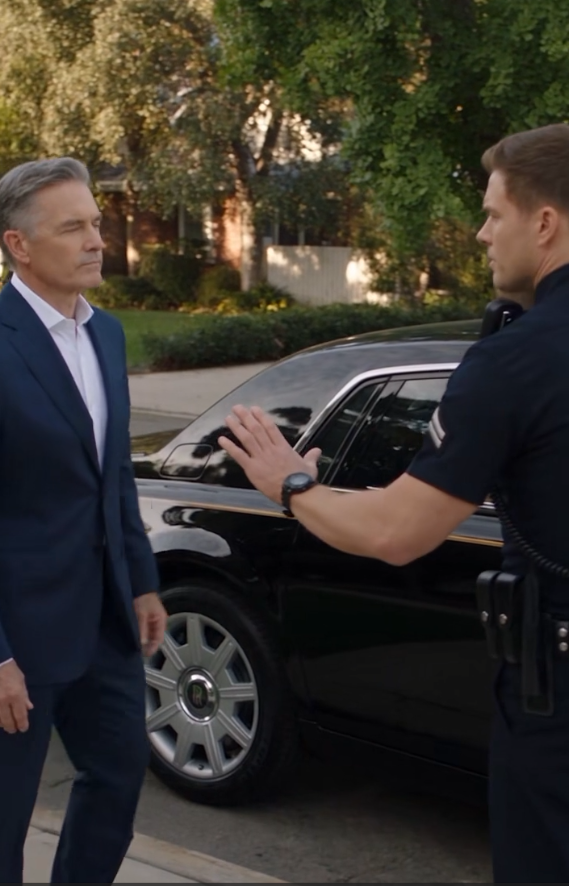
“You didn’t cause that inequality.”
“No.”
“But you’re standing inside it.”
“Yes.”
He looked at the robe hanging nearby.
“The question is what I do from here.”
Part V — Pressure
Callaway requested union representation before giving his formal statement.
Terrence learned that from Miller, not because Miller was supposed to update him, but because Miller called two days later and asked if Terrence would agree to meet privately.
Monica disliked the idea.
Terrence agreed.
They met in a courthouse conference room.
No cameras.
No reporters.
No Callaway.
Just Miller, Terrence, and Monica.
Miller looked older than he had at the precinct.
He placed a folder on the table but did not open it.
“I’m not here officially.”
Monica said, “Then why are you here?”
Miller looked at Terrence.
“To apologize.”
Terrence waited.
Miller drew a breath.
“Not for Callaway. He can answer for himself. For what happened after he brought you in.”
“The detention?”
“For not asking enough questions.”
Terrence folded his hands.
Miller said, “I saw a man in cuffs. Saw an officer with paperwork. I treated the arrest as legitimate because it arrived wearing procedure.”
Terrence’s eyes lifted.
Miller gave a humorless smile.
“I’ve been thinking about that sentence for two days.”
Monica said, “It’s an accurate one.”
Miller nodded.
“I should have checked the call immediately. I should’ve watched the footage before approving anything. Instead, I asked him what the charge was and let the label do the thinking.”
Terrence said, “Why are you telling me?”
“Because I want you to know what happened after you left.”
Monica’s posture changed.
Terrence remained still.
Miller opened the folder.
“I can’t give you internal records. But I can tell you what I personally reviewed.”
Terrence nodded.
“Go ahead.”
“Callaway’s had complaints.”
Monica looked at Terrence.
Miller continued before either spoke.
“Nothing sustained for excessive force. Nothing criminal. Mostly demeanor. Escalation. Unnecessary stops. People saying he decided what was happening before he got there.”
The phrase landed.
Terrence remembered Callaway stepping out of the cruiser.
The look.
Miller said, “Some were closed because body camera was inconclusive. Some because complainants didn’t follow through. One because the supervisor decided the officer’s actions were technically within policy.”
“Who was the supervisor?” Monica asked.
Miller looked at her.
“Me.”
The room became still.
Miller did not look away.
“That’s the other reason I’m here.”
Terrence leaned back.
“What happened?”
“A man was stopped outside a convenience store six months ago. Callaway thought he matched a shoplifting suspect. Wrong person. The man got angry. Callaway got defensive. It turned into a disorderly-conduct citation that was later dismissed.”
“Body camera?”
“Messy. Angle wasn’t clear. The man was loud. Callaway was within the outer edge of policy.”
Monica said, “That’s not the same as appropriate.”
“I know that now.”
“You knew it then.”
Miller absorbed the criticism.
“Yes.”
Terrence watched him.
“Why did you close it?”
Miller looked at the table.
“Because the week was already buried in staffing problems, complaints, mandatory training, overtime. Because Callaway was productive. Because nobody got hurt. Because I told myself a warning would be enough.”
Terrence said, “Did you warn him?”
“Yes.”
“In writing?”
“No.”
There it was.
Not corruption.
Not conspiracy.
Something more ordinary and therefore harder to dismiss.
Convenience.
A supervisor solving today’s workload at the expense of tomorrow’s consequences.
Miller rubbed a thumb across the folder edge.
“When the Marshal Service called, I was afraid because I realized who you were.”
Terrence said nothing.
“But after I watched the footage,” Miller continued, “that wasn’t what bothered me anymore.”
“What did?”
“That if you’d been anyone else, I might have signed off and gone home.”
Monica looked down.
Terrence felt the truth of that settle across the table.
Miller closed the folder.
“I’m not asking you for leniency.”
“I wouldn’t give it.”
“I’m not asking you to go harder either.”
“I wouldn’t do that.”
“I know.”
Miller stood.
“At least now I do.”
He left.
Monica waited until the door closed.
“That was not the conversation I expected.”
“No.”
“You believe him?”
Terrence considered.
“I believe he is telling the truth about himself.”
“That isn’t what I asked.”
“It’s the most important part.”
Monica studied him.
Terrence looked toward the closed door.
“This isn’t only about Callaway anymore.”
Part VI — The Choice
The department scheduled Callaway’s administrative hearing eleven days after the arrest.
Terrence was asked to provide testimony.
He agreed.
By then, local media had learned fragments of the story.
A federal judge.
A suburban stop.
An arrest.
A Marshal Service phone call.
The details spread faster than accuracy.
Some accounts made Terrence sound as if he had been targeted in a deliberate plot.
Others implied he had invoked his office to intimidate a patrol officer.
One commentator claimed Terrence demanded special treatment.
Another said he had threatened to “destroy” Callaway.
None of those statements appeared on any recording.
Terrence refused interviews.
Monica wanted him to correct the record.
He waited.
“Silence lets bad facts settle,” she told him over dinner the night before the hearing.
“I’m not staying silent forever.”
“When, then?”
“When there is a complete record.”
“There is a complete record.”
“There is evidence. That’s different.”
Monica set down her fork.
“You sound like you’re writing an opinion.”
“Occupational hazard.”
“You were the one in cuffs.”
“I remember.”
“I know you do.”
Her voice softened.
She looked at him across the table.
“I also know you’ve barely slept.”
Terrence glanced at his water glass.
He had not told her that sometimes, just before falling asleep, he felt again the moment Callaway’s hand closed around his arm.
Not pain.
Loss of control.
That was what stayed.
The speed with which an ordinary afternoon became someone else’s decision.
Monica said, “You keep turning this into an institutional question because that is easier for you than admitting it affected you personally.”
He almost objected.
Then stopped.
She raised one eyebrow.
Terrence sighed.
“You’ve been waiting to say that.”
“For eleven days.”
“Generous.”
“I’m trying.”
He looked toward the dark kitchen window.
“It did affect me.”
Monica waited.
“I keep thinking about how calm I was.”
“That sounds like you.”
“No. I mean I keep thinking about whether I was calm because I trusted the system would eventually recognize me.”
Monica frowned.
Terrence continued.
“If I had not known that my name would trigger questions somewhere—if I didn’t have chambers, marshals, colleagues, you—would I have been that controlled?”
“You don’t know.”
“No.”
“And you don’t need to.”
“I think I do.”
She leaned back.
“Why?”
“Because I have spent years judging people for decisions they made in moments when they believed nobody was coming.”
Monica’s expression softened.
Terrence looked at his hands.
“I understood that intellectually. I’m not sure I understood it physically.”
The next morning, he testified.
The hearing room was modest.
No dramatic bench.
No jury.
No audience beyond necessary personnel and counsel.
Callaway sat at one table with his representative.
Miller sat behind department counsel.