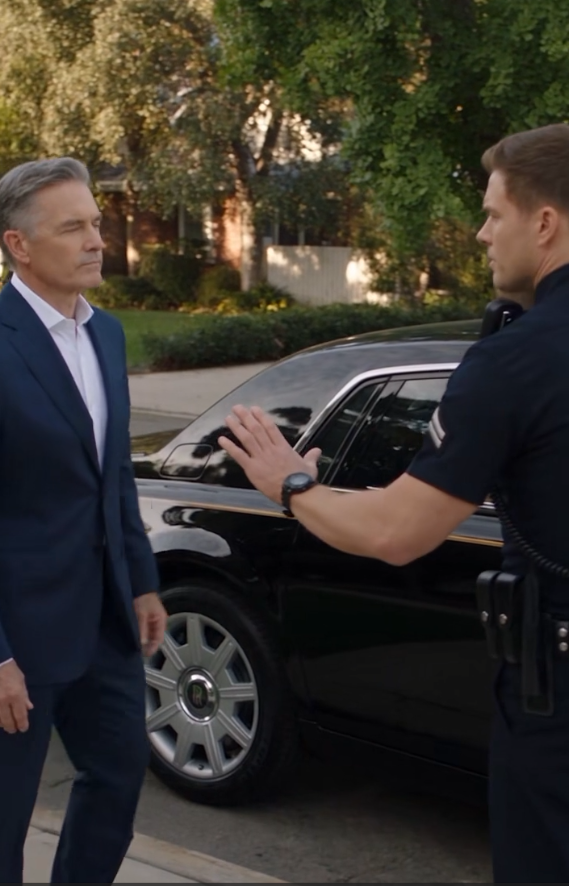
He received discipline.
He also remained responsible for implementing the retraining program he had requested.
Terrence found that appropriate.
Monica found it ironic.
“Punished with paperwork,” she said one evening.
“Some would call that justice.”
“You would.”
“I work for the federal government.”
She laughed.
Months passed.
The neighborhood video disappeared from public attention as quickly as most stories did once outrage no longer had new images to feed it.
Terrence gave one public statement.
Only one.
He did not mention Callaway by name.
He did not describe himself as a victim.
He spoke about records.
About accountability.
About why government power had to remain reviewable even when exercised by people acting under pressure.
A reporter asked whether he believed his status had protected him.
Terrence paused.
Then answered.
“Yes.”
The room shifted.
He continued.
“And that is precisely why this should concern people.”
Another reporter asked whether he believed the officer should have been fired.
Terrence declined to answer.
“That decision belonged to the employing department based on its standards and the evidence.”
“What do you personally think?”
Terrence looked at the reporter.
“I think institutions are strongest when outcomes do not depend on whether the person mistreated has an impressive title.”
That quotation traveled farther than he expected.
Then life resumed.
Not exactly as before.
But close enough.
One Saturday afternoon, several months after the stop, Terrence and Monica drove back to the same neighborhood.
Their family friend had complained that the original visit never happened.
“You still owe me cookies,” she had told Monica on the phone.
So they brought two bags.
Monica parked the black sedan in nearly the same place.
She turned off the engine.
Neither moved.
Terrence looked through the windshield.
Same trees.
Same sidewalk.
Same house.
Different season.
The sprinkler was gone.
Leaves had begun gathering at the curb.
Monica glanced at him.
“We can park somewhere else.”
“No.”
“You sure?”
“Yes.”
He opened the door.
Then paused.
Across the street, the man who had been holding the garden hose months earlier was raking leaves.
He looked up.
Recognized Terrence.
For half a second, both men stood still.
Then the neighbor raised one hand.
Terrence raised his in return.
No crowd.
No phone.
No cruiser.
No authority except the ordinary kind people granted each other when sharing a street.
Monica walked around the sedan carrying the cookies.
Terrence took one bag from her.
“You know,” she said, “most husbands would have let me handle the officer.”
He looked at her.
“That is absolutely not true.”
“It should be.”
“You nearly cross-examined him on the sidewalk.”
“I was warming up.”
Terrence smiled.
They started toward the house.
Halfway up the walkway, his phone buzzed.
He stopped.
Monica looked over.
“What?”
Terrence checked the screen.
A message from Sergeant Miller.
No greeting.
Just a photograph.
A training room.
Rows of officers seated at desks.
On a large screen at the front was a single sentence:
WHEN DID THE FACTS CHANGE?
Below the image, Miller had written:
We use this question now.
Terrence stared at the message.
Monica read it over his shoulder.
Neither spoke for several seconds.
Then she said, “You should answer.”
Terrence typed three words.
Good. Keep asking.
He sent it.
They continued toward the front door.
Behind them, the sedan sat quietly at the curb.
No flashing lights.
No voices raised.
No metal cuffs.
Only afternoon sunlight moving across the hood where his hands had once been pressed flat while a stranger decided what kind of man he was.
Terrence stopped at the porch.
Monica looked back.
“What now?”
He glanced once toward the street.
Then at the bag of cookies in his hand.
“Now,” he said, “we finally make the visit.”
She opened the door.
Terrence followed her inside.
And for the first time since that afternoon, he did not look back.