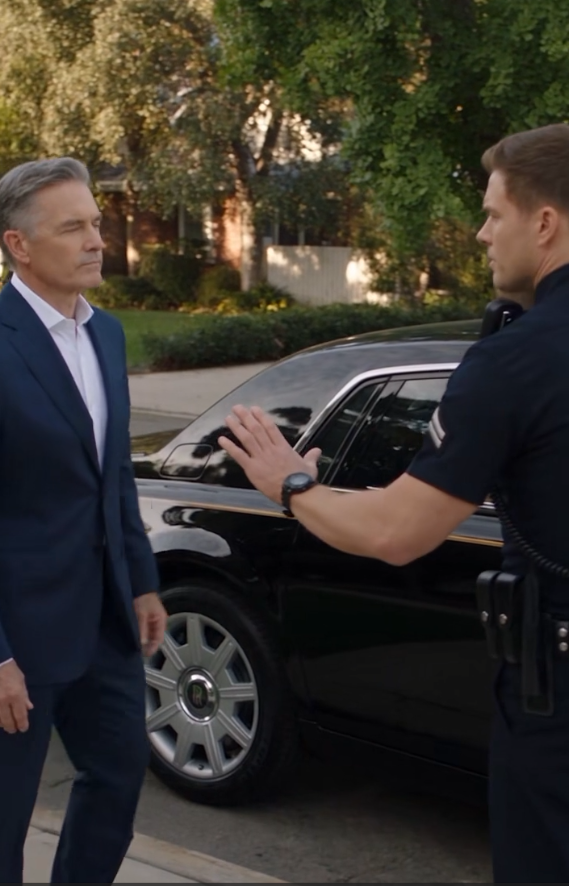
“Yes.”
“And eventually you learned not to reconsider.”
Callaway looked up.
Terrence held his gaze.
“That is what happened beside my car.”
Callaway’s expression tightened.
“You think you know my job.”
“No.”
“You sit in a courtroom after everything’s clean. Reports done. Videos queued up. Everybody safe. You get time.”
Terrence nodded.
“That is true.”
“You don’t know what it’s like making decisions in seconds.”
“That is also true.”
Callaway looked almost startled.
Terrence continued.
“But the recording shows you had opportunities to reconsider.”
Callaway said nothing.
“I answered why I was there. You did not reconsider. You searched me and found nothing. You did not reconsider. You read my identification. You did not reconsider. My wife told you there was a mistake. You did not reconsider. I told you my occupation. You mocked me. You did not reconsider.”
Callaway’s eyes dropped.
Terrence’s voice softened.
“The issue is not that you made one fast decision.”
He paused.
“It is that you kept choosing the same decision after the facts changed.”
No one moved.
Callaway finally said, “You think I’m a bad cop.”
Terrence did not answer immediately.
The easy response would have been yes.
The merciful response no.
Neither interested him.
“I think you developed a habit of treating uncertainty as disobedience.”
Callaway’s face tightened.
“And that habit hurt people.”
“People?”
Terrence saw it.
The exact moment Callaway understood this conversation was no longer only about the suburban stop.
“The review found earlier incidents,” Terrence said.
“I know.”
“Did you watch them?”
Callaway looked away.
“Some.”
“All of them?”
“No.”
“Why not?”
“I know what happened.”
Terrence’s voice sharpened for the first time.
“No. You know what you wrote.”
Callaway looked back.
The room went still.
Terrence felt Monica turn toward him.
He continued.
“Watch them.”
Callaway stared.
“Every one.”
The officer gave a hollow laugh.
“Why?”
“Because you want your job back.”
“That’s exactly why I’m appealing.”
“No.”
Terrence shook his head.
“You want your position back. I’m asking whether you want your judgment back.”
Callaway’s face changed.
Terrence leaned back.
“There is a difference.”
For several seconds, Callaway said nothing.
Then:
“What do you want from me?”
Terrence looked at him.
“Nothing.”
“Then why are we here?”
“Because I needed to decide what I wanted from myself.”
Monica’s eyes moved to him.
Terrence continued.
“I spent eleven days wondering whether I should use every ounce of influence available to me to make sure you never wore a badge again.”
Callaway’s expression hardened.
Terrence did not stop.
“I could have called people. I could have made public statements. I could have turned this into a national spectacle. I was angry enough to imagine all of it.”
Callaway’s attorney watched carefully.
“But then I realized something.”
Terrence placed both hands flat on the table.
“If I used my position to determine your punishment because you abused yours against me, then the lesson would be worthless.”
Callaway said nothing.
“So I did the harder thing.”
Terrence’s voice lowered.
“I stayed inside the process you denied me.”
The sentence remained in the room.
Callaway looked at him for a long time.
Then his shoulders lowered.
Not dramatically.
A small physical release.
The first one Terrence had seen from him.
“What happens now?” Callaway asked.
“That depends on your appeal.”
“No.”
Callaway shook his head.
“I mean after.”
Terrence studied him.
“I don’t know.”
Callaway looked toward his attorney.
Then Monica.
Then back to Terrence.
“I watched your stop.”
Terrence said nothing.
“After the hearing. Alone.”
Callaway’s voice was different now.
No performance.
“I thought it would look different than I remembered.”
Terrence waited.
“It didn’t.”
Callaway swallowed.
“The part with your wallet…”
He stopped.
“What about it?” Terrence asked.
“I saw your ID.”
Terrence felt Monica go still beside him.
Callaway stared at the tabletop.
“I saw the courthouse credential.”
The room changed.
His attorney sat forward.
“Brent.”
Callaway ignored him.
“I knew you were probably telling the truth.”
Terrence did not move.
There it was.
The final fact.
Not necessary to prove the detention wrong.
Not necessary to justify the termination.
But devastating because it explained the moment of hesitation Terrence and Monica had both noticed.
Terrence’s voice became very quiet.
“Then why did you arrest me?”
Callaway pressed his lips together.
His attorney said, “Do not answer that.”
Callaway looked at him.
Then back at Terrence.
“Because by then, if you were really a judge…”
He stopped.
Terrence waited.
Callaway finished.
“…then I had already gone too far.”
Monica closed her eyes.
Callaway’s attorney whispered something under his breath.
Terrence felt the truth settle with surprising calm.
“So you continued.”
“Yes.”
“Why?”
Callaway looked at him.
“Because backing down in front of everyone felt worse.”
Terrence breathed in slowly.
There was the whole encounter in one sentence.
Not fear.
Not public safety.
Not confusion.
Pride.
A man had kept escalating because admitting error felt more dangerous than committing another one.
Terrence thought of every courtroom apology offered too late.
Every witness who doubled down.
Every prosecutor who defended a weak argument because retreat felt like defeat.
Every defendant who turned one terrible decision into five because the first one seemed impossible to face.
Callaway said, “Say something.”
Terrence looked at him.
“What would you like me to say?”
“That I’m finished?”
“That isn’t my decision.”
“That I deserve it?”
“That isn’t either.”
Callaway’s voice cracked slightly.
“Then what?”
Terrence thought about the holding cell.
The cold hood beneath his palms.
The body camera chirp.
The phone ringing.
Miller asking who arrested him.
Monica standing in the precinct doorway.
The Marshal Service waiting outside.
All the safeguards that had activated because of his title.
And the people before him who had not had those safeguards.
He finally said, “Watch the other videos.”
Callaway stared.
“Every one?”
“Every one.”
“Then what?”
“Find the moment in each one where you could have reconsidered.”
Callaway looked down.
“And if you find it,” Terrence said, “do not explain it away.”
The former officer’s face tightened.
Terrence stood.
Monica rose with him.
Callaway remained seated.
As Terrence reached the door, Callaway spoke.
“Judge.”
Terrence turned.
Callaway looked smaller than he had beside the sedan.
Not humiliated.
Simply stripped of all the objects that had once made certainty look like authority.
“I am sorry.”
Terrence studied him.
The apology did not repair the stop.
It did not restore the afternoon.
It did not erase the other videos.
But it was the first sentence Callaway had spoken to him that contained no demand, no defense, and no assumption.
Terrence nodded once.
“I believe you mean that.”
Callaway swallowed.
“Is that enough?”
“No.”
Terrence opened the door.
“But it is where you start.”
Part X — Aftermath
Callaway’s appeal failed.
The termination remained in place.
Terrence learned of the decision from a formal notice weeks later.
He read it once, folded it, and placed it in a drawer.
No celebration.
No satisfaction.
Only consequence.
Sergeant Miller remained with the department.
His reopened supervisory review resulted in a formal finding that he had failed to document and escalate earlier warning signs involving Callaway.