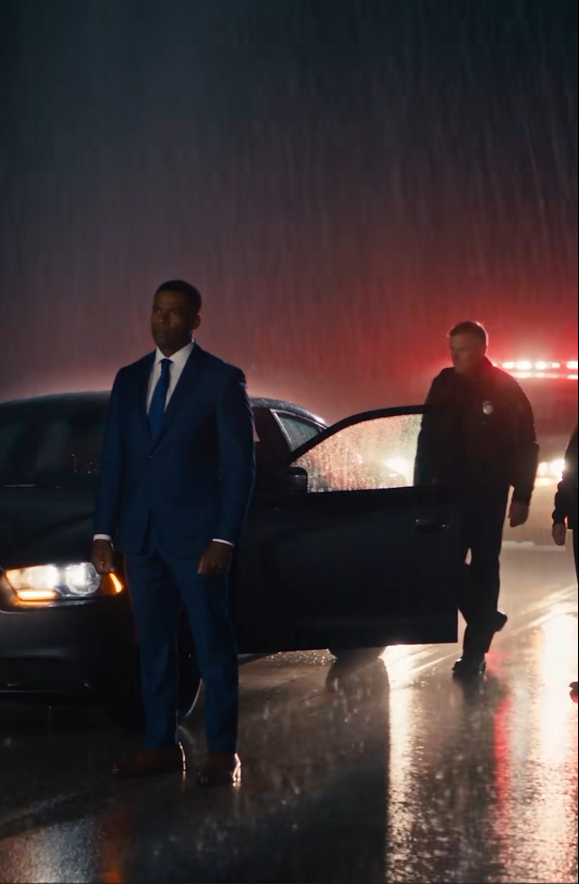
The broader review lasted another year.
Eleven convictions were vacated.
Four resulted in retrials.
Three defendants accepted time-served resolutions.
Two were exonerated completely.
One case remained disputed because evidence independent of Ryker’s testimony still supported guilt.
David insisted privately that each case be treated individually.
No automatic innocence.
No automatic trust.
Evidence again.
Always evidence.
Chloe Bennett remained on the force.
Some officers considered her courageous.
Others avoided her.
For months, partners became suddenly careful around her, as though honesty were contagious and dangerous.
Eventually that faded.
She became a field-training officer sooner than anyone expected.
On her first day training a rookie, she spent twenty minutes discussing report language.
“If you saw it, write that you saw it,” she said.
“If someone told you, write that they told you. If you don’t know, write that you don’t know.”
The rookie nodded.
Bennett looked at him.
“And never make your report stronger than your memory.”
“Got it.”
She paused.
“That sentence matters more than you think.”
Brenda Hayes received a county commendation.
She hated the ceremony.
Her supervisor made her attend.
The county executive praised her “commitment to evidentiary integrity.”
Brenda accepted the plaque, shook hands, and returned to work that evening.
She stored the plaque in a desk drawer.
Months later, someone asked why she didn’t display it.
“Because I did my job.”
“You saved the video.”
“The server saved the video.”
“You made sure it stayed saved.”
Brenda looked at Monitor Seven.
“That’s still the job.”
David changed too, though not in the ways reporters predicted.
He did not quit prosecution.
He did not become a defense attorney.
He did not build a public career around police reform.
He returned to court.
But his questions changed.
Before approving a search-based felony prosecution, he wanted original video whenever it existed.
Before relying on an officer’s description of evidence recovery, he checked timestamps.
Before calling contradictions insignificant, he asked whether they were actually insignificant or merely inconvenient.
Some officers disliked it.
Some appreciated it.
Younger prosecutors learned quickly that “the officer said so” was not enough in David Caldwell’s office.
One afternoon, nearly two years after the stop, a junior prosecutor entered his office carrying a narcotics file.
“We’ve got a possession with intent case.”
David looked up.
“Okay.”
“Three hundred pills. Officer says they were in a backpack behind the passenger seat.”
“Video?”
“Body cam starts after the search.”
“Why?”
“Battery issue.”
“Dash?”
“Blocked.”
“Consent?”
“Officer says verbal.”
“Recorded?”
“No.”
The junior prosecutor hesitated.
“There’s also a witness.”
“What witness?”
“Passenger says the backpack was already in the car.”
“Whose backpack?”
“Driver says it wasn’t his.”
“Fingerprints?”
“Pending.”
The young prosecutor shifted.
“It’s probably his.”
David leaned back.
“Probably isn’t a charge.”
“I know.”
“Do you?”
The prosecutor looked at him.
David closed the file.
“Find out what we can prove.”
“And if we can’t?”
“Then we don’t pretend uncertainty is evidence.”
The prosecutor nodded and left.
David returned to his work.
On the corner of his desk sat no newspaper clippings.
No photograph from the hearing.
No commendation.
Only a small printed image Sarah had once given him as a joke.
It showed the frozen frame from Bennett’s camera.
Not the bag.
Not Ryker.
The timestamp.
00:43:14.
Underneath, Sarah had written:
Three seconds matter.
David kept it because she was right.
The final piece surfaced unexpectedly.
Not during a trial.
Not through investigators.
Through a letter.
It arrived at the District Attorney’s office almost three years after the night on Interstate 49.
No return address David recognized.
The envelope contained four handwritten pages.
The author was the man who had served six years on the heroin conviction tied to Ryker.
He had been exonerated the previous spring.
David read the letter alone.
The man did not thank him.
David was grateful for that.
He wrote instead about prison.
About missing his daughter’s high-school graduation.
About returning home to a neighborhood that remembered the accusation better than the exoneration.
About how difficult it was to explain that a court clearing your name did not return the years during which everyone believed the opposite.
Near the end, one paragraph stopped David.
You had cameras. I didn’t. That doesn’t mean I’m angry you got lucky. It means I’m glad somebody finally had proof. But don’t make the mistake of thinking the camera created the truth. It only caught it.
David read that sentence twice.
Then again.
He folded the pages carefully.
That evening, he drove home on Interstate 49.
The same route.
The weather was clear.
Traffic thin.
At the exit where Ryker had stopped him, David instinctively checked his rearview mirror.
Nothing there.
He almost laughed at himself.
Then headlights appeared farther back.
A patrol car.
For a moment his shoulders tightened.
The cruiser gained ground.
David kept his speed steady.
It moved into the left lane.
Passed him.
The officer inside never looked over.
The vehicle continued ahead until its taillights became small red points beneath the interstate lamps.
David drove on.
At home, he parked but remained behind the wheel for a while.
No rain.
No flashing lights.
No cameras he could see.
He thought about Ryker believing darkness would protect him.
About Bennett standing six feet away and doubting what her own eyes had registered.
About Brenda deciding that evidence was safest when no single institution controlled it.
About Sarah opening one folder and asking for the second camera.
About the man who had lost six years without one.
David took the letter from his briefcase.
He had carried it home to answer later, though he still did not know what to say.
You had cameras. I didn’t.
He read the words beneath the parking-lot light.
For most of David’s career, he had thought truth was something lawyers established.
Gather facts.
Test witnesses.
Build arguments.
Present evidence.
Win or lose.
Now the idea seemed incomplete.
Truth existed before anyone believed it.
Before a judge admitted it.
Before a jury accepted it.
Before a camera captured it.
The law did not create truth.
At its best, it created a disciplined way to find it.
At its worst, it could bury truth beneath a confident report and an official signature.
David folded the letter.
His phone buzzed.
Sarah.
He answered.
“What?”
“No hello?”
“It’s late.”
“You’re getting friendlier with age.”
“I doubt that’s why you called.”
“You still have the letter?”
“Yes.”
“You going to answer him?”
David looked through the windshield at the empty parking space ahead.
“I think so.”
“What are you going to say?”
He considered it.
“I don’t know yet.”
“That’s unlike you.”
“Maybe I’m improving.”
She laughed.
They spoke for another minute and disconnected.
David remained in the car.
Then he reached for the door.
Halfway out, he stopped.
A memory had returned with startling clarity.
Ryker standing beside the sedan in freezing rain.
The bag raised in his hand.
Looks like cocaine.
In that instant Ryker had believed the story was finished.
David had believed the opposite.
Preserve both cameras.
But neither of them had understood the real reason the night would matter.
It was not because one prosecutor had been framed.
It was because for once, the lie had arrived after the truth was already recording.
David stepped out of the car.
He shut the door and started toward his building, carrying the letter beneath one arm.
Behind him, traffic moved steadily along the interstate.
Thousands of headlights.
Thousands of ordinary journeys.
Most would never become evidence.
Most would never need to.
And somewhere across the county, another officer was beginning another stop, another camera was blinking awake, another dispatcher was watching a screen, and another citizen was trusting that what happened would matter more than who told the story afterward.
David entered the building.
The glass door closed behind him.
On the passenger seat of his car, beneath the parking-lot light, Sarah’s old photograph had slipped from his briefcase.
Only the timestamp showed.
00:43:14.
Three seconds before a lie became a case.
And just long enough for the truth to get there first.