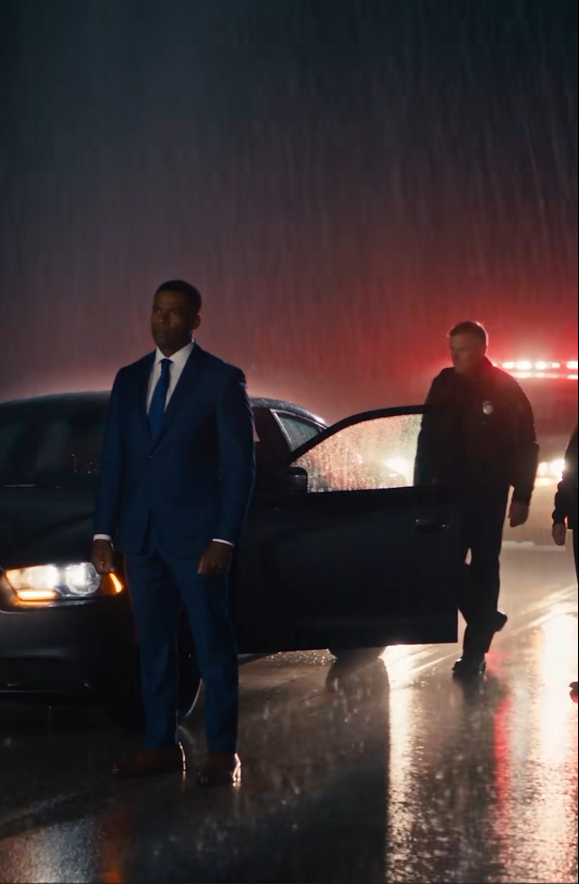
David understood the warning and stopped.
The attorney changed direction again.
“Mr. Caldwell, you testified that you were calm during the stop.”
“I don’t believe I used that word.”
“You appeared calm.”
“I tried to remain controlled.”
“Because you knew cameras were recording.”
“I hoped they were.”
“Because you understood how video could help you.”
“Yes.”
“And today you are asking this jury to interpret video exactly as you do.”
“No.”
The attorney’s eyebrows lifted.
David looked directly at the jurors.
“They should interpret it themselves.”
The courtroom stayed quiet.
The defense lawyer returned to his table.
“No further questions.”
As David stepped down, he passed within twelve feet of Ryker.
Ryker did not look at him.
The most damaging witness was not David.
It was Chloe Bennett.
By trial, she had two years on the job.
She entered the courtroom in uniform.
Ryker watched her take the oath.
The prosecutor began gently.
“Officer Bennett, were you working with the defendant on January seventeenth?”
“Yes.”
“Were you a probationary officer?”
“Yes.”
“Did you respect Officer Ryker?”
A pause.
“Yes.”
“Did you trust him?”
Another pause.
“At that time, yes.”
The prosecutor displayed her body-camera footage.
“Do you recognize this?”
“Yes.”
“Is it a fair and accurate recording?”
“Yes.”
The clip played.
Her younger self stood in the rain.
Her breathing audible.
Ryker’s hand moved.
The bag appeared.
Bennett watched without turning away.
“What did you think at the time?” the prosecutor asked.
“I wasn’t sure what I’d seen.”
“Did you see cocaine beneath Mr. Caldwell’s seat before Officer Ryker reached there?”
“No.”
“Did you smell marijuana?”
“No.”
“What happened after the arrest?”
Bennett swallowed.
“I told Officer Ryker I hadn’t seen the bag there before.”
“What did he say?”
“He said I wasn’t searching.”
“And later?”
“I told him I wanted to correct my report.”
“Why?”
“Because I thought the wording implied I personally saw him recover the drugs from beneath the seat.”
“What did Officer Ryker say?”
“He told me not to correct it.”
“Were you afraid of him?”
The defense objected.
Sustained.
The prosecutor rephrased.
“Why did you initially follow his direction?”
Bennett looked toward the jury.
“Because he had twenty years in the department and I had twenty-seven shifts.”
That line reached them.
David could see it.
The prosecutor approached the witness box.
“When investigators later showed you still images from your camera, what did you do?”
“I told them what I remembered.”
“Did anyone promise you anything?”
“No.”
“Were you threatened with charges?”
“No.”
“Why testify?”
Bennett looked down briefly.
Then back up.
“Because the camera doesn’t belong to the officer wearing it.”
The prosecutor stopped.
Bennett continued.
“It belongs to what happened.”
No further questions.
The defense’s central theory emerged during closing arguments.
Mistake.
Not planting.
Not conspiracy.
Mistake.
Ryker had carried a training prop bag in his vest, his attorney argued. He had forgotten it was there after an earlier demonstration. During the vehicle search, he removed the prop unintentionally while adjusting equipment, then confused it with drugs recovered from the floor.
It was a theory no witness had supported.
But it gave jurors a path away from deliberate framing.
The prosecutor dismantled it with one record.
Laboratory testing.
The cocaine recovered from David’s car matched the purity profile of cocaine stored in the Seventh Precinct evidence vault.
More specifically, it matched a batch associated with a closed case Ryker had accessed three days before the stop.
Then came the access logs.
He had opened the vault.
He had signed the sealed package out for “training review.”
No legitimate training event had occurred.
The package was twelve grams lighter when investigators later weighed it.
The bag in David’s car contained 11.8 grams.
The prosecutor stood before the jury.
“This case is not about whether police officers should be trusted.”
David listened from the gallery.
“It is not about whether prosecutors should be trusted. It is not about choosing a profession, a uniform, or a side.”
Ryker stared at the table.
“It is about whether evidence gets to mean something.”
The prosecutor showed three images.
The evidence-room log.
The body-camera frame.
The bag recovered from David’s car.
“Officer Ryker did not make one mistake. He made a series of decisions. He removed controlled narcotics. He selected a target who threatened his unit. He initiated a stop unsupported by clear video evidence. He claimed an odor no other officer detected. He moved cocaine from his uniform into a vehicle. He testified under oath that it was already there. And when he realized another camera might exist, he tried to alter records before anyone could connect the narcotics to his evidence vault.”
The prosecutor paused.
“This case exists because he believed every individual piece could be explained away.”
Then the screen went dark.
“The law asks you to consider them together.”
The jury began deliberating at 3:12 p.m.
At 6:40, they sent a question.
At 8:05, another.
At 9:18, the judge sent everyone home.
David slept badly.
The next morning he arrived early and sat beside Sarah.
“You don’t have to be here,” she said.
“Yes, I do.”
“Why?”
He looked toward the empty jury box.
“I don’t know.”
Sarah accepted that.
At 11:27, the courtroom deputy entered quickly.
Verdict.
People stood.
Ryker returned to the defense table.
The jury filed in.
David looked at the foreperson.
He stopped trying to predict.
The judge asked whether they had reached unanimous verdicts.
“Yes, Your Honor.”
The first count.
Evidence tampering.
Guilty.
Ryker did not move.
Perjury.
Guilty.
Official misconduct.
Guilty.
Obstruction.
Guilty.
Civil-rights violation related to the unlawful search and arrest.
Guilty.
Additional counts tied to earlier cases followed.
Some guilty.
One not guilty.
Another guilty.
David listened.
He felt no rush.
No triumph.
Only weight shifting from uncertain to real.
When the clerk finished, the judge ordered Ryker taken into custody pending sentencing.
A deputy approached him.
For a fraction of a second, Ryker looked toward David.
Their eyes met.
Then Ryker stood.
The deputy instructed him to turn around.
Hands behind his back.
David heard his own voice from eleven months earlier.
I am not resisting.
Ryker said nothing.
The handcuffs closed.
He was led away.
Reporters surged toward the doors.
Sarah remained seated.
David did too.
“You okay?” she asked.
He looked at the empty defense chair.
“I keep thinking about the stop.”
“The video?”
“No.”
He turned toward her.
“The moment before the lights came on.”
Sarah waited.
“I was just driving home.”
She nodded.
“That’s the part people forget.”
“What?”
“That most life-changing moments don’t announce themselves.”
David looked toward the courtroom door through which Ryker had disappeared.
“No.”
Then he stood.
“They just interrupt the drive.”
Part VI — Aftermath
Thomas Ryker was sentenced four months later.
The judge spoke for nearly thirty minutes.
About public trust.
About the unique power granted to police officers.
About the damage caused when authority was used not merely to conceal misconduct but to manufacture guilt.
Ryker received a substantial prison sentence.
David attended but did not speak.
He had been offered the opportunity to provide a victim-impact statement.
He declined.
When Sarah asked why, he told her, “The evidence has said enough.”