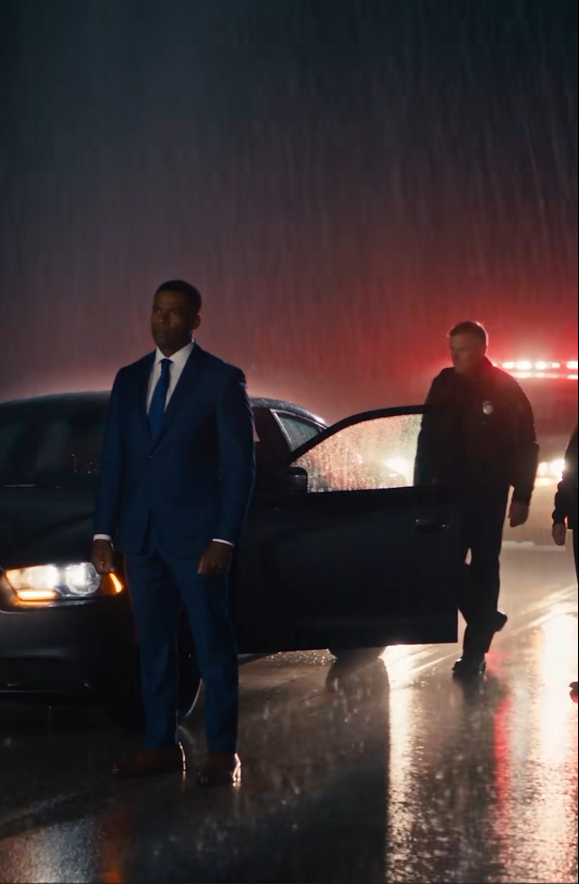
“But eventually we will be.”
Ryker guided him toward the patrol car.
David didn’t resist.
He didn’t raise his voice.
He didn’t give Ryker anything that could become another sentence in another report.
As Bennett opened the rear door, David glanced once toward the wet highway.
Cars passed.
Headlights.
Rain.
Normal life continuing twenty yards away.
Then he ducked into the back seat.
Ryker closed the door.
Through the glass, David saw Bennett standing alone beside the patrol car.
Her body camera was still blinking.
Thirty-one miles away, dispatcher Brenda Hayes had stopped typing.
She had been working the midnight communications desk for eleven years.
She had heard shootings, crashes, domestic calls, officers screaming for backup, children whispering addresses from closets.
Very little surprised her anymore.
But the image on Monitor Seven had.
Patrol unit feeds automatically appeared during certain traffic events, an upgrade the county had installed after a lawsuit involving an officer injured during a roadside stop. Most supervisors barely looked at them unless an emergency alert occurred.
Tonight the system had routed Bennett’s camera to dispatch when Ryker activated the vehicle’s lights.
Brenda had been half-listening while entering another call.
Then David Caldwell said, I do not consent to any search.
Something about his voice made her look up.
Two other dispatch employees watched with her.
None spoke when Ryker reached toward his vest.
None spoke when his hand went underneath the seat.
Then the plastic bag appeared.
One dispatcher whispered, “Oh, no.”
Brenda stared at the timestamp.
00:43:17.
Ryker turned toward David.
Looks like cocaine.
At 00:43:22, Brenda reached for her keyboard.
Not the police messaging system.
The archive console.
She flagged the stream as evidentiary data.
Then duplicated it to the county’s emergency retention server.
The woman beside her said, “What are you doing?”
“Saving it.”
“It saves automatically.”
Brenda’s hands continued moving.
“Not where he can touch it.”
The dispatcher glanced toward the closed supervisor’s office.
“Brenda.”
“I saw what I saw.”
“You don’t know what you saw.”
Brenda stopped.
She looked at her colleague.
“Yes, I do.”
On screen, David Caldwell was being placed inside the patrol car.
Brenda created a second export.
Then a third.
One went to the county legal retention system, triggered under litigation-preservation protocols.
Another went into a locked communications archive requiring two administrators to delete.
The third she marked for automatic integrity verification, producing a checksum and timestamp independent of the police department.
Her colleague lowered her voice.
“If somebody asks why you did that?”
Brenda looked back at the monitor.
“Then I’ll tell them.”
“You could lose your job.”
Brenda watched Ryker speak to Bennett beside the car.
No audio reached them for a moment because wind overwhelmed the microphone.
Then Bennett’s voice came through.
“Sergeant, I didn’t see it there before.”
Brenda froze.
Ryker moved close to her.
“You weren’t searching.”
“I know, but—”
“You were controlling the suspect.”
“He’s a prosecutor.”
“He’s a suspect.”
Bennett stared at him.
Ryker pointed toward the cruiser.
“Write what happened.”
The feed cut as Bennett entered the vehicle.
Brenda looked at the black screen.
Then at the archive confirmation.
Three copies.
Three systems.
Three timestamps.
She picked up the telephone.
Not the precinct line.
Not Internal Affairs.
She called the county duty attorney.
By seven the next morning, David’s mug shot was everywhere.
Part II — Pressure
The photograph had been taken at 2:16 a.m.
David looked tired but composed, tie removed, white shirt collar open, rain still darkening one shoulder.
By 6:30, the image had appeared on local television.
By 7:05, a news anchor used the phrase “stunning fall.”
At 7:20, the police union released a statement saying the arrest raised “serious questions about integrity within the prosecutor’s office.”
At 8:10, the District Attorney called David into his office.
David had been released on bond less than an hour earlier.
He sat across from his boss wearing the same suit from the night before.
No one offered coffee.
The District Attorney looked older than he had the day before.
“This is administrative leave.”
David nodded.
“I expected that.”
“It is not discipline.”
“It feels remarkably similar from this side of the desk.”
His boss rubbed his forehead.
“You know what I mean.”
“I do.”
The District Attorney lowered his hand.
“Did they find cocaine in your car?”
“No.”
“That’s not what I asked.”
David watched him.
His boss corrected himself.
“Was cocaine recovered from your car?”
“Ryker produced cocaine while standing inside my driver’s compartment.”
The distinction landed.
The District Attorney sat back.
“You’re saying he planted it.”
“I’m saying I watched him reach toward his vest before he reached beneath my seat.”
“You saw that?”
“Yes.”
“Clearly?”
“Clearly enough.”
The District Attorney stood and walked toward the window.
“You were investigating his unit.”
“I still am.”
“No. You’re not.”
David’s expression hardened.
“Until this is resolved, you are not touching those cases.”
“Which is exactly what he wanted.”
His boss turned.
“That may be true. It also doesn’t change what I have to do.”
David looked toward the closed office door.
Through the frosted glass he could see shadows passing.
People who had worked beside him for years.
People who had watched him send murderers to prison and dismiss weak cases when the evidence failed.
Today, some would believe him.
Some wouldn’t.
Most would wait to see which belief was safer.
“Has anyone secured the body-camera footage?” David asked.
The District Attorney hesitated.
“Your attorney filed preservation notices.”
“Sarah?”
“She was here before six.”
That almost made David smile.
Sarah Jenkins had been a public defender before moving into private criminal practice. She and David had spent years arguing opposite sides of cases and respecting each other enough to become friends despite it.
She had once told him he was irritatingly difficult to surprise.
He wondered what she would say now.
“Good,” he said.
His boss returned to the desk.
“David.”
David paused at the door.
“If you are right, we’ll deal with it.”
David looked back.
“That word is doing a lot of work.”
“If.”
“Yes.”
His boss held his gaze.
“The drugs existed.”
“So did the officer holding them.”
David opened the door.
“You don’t have to believe me yet.”
He stepped into the hallway.
“But make sure you remember who benefits from everyone waiting.”
Sarah was sitting on the hood of her car in the courthouse garage.
She held two coffees.
David took one.
“Black?”
“You’ve been drinking the same thing since law school.”
“I was hoping prison would change me.”
“You spent four hours in county holding.”
“Transformative experience.”
She studied him.
“You okay?”
David drank the coffee.
“No.”
“Good answer.”
He looked toward the garage entrance.
Rainwater dripped from the concrete beams.
“What do we have?”
“Official report says you crossed the center line twice.”
“I didn’t.”
“Ryker claims he smelled raw marijuana.”
“There wasn’t marijuana.”
“None found.”
“Convenient.”
“He writes that you appeared nervous.”
David looked at her.
Sarah raised one eyebrow.
“I know.”
“What does Bennett say?”
“Her supplemental report is six lines.”
David waited.
Sarah pulled a folded page from her bag.