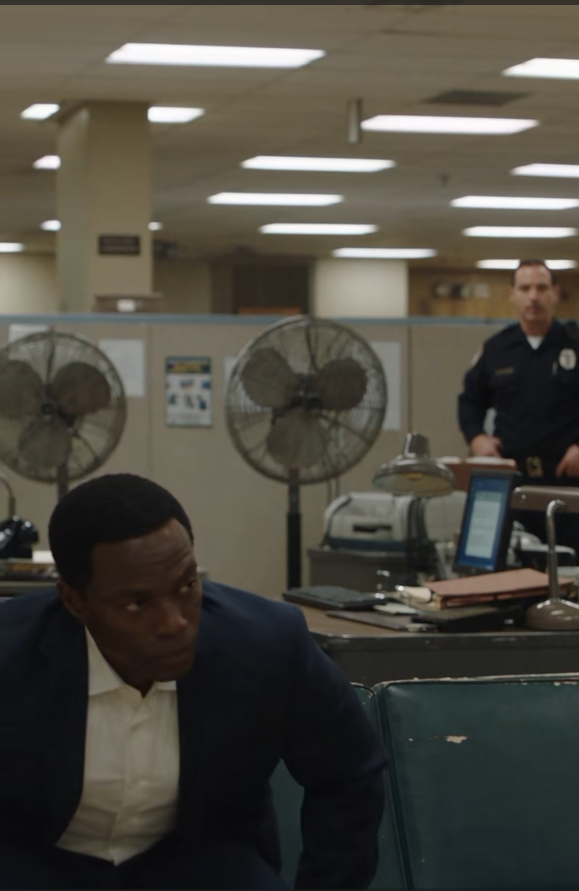
Part I — Disruption
Officer Travis Rourke’s fist landed beneath Kendrick Hayes’s left eye before Kendrick had even finished reaching for his credentials.
The impact turned Kendrick’s face hard to the right.
His shoulder struck the painted concrete wall beside the public entrance. His leather briefcase tipped against the cracked vinyl bench. For one sharp second, the whole lobby narrowed to fluorescent light, the taste of iron, and the scrape of his shoe against dirty tile.
Across the bullpen, two officers stopped what they were doing.
Neither moved toward him.
That told Kendrick almost as much as the punch did.
He did not stagger far. He did not swing back. He did not raise his voice.
Instead, he slipped his left thumb beneath the edge of his shirt cuff and pressed the concealed switch strapped against his wrist.
One second.
Rourke was still standing close enough for Kendrick to smell coffee and sweat on him.
Two seconds.
Someone near intake muttered, “What the hell?”
Three.
Heavy electronic bolts engaged throughout Oak Haven Police Headquarters with a sequence of hard mechanical clicks.
Front entrance.
Sally port.
Records corridor.
Evidence wing.
Rear staff door.
The sound moved through the building like a row of steel teeth closing.
Rourke turned.
“What was that?”
Kendrick touched the skin below his eye. His fingers came away with a trace of blood.
A red indicator above the public entrance had replaced the usual green.
Locked.
Rourke looked back at him.
“What did you do?”
Kendrick’s breathing stayed even.
“I tried to show you my identification.”
Rourke stepped closer again.
“I asked you what you did.”
Kendrick lowered his hand.
“You should probably stop touching me.”
That was when Captain Richard O’Malley appeared at the far end of the bullpen.
He was a heavyset man in shirtsleeves, tie loosened, reading glasses still in one hand as if he had just come out of his office after hearing the locks engage. He looked first at Rourke.
Then at Kendrick.
Then at the blood beginning to darken the collar of Kendrick’s white shirt.
Something in O’Malley’s face changed.
Not surprise.
Recognition.
And then calculation.
Kendrick saw it.
For fourteen months, he had been paid to notice changes like that.
O’Malley stopped walking.
“Officer Rourke,” he said.
Rourke kept his eyes on Kendrick. “This guy triggered something.”
O’Malley’s gaze shifted toward the locked front entrance.
“What guy?”
Rourke gave a short, incredulous laugh. “The guy standing right there.”
O’Malley looked at Kendrick again.
Kendrick had been scheduled to meet him at 3:30 under the pretext of an interagency records matter. It was 3:16 now.
Fourteen minutes early.
Too early for the planned introduction.
Far too late for pretending this was ordinary.
O’Malley’s voice dropped. “Mr. Hayes.”
Rourke glanced at him.
“You know him?”
Kendrick answered before O’Malley could.
“He knows I had an appointment.”
Rourke looked from one man to the other.
“With what agency?”
Kendrick did not answer.
Instead, he bent carefully, picked up his briefcase, and set it upright beside the bench.
The movement was small.
Rourke flinched anyway.
Kendrick noticed.
O’Malley noticed that Kendrick noticed.
There was a moment then—brief, quiet, but decisive—when everyone in the lobby understood that the room had changed.
Rourke had started the confrontation believing Kendrick was alone.
He was not.
The building itself had just announced that fact.
Outside, beyond the locked glass entrance, tires rolled to the curb.
Not sirens.
No flashing lights.
That had been part of the plan.
Controlled execution.
Low visibility.
No spectacle.
Through the glass, Kendrick saw dark sedans stopping in sequence along the front drive.
A plain white utility van turned into the employee lot.
Two unmarked SUVs appeared near the side entrance.
Federal agents began stepping out.
Rourke looked through the glass.
His face lost some of its heat.
“What is this?”
O’Malley moved toward the lobby desk.
“Everybody stay where you are.”
Nobody obeyed.
Not exactly.
Officers stood from chairs.
Phones came out.
Someone tried the rear corridor and found the security door locked.
Another officer called toward dispatch.
“Is the system down?”
“No.”
“Then unlock it.”
“I can’t.”
That answer traveled quickly.
The fans still pushed hot air across the bullpen.
A printer hummed.
Somewhere, a radio crackled with a traffic stop from another part of the city.
Inside headquarters, however, nobody seemed interested in the ordinary police work continuing outside.
Kendrick watched the building react.
That, too, was evidence.
People who had nothing to hide usually wanted explanations.
People who did had a different instinct.
They wanted exits.
Near the records corridor, a uniformed sergeant reached for a keycard.
The reader flashed red.
He tried again.
Red.
O’Malley saw him.
“So everybody just relax.”
Kendrick finally smiled, but there was no warmth in it.
“Captain, I don’t think that’s going to help.”
O’Malley’s eyes hardened.
Rourke looked at Kendrick. “Who are you?”
Kendrick reached slowly into his jacket.
This time Rourke did not move.
Kendrick removed a leather credential wallet and opened it.
The federal seal caught the fluorescent light.
Rourke stared at it.
Then at Kendrick.
Then back at the seal.
Kendrick said, “Special Agent Kendrick Hayes.”
The bullpen went quiet in a way it had not gone quiet for the punch.
Rourke took half a step backward.
Kendrick continued.
“Federal law enforcement.”
O’Malley closed his eyes for barely a second.
There it was again.
Not confusion.
A man doing math.
How much did they know?
Who had talked?
What was already outside?
Kendrick had seen that look on mob captains, city contractors, police supervisors, and elected officials.
The first crack in certainty.
He slipped the credentials back into his jacket.
Rourke said, “He reached inside his coat.”
Kendrick looked at him.
“I told you exactly what I was doing.”
“You could’ve been reaching for anything.”
“My hands were visible.”
“You don’t tell me how to do my job.”
“No,” Kendrick said. “But a federal judge might.”
Rourke’s face tightened.
O’Malley cut in.
“Enough.”
Kendrick looked past him toward the far wall, where a digital clock displayed 3:17.
The arrest team had been scheduled to move at 3:30 after his confirmation.
His duress signal had moved the timetable forward.
That was the entire point.
If the operation was compromised, nobody inside would get thirteen minutes to destroy evidence.
Outside, agents approached the doors.
One of them held up a document through the glass.
O’Malley did not need to read the heading.
Kendrick did.
United States District Court.
Search and seizure warrants.
He looked at O’Malley.
“You were supposed to get thirteen more minutes.”
O’Malley said nothing.
“You don’t anymore.”
Rourke turned to his captain.
“What is he talking about?”
O’Malley ignored him.
Kendrick saw the slight movement in O’Malley’s right hand.
Not toward his weapon.
Toward the phone clipped to his belt.
Kendrick spoke quietly.
“Don’t.”
O’Malley froze.
“It’s just my phone.”
“I know.”
“You planning to arrest me for making a call?”
“No.”
Kendrick looked toward the locked records corridor.
“But if you’re thinking of calling somebody back there, I wouldn’t.”