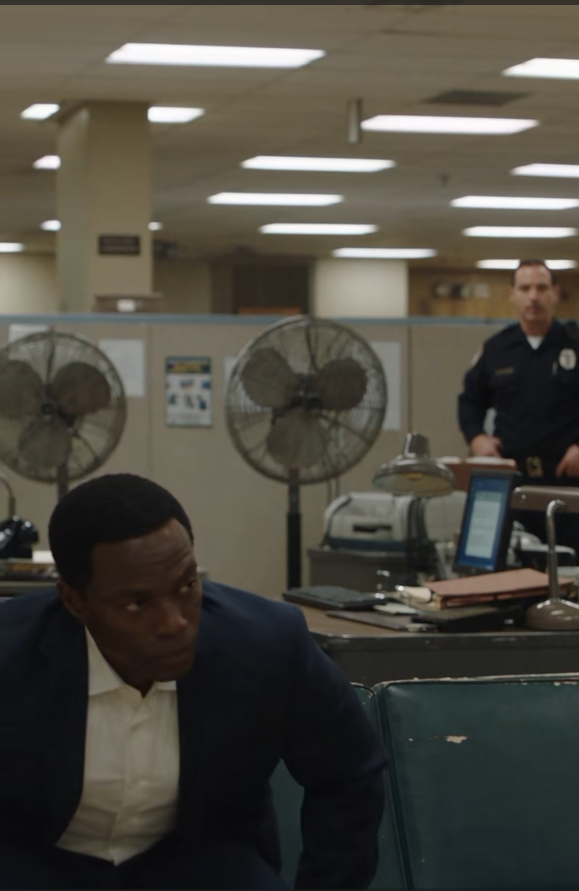
That landed.
The sergeant near records stopped trying his card.
O’Malley stared at Kendrick for a long moment.
Then he slowly lifted both hands away from his belt.
The front doors clicked.
Not unlocked from inside.
Released remotely under the joint security protocol.
The first federal agents entered.
Dark suits.
Visible credentials.
Measured pace.
Behind them came evidence technicians in plain clothes carrying hard-sided cases.
No one ran.
No weapons came out.
That made the scene feel more serious, not less.
The lead agent stepped directly to Kendrick.
“You all right?”
Kendrick touched his cheek once.
“I’m fine.”
The agent looked at Rourke.
Rourke immediately said, “He made a movement toward his jacket.”
Kendrick said nothing.
The agent looked to Kendrick again.
“You want medical?”
“No.”
“You sure?”
“Yes.”
The agent nodded.
Then his attention shifted to O’Malley.
“Captain Richard O’Malley?”
O’Malley’s jaw moved once.
“Yes.”
The agent held out the warrant.
“We have federal court orders authorizing a search of this facility and seizure of specified records, devices, evidence logs, digital systems, and financial materials. You and your personnel are instructed not to interfere.”
Rourke said, “What the hell is happening?”
Nobody answered him.
That was the first moment Kendrick saw fear settle fully into his face.
Not because of the punch.
Because he had finally understood the punch was the smallest problem in the room.
Three days earlier, Kendrick had sat in a windowless federal conference room with a stack of evidence thick enough to bend the metal clips holding it together.
The room had smelled like toner and stale coffee.
On the whiteboard were four columns.
Businesses.
Evidence.
Complaints.
Money.
The case had not begun dramatically.
No undercover recording of a suitcase changing hands.
No midnight confession.
No spectacular raid.
Just a missing dash-camera file.
A public defender had asked a routine question about a traffic stop.
The department’s system showed the file had existed.
Then it did not.
A technical audit revealed it had not been automatically deleted.
Someone had removed it.
That alone was not enough for a federal case.
Then another file vanished.
Different officer.
Same supervisor chain.
A few weeks later, a restaurant owner admitted he had been paying cash each month to avoid “problems.”
When Kendrick asked what kind of problems, the man had rubbed both palms over his face before answering.
Health inspections.
Patrol harassment.
Noise complaints.
Liquor enforcement.
Parking citations.
Anything that could make a business owner miserable one violation at a time.
“Who did you pay?”
The owner had shaken his head.
Kendrick waited.
Silence was useful when you let it work.
Finally the man said, “I don’t know who gets what.”
“That wasn’t my question.”
“I gave it to officers.”
“Which officers?”
Another long pause.
“Different ones.”
“Names?”
“No.”
“You know names.”
“I know what happens if I say them.”
That statement had led to witness protection measures.
Then came the public defender.
Three separate clients.
Three separate arrests.
Three evidence logs with the same irregularity.
Each log had handwritten amendments initialed after the fact.
Each involved narcotics weight changes.
Each had moved through the same evidence room.
One inconsistency became ten.
Ten became dozens.
Financial subpoenas showed unexplained cash deposits.
Phone records connected officers with known dealers.
Internal complaints against aggressive officers repeatedly disappeared after reaching command review.
And threading through multiple pieces of evidence was one name.
Richard O’Malley.
Not always directly.
That was what made the case difficult.
O’Malley was careful.
He did not take envelopes where cameras could see.
He did not put instructions in messages.
He did not write, Destroy the recording.
He asked whether a file was “still necessary.”
He wondered aloud whether a complaint was “credible.”
He told people to “handle local problems locally.”
Language designed to sound harmless later.
Kendrick had built cases against men like that before.
They rarely believed they were corrupt.
They believed they were practical.
Then the money came in.
Then favors became structure.
Then structure became loyalty.
Then loyalty became fear.
By the time investigators could see the whole shape, the people inside it had usually stopped noticing how distorted their lives had become.
Oak Haven looked exactly like that from the outside.
The question was how deep it went.
The federal warrants were designed to answer it.
The plan had been precise.
Kendrick would enter alone.
He would confirm O’Malley was present.
No premature arrests.
No confrontation.
At 3:30, the building’s security system would shift to joint federal control.
Records access would freeze.
Agents would enter simultaneously through three points.
Servers would be imaged.
Evidence rooms secured.
Command staff separated.
Phones seized.
No one would have time to coordinate stories.
Kendrick had objected to one part of the plan.
“Why am I walking in alone?”
The lead prosecutor had said, “Because O’Malley agreed to meet you.”
“That doesn’t answer the question.”
“You’re the face he expects.”
Kendrick had looked at the map of headquarters on the table.
“And if someone decides they don’t like my face?”
The room went quiet.
Kendrick had not smiled.
It had not been a joke.
The prosecutor finally said, “Duress switch.”
A small transmitter was placed on the table.
“If you trigger it, we lock the controlled doors and move.”
Kendrick picked it up.
“How fast?”
“Three seconds.”
He turned the device over in his palm.
“Three seconds is a long time.”
No one answered.
Now, standing inside Oak Haven headquarters with blood under his eye, Kendrick thought the device had worked exactly as designed.
The people had not.
Part II — Pressure
The search began at 3:24 p.m.
By 3:31, every officer inside headquarters had been separated into designated areas.
By 3:36, federal technicians had entered the records unit.
By 3:42, Kendrick was sitting at an unused desk with an instant cold pack against his cheek while another agent photographed the swelling.
Rourke stood thirty feet away under supervision.
He had not been arrested.
Not yet.
That bothered him.
Kendrick could tell because Rourke kept asking the same question in different forms.
“Am I being detained?”
“Can I leave?”
“Am I under investigation?”
“Do I need a lawyer?”
The answer depended on which question he asked.
He was not free to move through the building because the site was under federal warrant control.
He was not under arrest for the punch at that moment.
And yes, Kendrick thought, he definitely needed a lawyer.
Rourke looked across the bullpen.
Their eyes met.
Rourke looked away first.
Kendrick pressed the cold pack more firmly beneath his eye.
The lead agent leaned against the desk.
“You want to file on the asNextlt now?”
“Later.”
“He hit you in front of half the building.”
“I noticed.”
“He’s already claiming officer-safety response.”
“Of course he is.”
“You warned him before reaching?”
“Twice.”
“Witnesses?”
Kendrick looked toward the two officers who had watched the confrontation.
“One question is whether they saw it.”
The lead agent followed his gaze.
“The other?”
“Whether they’ll admit they saw it.”
That was the larger problem.
The investigation had never been about a handful of bad actions.
It was about a system that absorbed them.