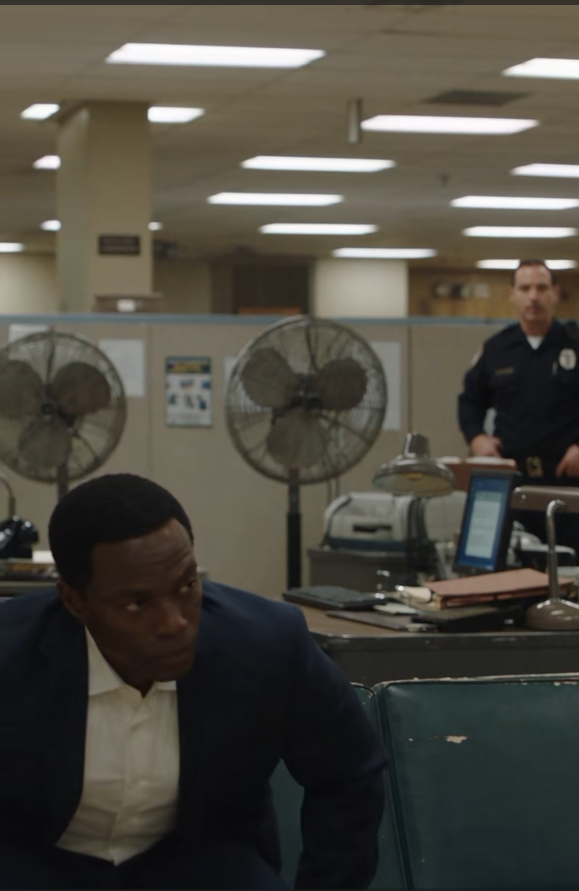
“What?”
“The evidence room.”
Part V — Final Confrontation
The evidence room had already been searched.
That was Kendrick’s first response.
Rourke shook his head.
“Not the part I mean.”
“What part do you mean?”
“Old property annex.”
“Off-site?”
“No.”
“Then where?”
Rourke looked toward the camera.
“Basement.”
Headquarters blueprints showed a basement storage level.
Agents had searched it.
Cleaning supplies.
Archived forms.
Broken furniture.
Old radio equipment.
No secret room.
Kendrick said, “We’ve been there.”
“You missed the cage.”
“What cage?”
“Behind the old property racks.”
Kendrick stared at him.
“Why wasn’t it on the floor plan?”
Rourke shrugged.
“Building’s old.”
“Who uses it?”
“O’Malley.”
“For what?”
“I never went inside.”
“Then how do you know?”
“I moved boxes there twice.”
“What boxes?”
“Evidence.”
Kendrick’s voice changed.
“From active cases?”
“I don’t know.”
“Were they logged?”
Rourke looked away.
“No.”
The room went very still.
“When?”
“First time maybe eight months ago. Second about three months.”
“Who told you?”
“O’Malley.”
“Who else was present?”
“A sergeant.”
“Name?”
Rourke gave it.
Kendrick wrote it down.
“What did O’Malley say?”
“Put these downstairs. Don’t make paper.”
There it was again.
The phrase.
Kendrick stood.
“Why didn’t you tell us earlier?”
Rourke’s face hardened defensively.
“I’m telling you now.”
“That wasn’t the question.”
“I didn’t know what you already had.”
“So you were bargaining.”
“Yes.”
At least he was honest.
Kendrick looked at him.
“If you’re lying—”
“I’m not.”
“If you’re trying to trade useless information for consideration—”
“I’m not.”
Kendrick leaned closer.
“Then understand something. We verify this before anybody promises you anything.”
Rourke nodded.
“Fine.”
Kendrick left the room.
The basement smelled of dust, concrete, and old paper.
Agents moved the property racks.
At first nothing.
Then one technician noticed that a section of shelving did not sit flush against the wall.
They emptied it.
Behind the lowest rack was a steel panel painted the same gray as the concrete.
No handle.
Just a keyed cylinder near the floor.
The key was not on any official facility ring.
A warrant amendment was obtained before forced entry.
Kendrick waited upstairs during the legal process.
That hour felt longer than the entire search.
When approval came, the panel was opened.
Behind it was a narrow storage cage.
Inside were six plastic evidence tubs.
Three cardboard banker’s boxes.
Two sealed envelopes.
And a small metal cash box.
Everything was photographed in place.
Kendrick entered only after technicians completed the first documentation pass.
He stood at the threshold.
One tub contained narcotics evidence with case numbers that should have been in the main property room.
Another contained cash envelopes.
Some labeled.
Some not.
One banker’s box held copies of business-payment records.
Not official ledgers.
Handwritten.
Dates.
Initials.
Amounts.
The second box contained complaint files marked closed.
The third held digital storage drives.
Kendrick looked at the technician.
“Any indication who created these?”
“Not yet.”
A federal evidence specialist opened the cash box under camera.
Inside were bundles of currency and a small notebook.
The notebook was not dramatic.
Black cover.
Cheap paper.
Neat handwriting.
Initials and numbers.
One set of initials appeared repeatedly.
T.R.
Rourke.
Kendrick stared at it.
That complicated everything.
He had said he never received money.
Maybe T.R. meant someone else.
Maybe it was a trap.
Maybe he had lied.
Kendrick photographed the page mentally and stepped back.
“Bag it.”
The specialist nodded.
Kendrick left the cage.
The lead agent followed.
“You saw it.”
“Yes.”
“You think it’s him?”
“I think initials are not a confession.”
“You’re defending him again.”
“No. I’m refusing to build a case from two letters.”
The agent stopped walking.
“Kendrick.”
He turned.
“You want to believe he finally told the truth.”
Kendrick’s eyes narrowed.
“I don’t want to believe anything.”
“You think because he admitted some things, he’s clean on the money?”
“I think evidence decides.”
“You’re too close.”
Kendrick stared at him.
The words landed because they were possible.
His own warning.
Prove. Don’t assume.
He said, “Then take me off the Rourke interview.”
The agent blinked.
“What?”
“Take me off it.”
“You don’t have to—”
“You just told me I may be too close.”
“I said—”
“And you may be right.”
Kendrick handed him his notebook.
“You run the next interview.”
The agent looked at the notebook.
Then at Kendrick.
“You sure?”
“No.”
“But?”
“But that’s the point.”
He walked away.
The notebook was analyzed.
T.R. did not stand for Travis Rourke.
The handwriting context linked the initials to a restaurant called The Ridge, one of the businesses under investigation.
That finding should have brought relief.
Kendrick did not let himself feel it until a second analyst confirmed.
Then the larger revelation came.
The business ledgers connected O’Malley directly to payments.
Not through inference.
Not through timing.
Through handwritten allocation notes.
Monthly totals.
Shares.
Names disguised by initials, but supported by phone records and deposits.
The hidden cage was the center of the conspiracy.
And O’Malley had known federal investigators were getting close.
The shredder had not been panic caused by the raid.
Shredding had begun before Kendrick entered the building.
Someone had warned him.
That changed the case again.
The operation had been compromised before Rourke ever threw the punch.
Kendrick returned to the timeline.
At 2:48 p.m., an internal computer accessed several complaint archives.
At 2:53, files were printed.
At 2:56, the shredder activated.
At 3:01, O’Malley placed a six-minute call.
To whom?
The number was not saved.
Agents traced it.
The call went to a prepaid phone recovered from a vehicle associated with one of the officers already under investigation.
But that officer had been on duty across town.
The phone itself had been left elsewhere.
A dead end.
Until metadata from command-office access logs showed something else.
Someone had used O’Malley’s credentials at 2:41 p.m.
O’Malley had been in a command meeting at that time.
Video confirmed it.
Someone else had his password.
The betrayal inside the department ran both directions.
O’Malley had created a loyalty system.
And someone inside that system had learned to use it against him.
Kendrick gathered the relevant officers’ access histories.
One stood out.
The second witness.
The one who initially lied about seeing Rourke hit him.
He had administrative systems access from a temporary assignment three months earlier.
He was A-list.
And at 2:41 p.m., his workstation had pinged the command network.
Kendrick felt the final shape of the case begin to form.
Not certainty.
A direction.
He requested another interview.
The officer came in without resistance.
He looked at Kendrick’s healing bruise and then away.
Kendrick sat across from him.
No anger.
No accusation.
Just documents.
“You amended your statement about Tuesday.”
“Yes.”
“You said you lied because you were afraid of Rourke and O’Malley.”
“Yes.”
“You had access to command administrative systems.”
The officer’s face changed slightly.
“For a temporary assignment.”
“You retained credentials.”
“I forgot I had them.”
Kendrick slid a log across the table.
“Your workstation accessed O’Malley’s account at 2:41 Tuesday afternoon.”