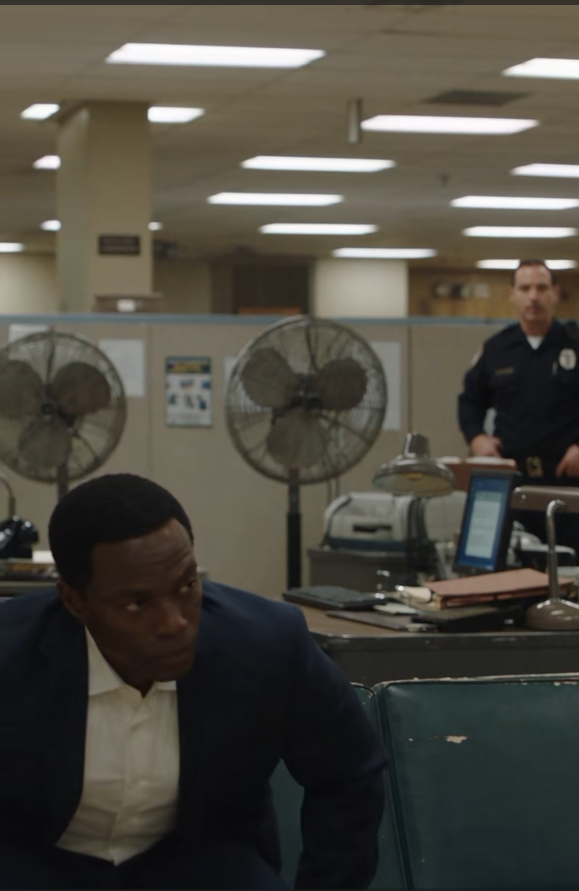
The officer looked down.
“I don’t know why.”
“Try again.”
Silence.
“At 2:48, complaint records were opened. At 2:56, shredding began. At 3:01, O’Malley called a prepaid phone.”
The officer said nothing.
Kendrick folded his hands.
“You warned him.”
The officer’s breathing changed.
“No.”
“You accessed his account.”
“No.”
“The log says otherwise.”
“I didn’t warn him.”
Kendrick watched.
The denial was specific.
Not I didn’t do it.
I didn’t warn him.
“Then what did you do?”
The officer closed his eyes.
Kendrick waited.
Finally, the man whispered, “I was trying to copy files.”
Kendrick said nothing.
“I knew something was wrong.”
“For how long?”
“Months.”
“Why didn’t you come forward?”
“You know why.”
“I know the answer you gave us before.”
The officer looked up.
“I was collecting proof.”
“Using stolen credentials.”
“Yes.”
“Without telling anyone.”
“Yes.”
“And you accessed files Tuesday because?”
“I heard O’Malley say federal people were coming in.”
Kendrick’s attention sharpened.
“When?”
“Maybe two-thirty.”
“To whom?”
“Sergeant in his office.”
“What exactly did he say?”
“He said, ‘We may have company this afternoon. Clean the desk.’”
Kendrick sat very still.
The officer continued.
“I panicked. I thought he was going to erase everything. I logged in to copy complaint records.”
“Did he catch you?”
“No.”
“Then why did shredding start?”
“I don’t know.”
“Did you tell anyone?”
“No.”
“Did you make the 3:01 call?”
“No.”
“Can you prove where you were?”
“I was at my desk.”
Video later confirmed it.
The officer had not warned O’Malley.
He had tried, clumsily and illegally, to preserve evidence.
And in doing so, he had left a trail that initially made him look like the leak.
Kendrick left the interview with less certainty than when he entered.
That was sometimes progress.
The true leak came from a place Kendrick should have considered earlier.
The court process.
Not a judge.
Not a prosecutor.
A clerk-system notification.
One of the warrants required technical coordination with city facilities personnel for the security lockout.
That coordination generated an internal municipal work order.
Most of the description was sanitized.
But one facilities supervisor had contacted police headquarters that morning to confirm an “electronic access override test.”
The message went to a generic command inbox.
O’Malley saw it.
He did not know the full operation.
But he knew enough to suspect.
That was why shredding began.
That was why he had been watching the clock before Kendrick ever arrived.
And that was why the 3:30 meeting mattered.
O’Malley had planned to use Kendrick.
Not attack him.
Not flee.
Talk to him.
Find out what the federal government knew.
Buy time.
Rourke destroyed that plan with one punch.
The irony was almost too clean.
O’Malley’s own culture of aggression had collapsed his opportunity to protect himself.
The officer he had rewarded for being forceful had acted exactly as he had been taught.
And triggered the lockout before the shredding was complete.
Kendrick stared at the timeline on the wall.
2:48.
2:56.
3:01.
3:12 Kendrick enters.
3:16 asNextlt.
3:16:03 lockdown.
Fourteen minutes.
If Rourke had done nothing, O’Malley would have had fourteen more minutes before the planned entry.
Fourteen minutes with access to files.
Fourteen minutes with a shredder.
Fourteen minutes with people under his command.
Enough time to destroy the notebook?
Move the basement boxes?
Call someone?
Maybe.
The punch had not created the case.
But it had preserved part of it.
Kendrick did not find that satisfying.
Systems like O’Malley’s survived because violence was unpredictable until the day it turned inward.
That was not justice.
It was consequence.
Part VI — Aftermath
The indictments came six weeks later.
O’Malley faced federal charges related to extortion, obstruction, evidence tampering, conspiracy, and civil-rights violations.
Multiple officers were charged based on their individual conduct.
Some entered plea agreements.
Some fought.
Rourke pleaded guilty to participating in coercive enforcement against targeted businesses and to a civil-rights offense tied to one earlier use-of-force incident uncovered during the investigation.
His asNextlt on Kendrick remained part of a separate proceeding.
His cooperation reduced his exposure but did not erase it.
Kendrick insisted on that distinction whenever people tried to simplify the story.
Rourke had helped investigators.
He had also harmed people.
Both facts were true.
The first officer who had immediately told the truth kept his job and later testified.
The second officer—the one who had lied, then admitted it—also testified, but his own conduct was reviewed administratively.
Fear explained his first lie.
It did not excuse it.
Several old complaints were reopened.
Businesses received notice that the city was reviewing enforcement actions against them.
Evidence connected to criminal defendants was reexamined.
Some convictions were challenged.
Some cases were dismissed.
Others held.
The damage did not disappear because arrests had been made.
That was the part press conferences rarely captured.
A corrupt system left paperwork behind long after the people were gone.
Three months after the raid, Kendrick returned to Oak Haven Police Headquarters.
The air-conditioning had been repaired.
That was the first thing he noticed.
The second was the lobby wall.
Fresh paint covered the spot where his shoulder had struck it.
The cracked vinyl bench was gone.
A new row of molded chairs had replaced it.
The building looked cleaner.
That did not mean better.
Buildings changed faster than cultures.
He checked in at the front desk.
The officer there was young and unfamiliar.
“Can I see ID, sir?”
Kendrick looked at him.
For half a second, the question brought back Rourke’s voice.
Identification.
Stand up.
Hands where I can see them.
Kendrick reached slowly toward his jacket.
The officer waited.
Nothing happened.
Kendrick produced his credentials.
The officer looked at them and handed them back.
“Thank you, Agent Hayes.”
Kendrick nodded.
“Thank you.”
Such a small thing.
A person asks.
Another person explains.
The explanation is allowed to finish.
He walked deeper into the station.
The first officer who had testified was waiting near the bullpen.
He looked healthier than he had during the raid.
Still cautious.
But different.
“Good to see you.”
“You too.”
They shook hands.
The officer glanced at Kendrick’s eye.
The bruise was gone.
“You heal okay?”
“Eventually.”
They walked toward the old conference room.
Several desks were empty.
Command photographs had been removed from the walls pending permanent replacements.
The officer said, “Feels strange.”
“What does?”
“Quiet.”
Kendrick looked around.
“That can be good or bad.”
The officer nodded.
“People are talking more.”
“Also good or bad.”
The officer smiled.
“You always answer like that?”
“So I’ve been told.”
They entered conference room two.
It was the same room where O’Malley had sat with an untouched water bottle and told Kendrick one punch did not prove institutional corruption.
Kendrick remembered his answer.
The institutional part was everybody watching.
Now there were new complaint protocols.
External review.
Automatic video retention rules.
Multiple-signature evidence transfers.
Changes written by lawyers and consultants and city officials trying to prevent the old system from rebuilding itself.
Some would work.
Some would become paperwork.
Kendrick knew enough not to confuse reform with permanence.
The officer sat across from him.
“They want me to apply for sergeant.”
Kendrick looked at him.