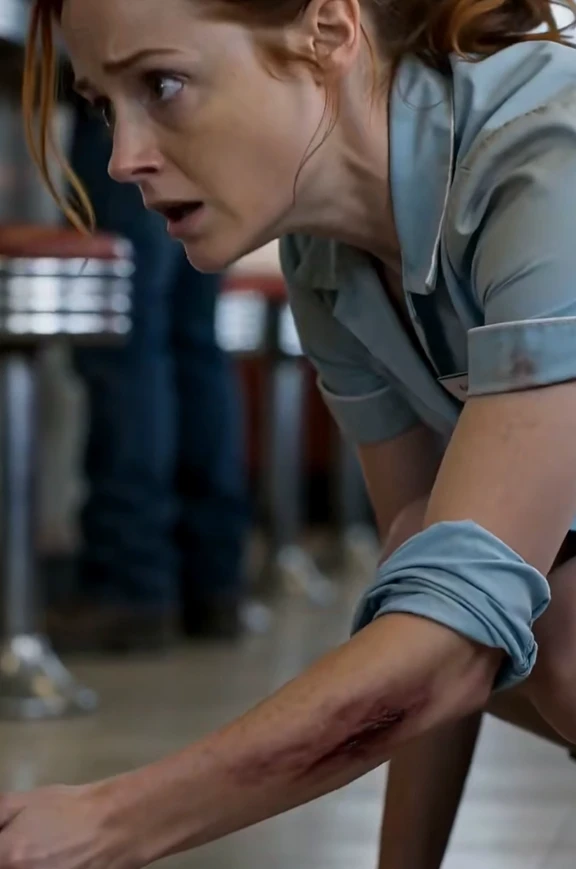
The old diner looked like the kind of place people forgot the moment they pulled back onto the highway — faded sign, cracked red booths, weak coffee, and a jukebox that still clung to songs from another lifetime. But on that pale Kansas afternoon, something changed the second the motorcycles came into view.
No One Thought They Were Watching. They Were Wrong.
The diner had been fading for years, but that afternoon it felt like it was holding its breath.
Mason’s Stop sat alone beside a long stretch of Kansas highway, its paint sun-bleached, its neon sign missing two letters, its windows reflecting only sky and road and the occasional passing truck. Inside, the world seemed older. The red vinyl booths were cracked. The coffee was strong enough to wake the dead. The jukebox near the restrooms still played songs that belonged to another generation. For some people, it was charming. For others, it was a place to stop, eat, and forget.
But on that pale, wind-brushed afternoon, **something invisible entered before the motorcycles did**.
A trucker near the window looked up first. A mother quieted her son without knowing why. A waitress at the register froze with a pen in her hand as the low **hum of engines gathered outside**—not chaotic, not reckless, but steady, controlled, united.
Then the door opened.
The bell above it rang.
And **twelve bikers walked in**.
No one spoke.
Not because the men looked violent, but because people carry stories in their heads, and leather vests and road-worn boots usually arrive before understanding does.
The first man inside removed his helmet slowly. He was in his fifties, broad-shouldered but not imposing, his dark hair threaded with gray. His face held the quiet wear of someone who had survived more than he talked about. His name was **Caleb Rourke**, and he looked around the room the way some men checked weather—calmly, carefully, reading what others missed.
“We’ll take the booths in the back, if that works,” he said. “Coffee for everyone.”
His voice was steady, respectful.
Not a threat. Not a test.
Just a man asking for coffee.
And somehow, **that changed the room**.
Conversations resumed in small, hesitant pieces. Silverware clinked again. A trucker returned to his pie. The tension didn’t vanish, but it loosened.
Behind the counter, a young waitress gave a polite nod and reached for the coffee pots.
Her name tag read **Lila Hart**.
Her smile was quick and practiced, and to anyone not paying close attention, she looked fine—efficient, composed, professional. But Caleb noticed the details that didn’t fit. **The way she favored her left leg slightly when she turned. The stiffness in her shoulders. The way her eyes moved, never settling for long, as if some part of her was always listening for danger.**
One by one, she filled cups at the bikers’ table. Most of Caleb’s men kept their voices low, respectful. They were road riders from Missouri on their way west for a memorial run. They’d seen enough of the world to know that people often feared them before speaking to them. So they made a habit of being gentler than expected.
Lila reached Caleb last.
“You all passing through?” she asked.
“For now,” Caleb said.
She gave the slightest nod, but before she could move away, a sharp male voice barked from the kitchen.
“Lila!”
It was just her name. Nothing more.
Yet **she flinched so hard the coffee cup slipped from her fingers**.
It hit the floor and shattered.
The whole diner jerked at the sound.
“I’m sorry,” she said quickly, kneeling at once. “I’m so sorry.”
As she crouched, her sleeve rode up.
Only for a second.
But Caleb saw enough.
**Dark bruising circled her wrist**, partly hidden beneath makeup, shaped like fingers. Not a bump. Not a fall. A grip.
Lila saw his eyes drop to it and yanked her sleeve down with a panicked motion that was far too fast to be casual.
Then Caleb saw something else.
In the reflection of the chrome napkin dispenser, the kitchen door had swung open a few inches. Just enough to show a man standing in the shadows. Thick neck. Heavy arms. Apron across his chest. Watching.
Not curious.
Watching.
Lila stood, breathing too carefully. “I’ll clean that up.”
Caleb only nodded. He didn’t ask questions. Didn’t expose what he had noticed. But when the man from the kitchen stepped out fully a minute later, Caleb understood the shape of the room.
He was in his late forties, solidly built, with a face made hard by anger practiced too often. His name tag said **Dale Mason**. Owner.
“You got a problem out here?” Dale asked, eyes on the bikers, not Lila.
“No,” Caleb said mildly. “Coffee’s good.”
Dale stared a second too long, then turned back toward the kitchen.
Lila kept working, but now Caleb saw how every movement in the diner bent around Dale. How the cook wouldn’t meet his eyes. How the teenage dishwasher stayed hidden. How Lila smiled only when he was looking, and how that smile vanished the second he turned away.
When the bikers finished, Caleb paid in cash.
As he stood, Lila came by with the receipt tray.
For the briefest moment, Caleb let his hand rest on the table and said quietly, “You all right?”
Her face didn’t change.
But her eyes did.
For one second, **raw terror flashed through them**.
Then she said, “Of course. Have a safe ride.”
Dale was watching from the counter.
Caleb nodded and walked out.
Outside, the wind moved dust across the lot. The men stood by their bikes, helmets in hand.
“Something’s wrong in there,” said Micah, one of the younger riders. “I saw her wrist.”
“So did I,” Caleb said.
“Call the cops?” another asked.
Caleb looked back at the diner windows. “And say what? That a waitress dropped a cup and looked scared? By the time anyone gets out here, he’ll have a story ready.”
Micah frowned. “So what do we do?”
Caleb’s gaze settled on the side entrance near the dumpsters, then on the upstairs apartment window above the diner where a curtain twitched and fell still.
“We come back tonight.”
---
They returned after dark.
Not roaring in.
Not circling the place.
Just two at a time over forty minutes, parking out of sight behind an abandoned feed store across the road.
The diner closed at nine. By ten, the sign was dark, but a weak yellow light still glowed upstairs.
Caleb and four others crossed the ditch behind the building on foot. Two more watched the road. Three remained by the bikes. The rest spread out where they could see both entrances.
No one carried guns.
Caleb had rules about that.
But every man there had lived enough life to know how to handle violence if it came.
From the back alley, they heard shouting through the thin kitchen window.
Dale.
And then Lila.
“No, please—”
Something slammed.
Micah moved first, rage flashing across his face, but Caleb caught his arm. “Not yet.”
Then they heard it.