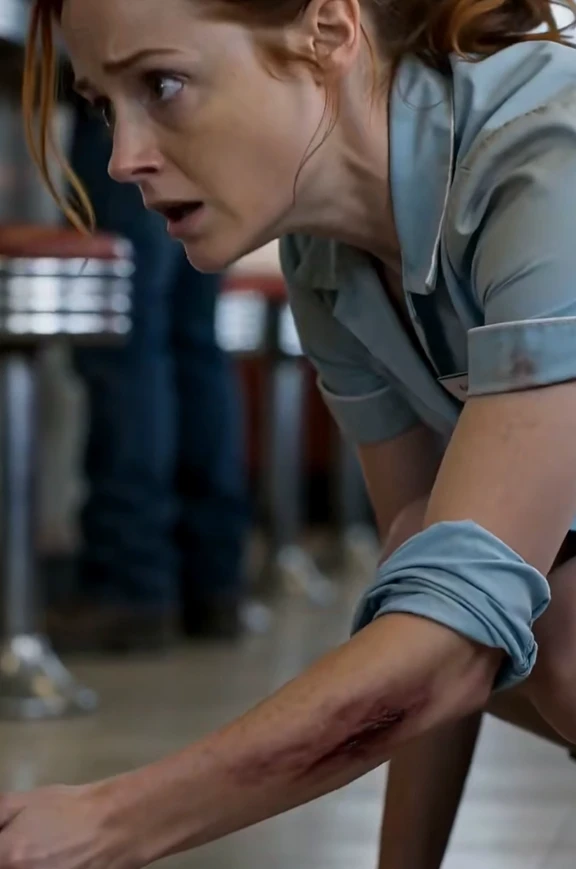
A muffled cry.
A child’s cry.
All six men froze.
Caleb’s expression hardened. “There’s someone else in there.”
That changed everything.
He stepped to the back door and tried the handle. Locked.
One of the others, Boone, produced a flat pry bar from inside his cut. “For jammed saddlebags,” he muttered.
Thirty seconds later, the back door opened without a sound.
The kitchen was dim, lit only by the hood light over the grill. A pan lay overturned on the floor. A chair had been knocked over. Voices came from the hall beyond.
Dale’s voice was low and venomous now. “You think those road rats are coming back for you? You think anybody cares?”
A small voice whimpered.
Caleb moved down the hall.
The door at the end was cracked open.
Inside was a cramped living room that doubled as an office. Lila stood near the sofa, one arm wrapped protectively around a little girl of maybe seven. The child had tangled brown hair and wide frightened eyes. Dale stood in front of them holding a leather belt wrapped around his fist.
Lila looked up first.
When she saw Caleb in the doorway, **shock hit her so hard she couldn’t even speak**.
Dale spun around. “What the hell—”
Caleb stepped fully into the room. “Put it down.”
Dale laughed once, ugly and sharp. “You break into my place and start giving orders?”
Behind Caleb, the other bikers filled the hallway.
The room changed.
For the first time that night, **Dale looked uncertain**.
“This is my daughter,” Lila said suddenly, voice shaking. “He said if I ever left, he’d take her. He said no one would believe me.”
Micah’s jaw tightened. Boone’s hands curled.
Dale pointed the belt like a weapon. “You all need to get out before I—”
Before he what?
The sentence never finished.
Because the little girl looked at Caleb and whispered, “Please don’t leave us.”
The room went very still.
Then Dale lunged.
He didn’t go for Caleb. He grabbed Lila by the arm and yanked her forward so violently she screamed.
That was his mistake.
Caleb crossed the room in two steps and drove Dale backward into the wall. The belt fell. Micah caught Lila before she hit the floor. Boone pulled the child away. Dale swung wild, full of panic now, but he was fighting men who had spent years surviving worse than barroom bravado and domestic cruelty. They pinned him fast—one arm twisted, face shoved into the carpet, every ounce of bluster leaking out of him in curses and choking threats.
“Call the sheriff,” Caleb said.
One of the men already had.
It took sixteen minutes for deputies to arrive.
Long minutes.
Long enough for Lila to sit at the edge of the sofa holding her daughter in both arms, trembling so hard the cushions shook. Long enough for Caleb to drape his own riding jacket over the child’s shoulders. Long enough for Dale to spit lies into the carpet about trespassing, asNextlt, biker gangs, anything he thought might save him.
Then the first deputy stepped inside.
And the whole story should have become simple.
It didn’t.
Because the deputy who entered the room took one look at Dale on the floor and said, “What in God’s name happened here?”
Lila went white.
Not pale. White.
Caleb turned toward her.
She was staring at the deputy with a horror deeper than the one she’d shown Dale.
“Don’t,” she whispered.
The deputy’s name tag read **Sheriff Tom Berringer**.
He looked from Dale to Lila to the men in leather crowding the hallway, and Caleb saw the recognition pass between him and Dale in an instant. Not surprise.
History.
“Untie him,” Berringer said.
“No,” Lila said.
The sheriff ignored her.
“Untie him now.”
Caleb didn’t move. “We found him with a belt in his hand threatening her and the child.”
Berringer’s jaw flexed. “And I found six men breaking into a residence and asNextlting a business owner. So I’ll say this once.”
Lila made a broken sound in her throat.
Then, with shaking hands, she reached under the sofa cushion and pulled out a stack of papers tied with twine.
“Don’t make me do this,” she said to the sheriff.
Berringer froze.
Dale started swearing.
Lila’s voice cracked, but she kept going. “I kept copies. Every payment. Every delivery. Every girl.”
The room went silent.
Caleb stared at her. “What?”
Tears spilled down her face. “The diner wasn’t just a diner.”
She looked at the sheriff.
Then at Dale.
Then at the child in Boone’s arms.
And the truth finally surfaced.
For three years, trucks had stopped at Mason’s Stop after midnight. Not the regular freight routes. Special ones. Girls moved through back roads, undocumented and unnamed, traded between safe houses and interstate routes. Dale handled the location. Sheriff Berringer kept law enforcement away. And Lila—
Lila had not been Dale’s wife.
She had been one of the girls.
Taken at nineteen.
Broken slowly.
Kept alive because Dale found out she was pregnant.
“She’s my daughter,” Lila whispered, stroking the little girl’s hair. “I stayed because if I ran, they said they’d sell her when she turned eight.”
Micah staggered back like he’d been hit.
Caleb felt cold move through his chest.
The papers in Lila’s hand contained dates, plate numbers, names, cash amounts, hidden routes. She had copied them for years in secret, waiting for a moment she was never sure would come.
“You were waiting,” Caleb said softly.
Lila shook her head. “No. I was surviving.”
Dale began shouting from the floor, all control gone now. “She’s lying! She’s crazy! She belonged to—”
Caleb hit the wall beside Dale’s head so hard the framed clock crashed to the floor.
The room shook silent again.
Sheriff Berringer reached slowly for his weapon.
Bad choice.
Three bikers moved before the leather even cleared his holster. They disarmed him and shoved him against the filing cabinet. The old metal drawers rattled open, spilling folders across the floor.
Inside those folders were photographs.
Receipts.
Maps.
And one sealed evidence envelope that should never have been in a roadside diner office.
Berringer closed his eyes.
He knew it was over.
By the time state police arrived—called not by the sheriff but by one of Caleb’s riders from outside—the story had become too large to bury. The papers were real. The hidden ledgers matched the cabinet files. The child existed. Lila’s injuries existed. And under the floorboards of a locked storage room behind the freezer, investigators found passports, burner phones, and enough evidence to unravel a trafficking route across three states.
The diner made national news within days.
People called the bikers heroes.
Caleb hated the word.
Heroes arrived in time. Heroes saved people before years were stolen from them.
All he had done was notice a wrist.
A flinch.
A look.
Still, some endings do not arrive with clean edges. They come in pieces.
Lila and her daughter were moved into protective custody. State prosecutors built a case that stretched far beyond Kansas. Dale Mason never saw daylight again. Sheriff Berringer disappeared into a federal prison so deep and quiet that even his name seemed to rot there.