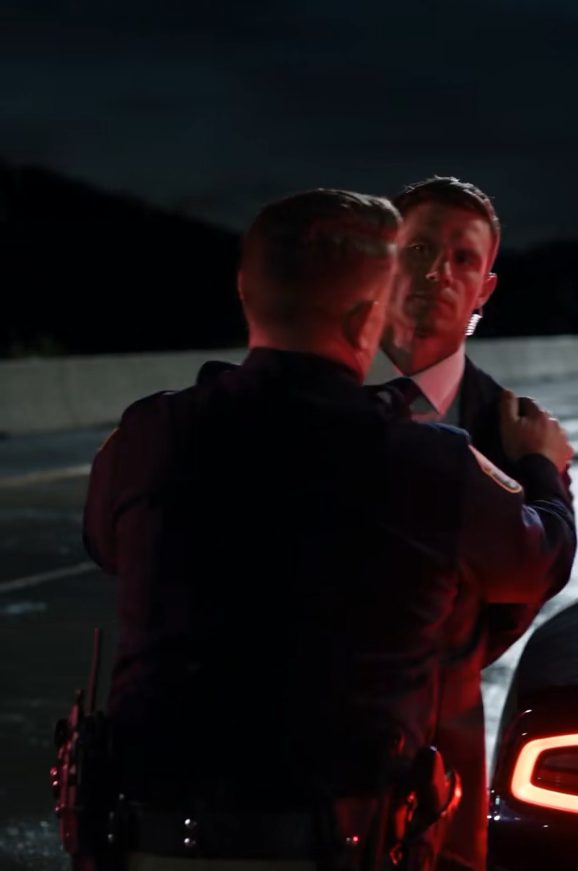
Part I — The Badge That Broke the Line
The steel edge of the handcuff cut into my left wrist at the exact moment Agent Harris told me the primary motorcade was ninety seconds away.
“Echo One, this is Command. Ninety seconds to your checkpoint. Confirm southbound lanes are locked.”
The words came through the acoustic tube in my right ear while Officer Mitchell drove me chest-first against the trunk of my unmarked sedan.
Cold sheet metal pressed through my suit jacket. My shoulder twisted under his grip. I tried to move just enough to keep the communications wire from snagging on my collar.
Mitchell took the movement for resistance.
His knee struck the back of my thigh.
“Quit moving.”
“I’m trying to keep you from making this worse.”
“That so?”
He dragged my right arm behind me.
The second cuff snapped shut.
The pressure hit the nerve along my wrist, and two fingers started tingling immediately.
Pain was information. Nothing more.
The problem was the countdown.
I had been positioned at Checkpoint Delta as the southbound advance unit for Eagle route. My job was simple in description and unforgiving in practice: arrive before the protectee, verify the closure, inspect the intersection, confirm the local barricades, and make sure the route remained sterile until the primary package passed.
A motorcade does not move through hope.
Every intersection is cleared. Every overpass is watched. Every access ramp is controlled. Every construction entrance, median break, frontage road, service lane, and shoulder becomes somebody’s responsibility.
At that moment, the southbound approach was mine.
And I was handcuffed to the wrong side of my own vehicle.
Mitchell tightened the cuffs one notch more.
“You think a black suit and tinted windows let you do whatever you want on my highway?”
His voice had the flat certainty of a man who believed the argument had ended when he touched the steel.
“You need to look at your dispatch screen,” I said.
“I looked at what I needed to look at.”
“No, you didn’t.”
His grip stiffened.
I kept my voice level.
“You are inside a federally secured transit line. Move your cruiser and contact dispatch.”
He gave a short laugh.
“You were doing eighty-five.”
“The road is closed.”
“Not for you.”
“For everyone.”
That made him angrier.
Not visibly at first. His expression barely moved, but his hand shifted higher on my shoulder.
“You want to tell me I don’t know whether my own interstate is closed?”
“Yes.”
He shoved me harder against the trunk.
The impact drove air from my lungs.
For half a second, my cheek rested against the cold paint.
Then I saw his shoulder radio.
The green power indicator was dark.
I stopped thinking about the cuffs.
A highway patrol officer could lose radio coverage. A battery could fail. Equipment could malfunction.
But his lapel microphone was dead too.
No static.
No dispatch traffic.
No neighboring unit checking status.
The inside of his cruiser was visible beyond him. The mobile terminal glowed blue-white through the windshield, but the radio stack beneath it was dark.
Mitchell had taken his vehicle off the voice network.
Deliberately.
That changed the problem.
I turned my head as far as the position allowed.
“Why is your radio off?”
He paused.
Only for a fraction of a second.
But I felt it.
Then he said, “You worry about yourself.”
That answer told me more than anything else he had said.
A routine officer might be mistaken.
A stubborn officer might refuse to listen.
A reckless officer might overreact.
But a patrolman on an isolated interstate does not voluntarily sever his connection to dispatch during a traffic stop unless he has made a conscious decision that he does not want somebody else involved.
He had not simply stumbled into Eagle route.
He had decided to handle something alone.
In my ear, Harris came back.
“Echo One, confirm.”
I flexed my fingers behind me.
The transmitter switch was hidden inside my jacket near the lower edge of my tie.
I could almost touch it with the side of my hand.
Almost.
“Echo One.”
Harris sounded different now.
Not alarmed.
Sharper.
He knew me well enough to recognize silence.
Mitchell began searching me.
His hands slapped across the outside of my jacket, then down both sides of my waist.
He passed directly over the leather credential case in my inside pocket.
If he had opened it, the encounter could have ended ten seconds later.
Instead, his attention moved upward.
To the wire.
He saw the clear acoustic tube disappearing beneath my collar.
His expression changed.
“What’s this?”
“Don’t pull that.”
Naturally, he pulled it.
He hooked a finger under the tube and yanked.
The molded earpiece came free.
A faint click sounded against my collarbone as it dropped.
Mitchell held the wire between two fingers.
“Who are you talking to?”
I didn’t answer.
He leaned closer.
“You carrying a police scanner?”
“No.”
“You running interference for somebody?”
“No.”
“A cartel?”
Despite everything, I almost looked at him.
“A cartel?”
“You tell me.”
His breath smelled like stale coffee.
I looked instead at the earpiece hanging against my shoulder.
The communications system had been designed around predictable failures.
A dead battery.
A lost signal.
An injured agent.
A forced disconnection.
If an advance unit disappeared without checking out, Command did not spend valuable time repeatedly asking whether everything was fine.
The loss of my connection had already transmitted a fault condition.
Mitchell had not silenced me.
He had announced my problem to everybody who mattered.
A faint voice leaked from the hanging earpiece.
“Echo One unresponsive.”
Mitchell heard something.
His eyes shifted toward the wire.
I heard the rest.
“All units, collapse on checkpoint Delta. Go hard.”
I looked down the highway.
The southbound lanes stretched black beneath the overpass lights, completely empty because civilian traffic had been diverted miles earlier.
Nothing moved.
Nothing except the alternating red and blue light washing over the pavement from Mitchell’s cruiser.
He followed my gaze.
“What?”
I said nothing.
The first vibration came through the soles of my shoes.
Small.
Almost imaginary.
Mitchell felt it too.
His head tilted.
Far beyond the crest of the hill, the road began to hum.
One vehicle moving fast creates noise.
Twelve armored vehicles moving fast in disciplined spacing create pressure.
The vibration deepened.
Mitchell looked toward the hill.
“What the hell is that?”
I took a slow breath.
“Move your cruiser.”
He looked back at me.
For the first time, the confidence in his face had developed a crack.
“I asked you who you’re talking to.”
The crest of the highway turned white.
Headlights appeared in pairs.
Then more.
Then an entire wall of them.
Mitchell’s hand dropped from the communications wire.
The approaching formation filled both secured lanes.
Black armored SUVs.
Advance vehicles.
Support units.
A counter-asNextlt vehicle.
No sirens.
No random lane movement.
No hesitation.
Just disciplined speed.
Mitchell stared.
The roar became physical.
His cruiser sat sideways across the right lane.
My sedan occupied part of the shoulder.
And I stood cuffed between them.
“Jesus,” Mitchell whispered.
I turned my head toward him.
“The United States Secret Service.”