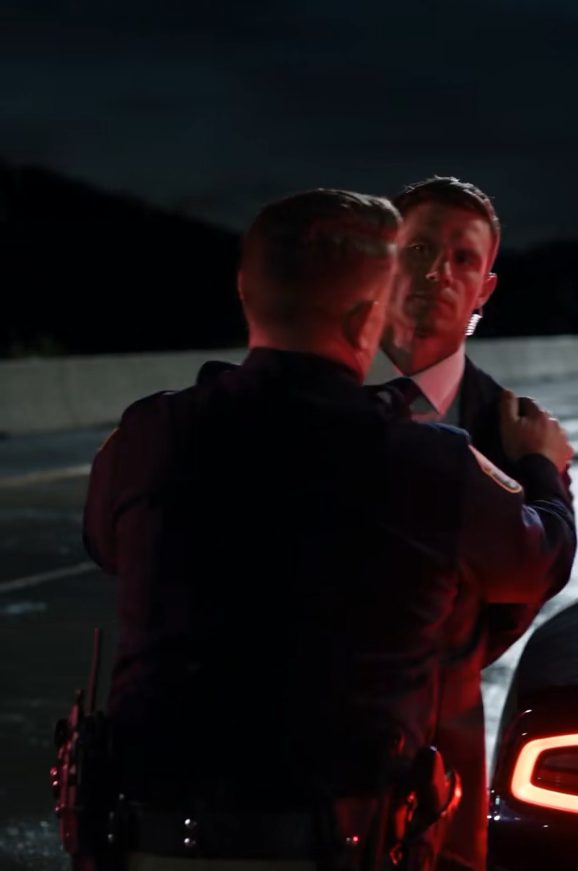
For one second, he didn’t move.
Then training finally overcame pride.
He stepped away from me.
Too late.
The lead tactical SUV braked hard fifty yards out.
The next vehicles split around it with practiced precision.
Doors opened before the wheels had fully stopped.
Men and women in dark tactical gear moved into positions around us, weapons controlled and pointed toward safe angles but ready.
“Hands visible!”
Mitchell raised both hands immediately.
“Officer, do not move!”
“I’m highway patrol.”
“We know.”
Harris came out of the second vehicle.
He did not run.
Harris almost never ran.
Running suggested you were late.
He moved quickly enough that everybody else adjusted around him.
He was forty-eight, broad-shouldered, iron-gray beginning at the sides of his hair. He had the unnerving habit of becoming quieter as situations became worse.
His eyes went first to Mitchell.
Then to me.
Then to the cuffs.
“Status.”
“Uninjured,” I said.
“Route?”
“Delta not confirmed.”
Harris looked once toward the intersection ahead.
“Primary?”
A voice answered over his earpiece.
“Holding at alternate mark.”
That mattered more than anything else.
The motorcade had not driven blind into Delta.
Protocol had done what protocol was supposed to do.
Harris turned to one of the agents beside him.
“Verify intersection. Two teams.”
They moved.
Only after that did he step behind me.
“Key?”
Mitchell swallowed.
“Front left pouch.”
An agent removed it without letting him lower his hands.
Harris unlocked one cuff.
Blood returned to my fingers in hot needles.
He looked at the abrasion around my wrist.
“You sure you’re good?”
“I’m good.”
“You look irritated.”
“I’m handcuffed.”
“One explains the other.”
It was Harris’s version of sympathy.
He removed the second cuff.
Across the highway, two agents had Mitchell away from his cruiser now.
One checked him for weapons while another secured the patrol car.
Mitchell did not resist.
He seemed smaller than he had three minutes earlier.
Not physically.
Context had changed around him.
That happens fast.
The same uniform that had dominated an empty road now looked very different inside a federal protective formation.
Harris picked up my dangling earpiece.
“You disconnect this?”
“No.”
His eyes shifted toward Mitchell.
“He did.”
“Before or after you identified yourself?”
“I told him it was a federally secured route. He never checked credentials.”
“Why?”
“He wasn’t interested in my wallet.”
Harris looked toward the patrol cruiser.
Then he noticed what I had noticed.
“No radio traffic.”
“He killed the set.”
Harris stopped.
“You saw him do it?”
“No. It was already off when I was against the trunk.”
“Equipment failure?”
“Lapel unit was dead too.”
Harris stared at the cruiser for another second.
Then he touched his earpiece.
“Command, preserve this scene. Nobody touches the patrol vehicle beyond safety requirements. Notify county command we need a supervisor and internal review.”
Mitchell heard him.
“Wait.”
Harris turned.
Mitchell lowered his hands a fraction.
An agent immediately corrected him.
“Keep them up.”
Mitchell obeyed.
His voice had changed.
Less authority. More urgency.
“My radio wasn’t working.”
I looked at him.
That was not what he had said before.
Harris noticed too.
“Wasn’t working?”
“Signal issue.”
“On a digital trunked system?”
“I was having problems.”
“Then why was the power off?”
Mitchell’s mouth closed.
Harris did not push him.
Not there.
Not beside a live protective route.
A call came over the net.
“Delta clear. Closure verified.”
Harris looked at me.
“You satisfied?”
I checked the intersection myself.
Barricades in place.
Cross traffic locked.
Local units where they were supposed to be.
No pedestrians.
No unsecured vehicle.
Everything had been right except the one thing nobody had planned for.
Mitchell.
“Delta green.”
Harris transmitted it.
Seconds later, the formation began to change.
The tactical vehicles repositioned.
The primary package, held outside the compromised segment, resumed movement.
I stood on the shoulder with my wrist burning while the motorcade came through.
The first vehicles passed at speed.
Then the armored limousine.
Then support.
To the people inside that moving security bubble, nothing visible had happened.
That was the point.
Good protection often looks like nothing happened.
The primary cleared Delta in less than twenty seconds.
Tail vehicles disappeared beyond the next rise.
The highway became quiet again.
Only then did Harris look back at Mitchell.
“Now,” he said, “we figure out why you were here.”
Part II — The Ninety-Second Problem
By sunrise, the incident had become paperwork.
That sounds anticlimactic until you understand what federal paperwork looks like after somebody penetrates a protective perimeter.
Every minute has to exist somewhere.
Who knew what.
Who moved where.
Which systems were active.
Which radios transmitted.
Which cameras recorded.
Which barriers were staffed.
Which decision altered the route.
Memory is not enough.
You build the event from independent evidence until the story no longer depends on anybody’s version of it.
We were using a temporary command facility attached to a municipal operations building twelve miles from the checkpoint.
I sat in a windowless conference room with a paper cup of bad coffee and a red mark around my wrist.
Harris stood at the far end of the table reading three screens at once.
Neither of us had slept.
“You should get that looked at.”
I glanced at the abrasion.
“It’s a cuff mark.”
“It’s swollen.”
“I’ve seen swollen.”
“Very reassuring.”
He tapped a tablet.
“Tell me the stop again.”
“I already recorded the statement.”
“Tell me again.”
So I did.
I gave him the sequence without interpretation.
I cleared the previous intersection.
I entered the southbound sterile zone.
Mitchell’s cruiser appeared from a maintenance access lane.
He accelerated behind me.
Emergency lights activated.
I initially assumed he was a local unit repositioning.
He signaled me to stop.
I pulled to the shoulder because we had standing orders not to create unnecessary conflict with local law enforcement inside the route.
He approached aggressively.
I identified the closure.
He ordered me out.
I repeated that I was a federal advance unit.
He placed me against the car.
He cuffed me.
He ignored my credential case.
He removed the earpiece.
Harris interrupted.
“What did you say when he first came to your window?”
“Federal protective movement. Check your dispatch.”
“Did you say Secret Service?”
“No.”
“Why?”
“I was reaching for credentials.”
“He prevented you?”
“He ordered my hands onto the steering wheel.”
Harris nodded.
“Then?”
“He told me to exit.”
“And you did.”
“I had a local officer with a sidearm standing three feet from the door during a live movement. I wasn’t going to turn a misunderstanding into a weapons problem.”
“That was the right call.”
“I know.”
He gave me a look.
I drank the coffee.
It was worse after it cooled.
“What bothers you?” he asked.
“The radio.”
“Obviously.”
“No. The timing.”
Harris waited.
I pointed toward the route map on the wall.
“He entered the highway from a maintenance cut less than a mile behind me. He didn’t come up through normal traffic because there was no normal traffic. Civilian closure was already active.”
“So?”
“So why was he there?”
Harris turned toward the map.
County command had given us a patrol roster during initial planning.