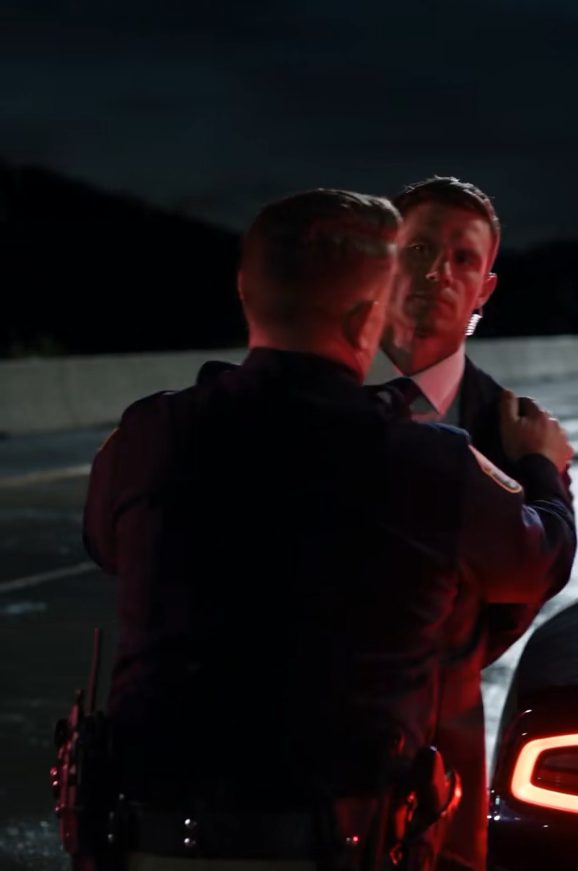
Mitchell’s attorney intervened.
“I think that characterization goes beyond—”
Mitchell lifted one hand.
“It’s fair.”
His attorney looked at him.
Mitchell kept his attention on the official.
“I thought if I called it in, they’d tell me to disengage before I knew what I had.”
“You were told to hold position.”
“Yes.”
“You turned off your radio after receiving that instruction.”
“Yes.”
“Why?”
Mitchell glanced toward me for the first time.
“Because the plate wasn’t right.”
I held his gaze.
The official turned toward me.
“Agent, was the plate valid?”
“Yes.”
“Was the county verification current?”
“No.”
There was movement around the table.
Small.
Pens paused.
People looked up.
Mitchell did too.
The official asked, “Explain.”
I did.
The original advance sedan had been removed from service hours before the movement.
A replacement vehicle was assigned.
Federal fleet registration was valid.
Internal verification was complete.
But the local interoperability database had not yet received the updated vehicle token.
“So Officer Mitchell received an ambiguous return?”
“Yes.”
Mitchell’s attorney leaned forward.
“That seems significant.”
“It is,” I said.
Harris did not look at me.
The attorney continued.
“Would you agree the return could reasonably cause an officer to question whether the plate was legitimate?”
“Question it? Yes.”
Mitchell looked surprised.
The attorney saw an opening.
“And investigate.”
“Yes.”
“And stop the vehicle.”
“Not inside a restricted federal corridor after dispatch explicitly tells him to hold.”
The attorney stopped.
I continued.
“A questionable database return justified verification. It did not justify disabling communications, disabling recording, rejecting dispatch, entering a protected route, refusing to examine credentials, and physically restraining an identified federal advance agent.”
Mitchell looked down.
I turned toward him.
“The plate gave you a reason to ask a question. You turned it into permission to reject every answer.”
No one spoke for a moment.
The state official asked Mitchell, “Why didn’t you inspect the credential case?”
Mitchell exhaled through his nose.
“Because I believed it could be counterfeit.”
“Did you run the agent’s name?”
“No.”
“Did you contact a federal operations center?”
“No.”
“Did you contact county command by alternate means?”
“No.”
“Did you request another unit?”
“No.”
“What verification did you actually intend to perform?”
Mitchell had no immediate answer.
That was the center of it.
Not suspicion.
Suspicion is part of police work.
The problem was that Mitchell had constructed a situation in which no evidence could disprove his suspicion.
If dispatch confirmed me, dispatch was gullible.
If credentials confirmed me, credentials could be fake.
If federal plates confirmed me, plates could be counterfeit.
If I mentioned the secured route, I was using jargon to intimidate him.
Every path led back to the conclusion he had chosen at the start.
Finally Mitchell said, “I wanted control of the scene.”
I believed him.
The room seemed to believe him too.
The official leaned back.
“And did you have control?”
Mitchell looked toward the frozen image on the screen.
Twelve armored vehicles surrounded his cruiser.
“No.”
The answer was quiet.
For the first time since the highway, I saw something in him that wasn’t defiance.
Not humiliation exactly.
Recognition.
The state official moved on to the motorcade response.
That portion went better.
My communications failure was detected.
Command correctly classified Echo One as compromised.
The primary package was held before Delta.
Tactical assets collapsed on the checkpoint.
A secondary visual inspection cleared the route.
The motorcade resumed.
No protectee exposure occurred.
No civilian vehicles entered the secured corridor.
No weapon was discharged.
No one sustained more than minor injury.
Operationally, the protective response worked.
Then came the question I knew Harris had been waiting for.
“What would have prevented the initial conflict?”
A county commander answered first.
“Officer compliance.”
True.
Not enough.
A federal planner said, “Positive vehicle data synchronization before route movement.”
Also true.
A state systems representative said, “Integrated alerting for fleet substitutions.”
The conversation became technical.
Databases.
Latency.
Credential verification.
Route notifications.
Radio patches.
The kind of language that makes failures sound mechanical even when human decisions created them.
I looked at Mitchell.
He was listening.
But something in his expression told me he was hearing a different conversation.
A room of people explaining why his decision had been understandable.
Not justified.
But understandable enough that the systems could be blamed.
The distinction mattered.
I raised my hand slightly.
The official nodded.
“There was another prevention point.”
“What?”
“Officer Mitchell could have left his radio on.”
Silence.
I continued.
“We should fix the database delay. We should improve vehicle-swap notifications. We should improve local verification. But none of those systems can help an officer who deliberately removes himself from them.”
Mitchell looked directly at me.
I wasn’t finished.
“And there is a federal lesson too.”
Harris finally turned his head.
I knew what he was thinking.
Choose carefully.
“We treat interoperability as a technical problem,” I said. “It isn’t. It’s a trust problem. We assumed that because local dispatch had our route information, local personnel would treat dispatch as authoritative. Officer Mitchell assumed the opposite.”
The county commander frowned.
“So what are you recommending?”
“Positive acknowledgment from every unit assigned near the sterile zone. Not just the agency. The unit.”
“That’s resource-heavy.”
“So was last night.”
Nobody argued with that.
The review lasted another three hours.
When it ended, Mitchell remained seated while everyone else began collecting papers.
I was almost at the door when he spoke.
“Agent.”
I stopped.
His attorney was still beside him.
Harris paused ten feet away.
Mitchell looked at my wrist.
The mark had darkened into a narrow bruise.
“I didn’t know who was in the motorcade.”
“I know.”
“I wasn’t trying to get anybody hurt.”
“I know that too.”
He seemed to expect more.
I didn’t give it.
Then he said, “You think I’m an idiot.”
“No.”
That surprised him.
I walked back toward the table.
“I think you were afraid of being wrong in the same way twice.”
His face tightened.
I had read the prior incident file.
After the contractor stop, Mitchell had become a joke in his unit for a while.
Federal car, federal plates, legitimate driver, and Mitchell refusing to release him.
There had been emails.
Training notes.
Informal ridicule.
He believed the lesson was that nobody else took counterfeit government vehicles seriously.
The actual lesson had been that verification mattered.
He had heard only the part that protected his pride.
“You saw my plate return,” I said, “and decided this was your second chance.”
Mitchell looked away.
“That doesn’t make you stupid.”
“What does it make me?”
“Dangerous for ninety seconds.”
He absorbed that.
I turned to leave.
“Agent.”
I stopped again.
His voice was quieter.
“If you had gotten to your credentials…”
“I was trying.”
“I know.”
“No. You know now.”
That ended the conversation.
Part V — The Second Route
Three weeks later, I stood beside another black sedan before sunrise and stared at a plate that had not synchronized.
I almost laughed.
Almost.
The protectee was scheduled to move in forty-two minutes.
Different city.
Different route.
Same multi-agency architecture.
The replacement sedan had been assigned at 3:10 a.m. after a tire-pressure monitoring fault in the original vehicle.