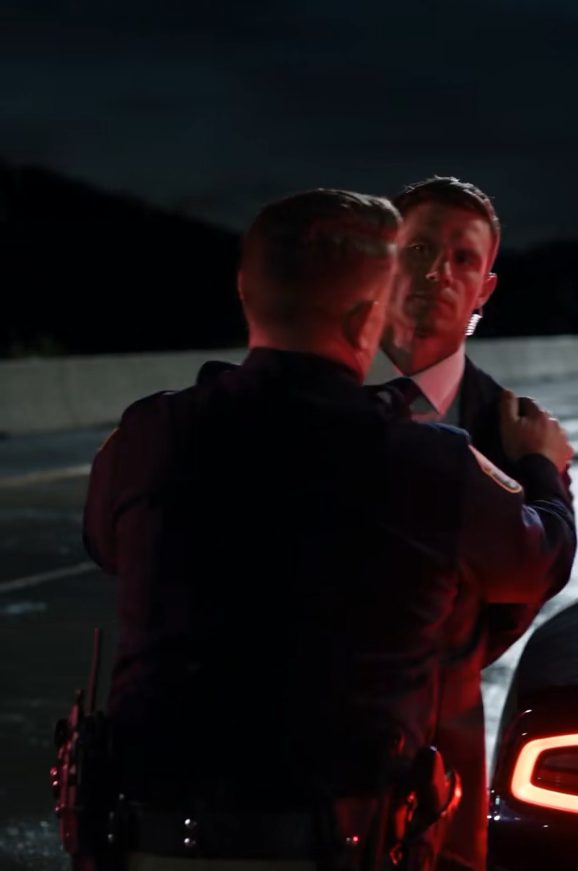
I stared at him.
“He acknowledged?”
“No.”
“He turned off the radio.”
“Seven seconds after dispatch called.”
There was no mystery left in that part.
Mitchell had not been confused by a dead system.
He had rejected an answer before it arrived.
“Then he disabled his camera.”
“Thirty-four seconds later.”
“Then left his assigned sector.”
“He was already outside it.”
I looked at the map.
“Why did AVL freeze?”
“That one is more complicated.”
“Meaning?”
“His vehicle modem dropped when he disabled the primary radio unit. It’s an older integrated configuration. County maintenance confirmed it.”
“So he didn’t separately disable tracking.”
“No.”
One apparent clue disappeared.
The situation became less sinister.
It did not become less serious.
“Did he know about the protective movement?”
“Not the principal. County personnel were given restricted traffic instructions. Mitchell knew there was a federal closure but not who was moving through it.”
“So he saw a federal car inside a federal closure, got a pending database result, was told by dispatch to wait, shut off the radio so nobody could stop him, killed his camera, entered the closure, and detained the driver.”
“That is his account.”
“He makes himself sound worse than a conspiracy would.”
Harris almost smiled.
“Conspiracies usually have planning.”
“What did he think I was doing?”
“Impersonating a federal officer.”
“Why?”
“He says real federal agents would have stopped when ordered.”
“I did stop.”
“He means complied without questioning him.”
I looked at Harris.
“That’s his standard?”
“Apparently.”
“Then he’s lucky he hasn’t arrested a judge.”
The sandwich remained unopened.
Harris pushed the interview summary toward me.
I read the relevant section.
Mitchell’s statements were defensive but coherent.
He had not believed the database lag was normal.
He had believed dispatch would accept federal assurances too quickly.
He had shut down the radio because he wanted to “verify independently.”
He had disabled the camera because he believed the prior complaint had been shaped unfairly by administrators who watched video “without understanding the street.”
Most revealing was his explanation for not checking my credential case.
I had to read it twice.
He said he did not trust credentials carried by a suspected impersonator.
I looked at Harris.
“So the evidence that could prove I was legitimate was meaningless because he had already decided a criminal could fake it.”
“That appears to be his reasoning.”
“That’s circular.”
“Most bad decisions become circular if you give them enough time.”
I kept reading.
Mitchell insisted he had not known the motorcade was near.
He believed the closed highway gave him an ideal environment to conduct the stop without traffic interference.
That explained the timing in the worst possible way.
He had not chosen ninety seconds before the primary package because he wanted to compromise it.
He had chosen that moment because the road was empty.
I put down the paper.
“So no plot.”
“Not that we’ve found.”
“No accomplice.”
“No evidence.”
“No target other than me.”
“Correct.”
I should have felt relieved.
Instead, I felt unsettled.
Malice is easier to design against.
You can investigate it.
Track it.
Disrupt it.
But Mitchell had done almost the same operational damage through a private conviction that the normal safeguards were obstacles to his judgment.
He had turned off every system capable of correcting him.
Harris watched me.
“You’re not satisfied.”
“He nearly put the primary into an unsecured checkpoint because he wanted to prove a plate return wrong.”
“The primary never entered.”
“That’s not the point.”
“It’s partly the point.”
I looked at him.
He tapped the paper showing the delayed registration.
“Your vehicle was not properly reflected in the county verification layer.”
“That didn’t cause him to turn off his radio.”
“No.”
“Or his camera.”
“No.”
“Or ignore dispatch.”
“No.”
“But?”
“But we gave him an ambiguity.”
I felt my irritation sharpen.
“A pending synchronization notice is not probable cause to penetrate a federal closure.”
“I didn’t say it was.”
“You’re about to tell me we share responsibility.”
“No.”
Harris leaned forward.
“I’m about to tell you responsibility and vulnerability are not the same thing.”
That stopped me.
He continued.
“Mitchell is responsible for Mitchell. His decisions are his. But our process produced a vehicle that local systems could not immediately validate during a multi-agency movement.”
“The swap happened late.”
“I know.”
“We verified it internally.”
“I know.”
“County had the VIN.”
“Eventually.”
I understood where he was going.
I didn’t like it.
“That needs to be in the review.”
“Yes.”
“And if it is, somebody will decide the vehicle swap caused the incident.”
“Somebody lazy might.”
“So we give Mitchell an excuse.”
“No. We give the next agent a better system.”
I looked down at the red mark on my wrist.
Harris’s voice softened slightly.
“You can want him held accountable and still admit the environment made his bad judgment easier.”
“I know.”
“Do you?”
I said nothing.
He stood.
“The joint review is tomorrow.”
“County and federal?”
“And state.”
“Mitchell?”
“He’ll be there with representation.”
I finally opened the sandwich.
“You expecting fireworks?”
“No.”
That meant yes.
Part IV — What the Camera Would Have Seen
The joint review took place in a state operations building with too much glass and not enough privacy.
Mitchell sat at the opposite side of a long conference table.
He was not in uniform.
Gray suit.
White shirt.
No tie.
Without the campaign hat, duty belt, and patrol lights behind him, he looked younger than I remembered.
Tired too.
His attorney sat on his right.
County command occupied one side of the room. Federal protective operations occupied the other.
Harris sat beside me.
A state review official opened the session with the sentence everybody uses when they want a room full of defensive professionals to stop acting defensive.
“This is not a disciplinary hearing.”
No one believed him.
Technically, it was true.
Discipline would happen elsewhere.
This meeting existed to reconstruct the event and identify failures.
That did not make it emotionally neutral.
They played the available video first.
There was less than anyone wanted.
Traffic cameras captured my sedan entering the sterile segment.
Ninety seconds later, Mitchell’s cruiser appeared from the maintenance lane.
His emergency lights came on.
Both vehicles moved out of frame.
A distant transportation camera recorded the first tactical vehicles arriving.
There was no body-camera footage of the stop.
No patrol-car audio.
No radio exchange after Mitchell powered his unit down.
The empty places in the record were more damaging than any recording might have been.
Mitchell knew that.
He watched the screen without moving.
The review official turned to him.
“Officer Mitchell, why did you disable your body-worn camera?”
His attorney shifted.
Mitchell answered anyway.
“I believed I was conducting an investigative detention involving a possible federal impersonation.”
“That explains why you should have activated it.”
Mitchell’s jaw moved once.
“I didn’t trust how the recording would be interpreted.”
Harris wrote something on his pad.
The official asked, “By whom?”
“Supervisors.”
“Your supervisors?”
“Yes.”
“Because of your previous incident involving a government-plated vehicle?”
“Yes.”
“So you deliberately removed the primary independent record because you anticipated disagreement with your decision.”