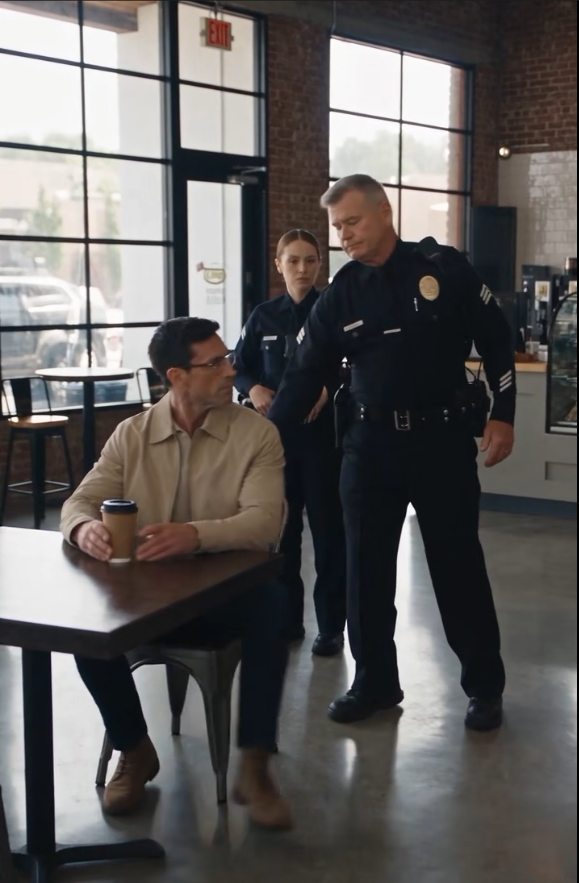
Part I — The Arrest
The first handcuff clicked around my wrist three seconds after my coffee hit the floor.
Chief Gerald Thornton had one fist twisted into the back of my khaki jacket and the other guiding my arm behind me. The edge of the table pressed against my ribs. My newspaper had slid under the neighboring chair. Coffee spread in a dark fan across the pale tile.
“Trespassing,” Thornton said.
Click.
“Failure to comply.”
He pulled my second wrist back.
Click.
“Resisting arrest.”
I turned my head enough to see him from the corner of my eye.
“You’re making a mistake.”
Thornton tightened the cuffs.
“No,” he said quietly. “You made the mistake.”
Around us, Common Grounds had gone unnaturally still.
A spoon rested halfway between a woman’s Nextcer and her mouth. Two men near the front window had stopped talking. The espresso machine hissed behind the counter, filling the silence with steam.
Officer Brenda Sullivan stood several feet away.
She had entered with Thornton less than five minutes earlier, ordered nothing, and spent most of the encounter watching him rather than me. She was in her early forties, brown hair pulled tightly back, uniform neat, posture disciplined.
Now her eyes dropped to the coffee on the floor.
Then to my chair.
Then to Nora Whitfield.
Nora stood beside the register with both hands flat on the counter.
She was the owner of Common Grounds. She had been for twenty years.
She had not asked me to leave.
That fact mattered.
Thornton either did not understand how much it mattered or believed it did not matter at all.
“Chief,” Nora said.
He looked toward her.
Not quickly.
Not nervously.
He turned with the weary impatience of a man being interrupted during something routine.
“This is police business, Nora.”
Her mouth tightened.
“He bought coffee.”
Thornton stared at her for a moment.
“So?”
“I didn’t ask him to leave.”
Officer Sullivan looked at the chief.
Thornton did not look at her.
“He was monitoring your register.”
“No,” Nora said. “He was reading the paper.”
I watched Thornton’s face.
Not because I was frightened.
Not exactly.
I had spent too many years interviewing people after moments like this to confuse fear with surprise. Fear comes from not knowing what can happen. Surprise comes from seeing something you expected eventually happen sooner and more clearly than you imagined.
What I felt was closer to the second.
For months, our team had been trying to answer a narrow question:
What did Gerald Thornton do when he believed nobody in the room had enough power to challenge him?
We had our answer.
But that answer was now attached to my wrists.
Thornton gave my jacket a short pull.
“Move.”
I straightened.
“I’ll walk.”
“You’ll walk when I tell you.”
I said nothing.
That was intentional.
My name is Aaron Cole. At the time, I was forty-four years old. To almost everyone in Ridgemont, I was a retired school administrator who had moved into a modest rental on the west side and developed a predictable morning routine.
Black coffee.
One newspaper.
Corner table.
Same khaki jacket often enough to become forgettable.
I complained occasionally about my knees.
I nodded to people without inviting conversation.
It was an intentionally boring life.
That was the point.
Nobody paid much attention to a middle-aged man who appeared to have nowhere important to be.
In reality, I was deputy director of the State Bureau of Professional Standards, an independent investigative agency responsible for serious cases involving law-enforcement misconduct.
Before that, I had spent ten years working federal civil-rights investigations.
Ridgemont had been on my desk long before I ever moved there.
The city had nearly ninety thousand residents. Almost a third were Black.
The complaints did not arrive as one dramatic accusation. They came in pieces.
A driver stopped, searched, then released without a citation.
A teenager detained because an officer said he “matched behavior.”
A business owner questioned outside a store he owned.
A woman ordered off a public sidewalk after asking why her son had been stopped.
Each complaint was investigated internally.
Each investigation seemed to reach the same language.
Insufficient evidence.
Conduct within policy.
No sustained finding.
No further action.
After a while, repetition becomes its own kind of evidence.
Not proof.
But direction.
A statewide review showed Black residents were being stopped and searched at rates well beyond their share of Ridgemont’s population. Statistics alone could not prove intent. Any responsible investigator knew that.
But statistics could tell you where to look.
So we looked.
For three years.
We interviewed former officers.
Residents.
Business owners.
People who had complained and people who had never bothered because they believed complaining would only make them more visible.
We examined dispatch records, complaint files, internal emails, traffic-stop data, body-camera logs, supervisor notes.
One location kept appearing.
Common Grounds.
It was a narrow downtown coffee shop with exposed brick, old wooden tables, and a handwritten menu Nora refused to replace with digital screens because she said people already spent enough time looking at glowing rectangles.
Chief Thornton came there regularly.
According to several Black customers, the atmosphere changed when he did.
Questions.
Warnings.
Requests for identification.
Orders to move along.
Nothing spectacular.
That was part of what made the pattern so difficult to prove.
Abuse did not always arrive shouting.
Sometimes it was a hand on the back of a chair.
Sometimes it was a uniform beside your table asking why you had been sitting too long.
Sometimes it was being made to understand that someone else’s suspicion outweighed your right to be where you already had permission to be.
Six months before my arrest, Nora agreed to cooperate with our investigation.
Four months later, Ray Coleman began working behind her counter.
Ray was one of our investigators.
To the public, he was simply a barista with a calm manner and an almost irritating ability to remember everyone’s drink.
To me, he was another pair of trained eyes.
The operation had one rule above all others.
We would not manufacture misconduct.
No bait.
No provocation.
No staged argument.
No attempt to lure Thornton into something he otherwise would not have done.
We did not need him to become someone else.
We needed to document who he already was.
So I sat.
Day after day.
Same table.
Same coffee.
Same newspaper.
Until Tuesday morning at 9:15, when Gerald Thornton walked through the door with Brenda Sullivan.
He ordered coffee.
Then he saw me.
His stare lasted too long.
He came directly to my table.
“How long have you been sitting here?”
“About an hour.”
“Doing what?”
“Drinking coffee.”
He leaned closer.
“I think you’re watching the register.”
I lowered my newspaper.
“I’m a paying customer.”
“Identification.”
I handed him the state-issued identification connected to my cover identity.
He barely examined it.
“Retired educator?”
“Yes.”
He dropped it onto the table.
Then he lowered his voice.
“You have sixty seconds to get out of my downtown.”
Behind him, Sullivan shifted.
Behind the counter, Ray wiped a glass.
Nora watched.
I set my coffee down.
“I’d like to finish my drink.”