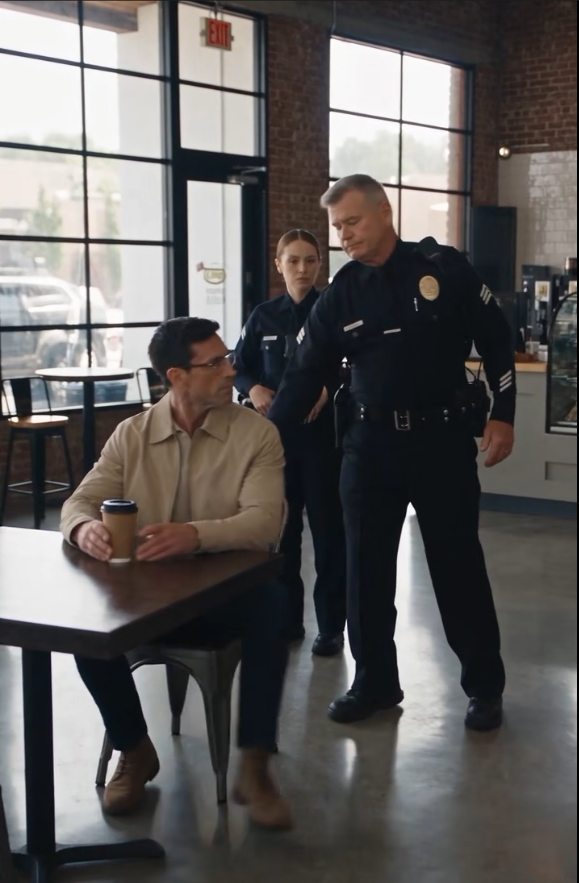
Thornton’s face changed.
Not dramatically.
The lines around his mouth simply hardened.
“This is your final warning.”
“The owner hasn’t asked me to leave.”
His hand closed around my jacket.
That was where the conversation ended.
And where the case changed.
Now he was walking me through the coffee shop with my hands cuffed behind me.
As we passed the counter, I looked at Ray.
Only once.
He did not acknowledge me.
Good.
His right hand remained beneath the counter for half a second longer than necessary.
The signal had already gone out.
Our operation had moved into a phase nobody had planned.
But planning and preparation are different things.
We had not planned for Gerald Thornton to arrest me.
We had prepared for the possibility that someone eventually might.
Outside, the morning sun reflected hard off the parked cars.
Thornton guided me toward a patrol vehicle.
A few pedestrians slowed.
I knew what they saw.
A Black man in handcuffs.
The police chief beside him.
No context.
No questions.
That is how authority often becomes its own explanation.
Thornton opened the rear door.
“Watch your head.”
I ducked into the car.
Before he shut the door, I said, “Chief.”
He paused.
“You should make sure your report is accurate.”
His face stayed flat.
“My reports always are.”
The door closed.
Through the glass, I watched him turn toward Sullivan.
She said something I could not hear.
He answered.
Her expression did not change, but she looked back toward Common Grounds.
Then toward me.
Thornton noticed.
He placed one hand on her shoulder and turned her slightly away from the car.
The gesture looked friendly from a distance.
It wasn’t.
I knew control when I saw it.
A minute later, Sullivan got behind the wheel.
Thornton sat in front beside her.
Neither spoke to me.
As we pulled away, Common Grounds disappeared behind us.
I looked down at my cuffed hands.
For three years we had been collecting fragments.
Now Thornton had given us something different.
Not proof of an entire system.
Not yet.
But a live event.
A decision.
A sequence.
And, if he behaved the way the complaints suggested he would, perhaps something even more valuable than the arrest itself.
What he did next.
Part II — The Story They Needed
The Ridgemont Police Department sat six blocks from Common Grounds.
I had walked past it dozens of times.
Entering through the rear gate in handcuffs gave the building a different shape.
Sullivan parked inside the secured area.
Thornton stepped out first.
When she opened my door, she avoided my eyes.
“Step out, please.”
Her voice was low.
Professional.
I stood.
Thornton was already walking toward the entrance.
He did not look back.
Sullivan placed a hand near my elbow but did not grip it.
That distinction was small.
I noticed it anyway.
Inside, the station smelled of old coffee, disinfectant, and paper.
A desk officer looked up when Thornton entered.
“Chief.”
Thornton pointed toward me.
“Book him.”
The officer hesitated.
“For?”
“Trespassing, failure to comply, resisting.”
The officer looked at Sullivan.
She said nothing.
Thornton turned.
“What?”
“Nothing, Chief.”
He faced the desk again.
“Process him.”
I knew enough about custody procedures to understand what came next.
Property.
Photograph.
Fingerprints.
Holding.
A phone call eventually.
Maybe an interview.
And paperwork.
Especially paperwork.
That was what interested me.
The arrest at Common Grounds had been recorded from multiple angles. Nora’s shop had cameras. Ray had a concealed system authorized under our operation. Thornton and Sullivan both had department-issued body cameras.
But cameras capture moments.
Paperwork captures choices made afterward.
A bad decision can happen quickly.
A false report takes time.
You have to choose the words.
That was why I did not identify myself.
Not yet.
I could have.
I had a credential Thornton would have recognized immediately.
One phone call from the station commander to the state capital would have turned the morning into institutional panic.
The cuffs would have come off.
Lawyers would have appeared.
Thornton would have stopped talking.
Every officer in the building would have begun choosing words carefully.
That might have protected me.
It would not have protected the investigation.
So I gave the desk officer the same cover identification Thornton had already seen.
The officer entered the information.
“Occupation?”
“Retired school administrator.”
Thornton, several feet away, gave a faint snort.
I looked at him.
He did not look back.
The booking officer continued.
“Any injuries?”
“No.”
“Do you need medical attention?”
“No.”
“Any medication?”
“No.”
He finished the form, then looked at Thornton.
“Chief, you want an interview room?”
“Yes.”
Sullivan turned toward him.
“For trespass?”
Thornton’s head moved slowly.
“What did you say?”
She held his gaze.
“I asked if you wanted an interview room for a trespass arrest.”
“Did you miss the other charges?”
“No.”
“Then yes.”
That was the first time I saw Brenda Sullivan openly resist him.
Not much.
Just enough to create friction.
Thornton noticed.
So did I.
He pointed down the hallway.
“Room two.”
Sullivan escorted me there.
The room was small, square, and aggressively plain. Metal table. Three chairs. Camera high in one corner.
She removed one cuff from my wrist and secured it to a ring attached to the table.
Then she paused.
Her fingers remained near the second cuff.
“You said the owner didn’t ask you to leave.”
“That’s correct.”
“Did anyone who worked there ask you to leave?”
“No.”
She looked toward the door.
Then back at me.
“Did you threaten anyone?”
“No.”
“Touch anyone?”
“No.”
“Block the register?”
“No.”
Her jaw moved slightly.
I said, “Officer Sullivan.”
She looked at me.
“You should write down exactly what you saw.”
Something changed in her expression.
Not recognition.
Not yet.
Maybe suspicion.
“Why would you say that?”
“Because memory gets crowded once other people start telling you what happened.”
The door opened.
Thornton entered.
Sullivan straightened.
He looked from her to me.
“You questioning my prisoner?”
“I was clarifying the incident.”
“I’ll clarify it.”
He jerked his head toward the hall.
Sullivan left.
Thornton closed the door and sat across from me.
For several seconds, he simply watched.
Then he placed my cover identification on the table.
“Aaron Cole.”
I nodded.
“Retired educator.”
“Yes.”
“How long have you lived here?”
“Several months.”
“Why Ridgemont?”
“It seemed quiet.”
He smiled.
There was no warmth in it.
“You picked the wrong downtown to play games.”
“I was drinking coffee.”
“You were watching people.”
“People are visible in coffee shops.”
“Don’t get smart.”
I leaned back as much as the cuff allowed.
“I’m answering your questions.”
Thornton studied me.
“You come in there a lot.”
“Yes.”
“Same table.”
“Usually.”
“Same time.”
“Usually.”
“Watching the door.”
“Reading a newspaper.”
“You expect me to believe you moved here to sit in Nora Whitfield’s shop every morning?”
“No. I moved here because I wanted to live here.”
“Why that shop?”
“The coffee is good.”
He stared.
The camera in the corner had a small dark lens.
I wondered whether he remembered it was there.
People usually remembered cameras when they were afraid of consequences.
Thornton did not behave like a man who expected consequences.