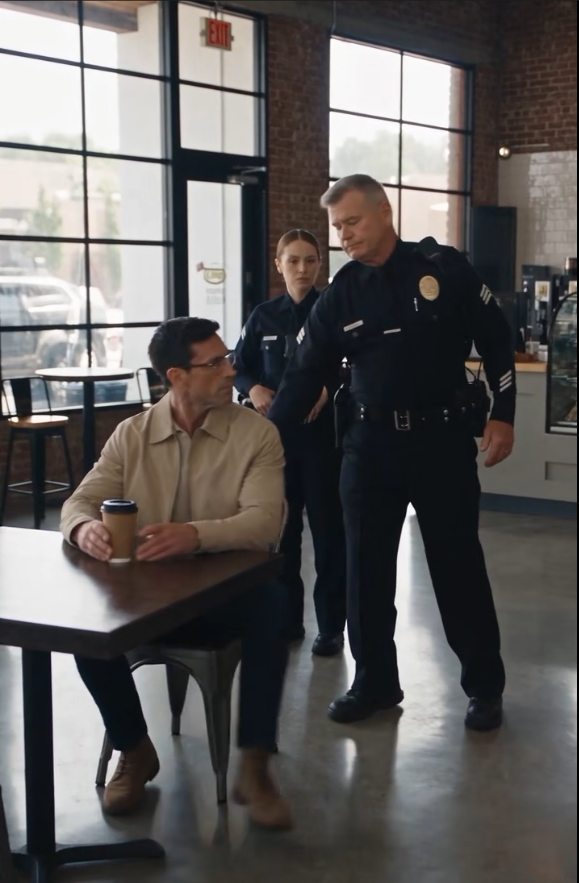
She waited.
I folded the newspaper.
“I’d read the complaints. I’d interviewed people. I knew the pattern. But some part of me still believed my own calmness would protect me.”
Sullivan looked down.
“That if you did everything right, he’d stop.”
“Yes.”
“Didn’t work.”
“No.”
She took a drink.
“Maybe that’s why people believed your case.”
I shook my head.
“They shouldn’t have needed my case.”
She looked toward the counter.
Nora was pretending not to listen.
Sullivan lowered her voice.
“Do you know what bothered me most afterward?”
“What?”
“The chair.”
I knew immediately.
“The sound?”
She nodded.
“When he pulled you up. That scraping sound. I kept hearing it.”
“So did I.”
We sat with that.
No lesson.
No speech.
Just recognition.
Ray returned to headquarters after his cover ended.
For weeks, people in the bureau called him Barista.
He hated it.
That guaranteed the nickname survived.
Nora mailed him an apron at Christmas.
He hung it in his office.
He claimed ironically.
Nobody believed him.
As for me, I moved out of the Ridgemont rental once the operation officially ended.
Before leaving, I told the neighbors the truth.
Most were more offended that I had lied about being a school administrator than that I was an undercover state official.
The man who washed his truck every Saturday stared at me for a long time.
“So your knees aren’t bad?”
“They’re actually not great.”
He nodded.
“At least that part was honest.”
Then he went back to his truck.
Some things survive scandal.
Common Grounds did too.
For a while, business increased because people came to see the coffee shop from the news.
Nora hated that.
“They order one drink and photograph your table for twenty minutes,” she complained.
“My table?”
“That’s what they call it.”
“It was your table first.”
“Tell them.”
Eventually curiosity faded.
The regulars returned.
The photographers stopped.
People went back to coffee.
That was better.
Nearly a year after the arrest, our bureau issued its final Ridgemont report.
It was 312 pages.
Most people never read it.
That did not bother me.
The recommendations became policy.
That mattered.
The statistical disparities did not vanish overnight.
No serious person expected them to.
But stops decreased.
Search rates changed.
Complaint sustainment rates rose—not because investigators had become anti-police, but because the standard finally allowed evidence to cut both ways.
Some officers complained.
Others said the new rules protected them too.
Clearer documentation meant fewer ambiguous accusations.
Better cameras protected lawful actions.
Independent review prevented supervisors from forcing junior officers to carry someone else’s story.
One afternoon, Nora called my office.
Not my cover number.
My actual office.
“You busy?”
“Yes.”
“Good. I need a favor.”
“What?”
“Come drink coffee.”
“That’s not usually how favors work.”
“My new barista keeps making yours too weak.”
“I don’t work undercover anymore.”
“Then complain officially.”
I drove to Ridgemont.
No disguise.
No cover identity.
No khaki jacket.
I wore a navy coat and carried no newspaper.
Common Grounds looked almost exactly the same.
Same exposed brick.
Same worn floor.
Same old tables.
Nora had replaced the broken chair from the morning of my arrest.
I noticed immediately.
“Where’s the old one?”
“In storage.”
“Why?”
She shrugged.
“I thought somebody might steal it.”
“Why would anyone steal a chair?”
She gave me a look.
“People are weird.”
Fair.
I sat in the corner.
She brought coffee.
I took one drink.
“It’s weak.”
“I know.”
“You said the barista—”
“There is no new barista.”
I looked at her.
She smiled.
“You don’t visit.”
“So you lied.”
“I prefer ‘operational cover.’”
I laughed.
Outside, afternoon traffic moved along the downtown street.
People entered and left.
A Black teenager came in carrying a backpack.
Two construction workers ordered sandwiches.
An older white couple sat near the window.
A police officer entered.
Young.
Someone I did not know.
For a fraction of a second, the old instinct returned.
I watched him.
So did Nora.
The officer walked to the counter.
“Afternoon.”
Nora nodded.
“What can I get you?”
“Large coffee.”
He paid.
Then turned toward the tables.
The teenager with the backpack was occupying a four-person table alone.
The officer glanced at him.
My shoulders tightened without permission.
The officer walked past.
He chose a seat by the window.
Nothing happened.
No question.
No identification.
No instruction to move.
Just coffee.
Nora looked at me.
I looked at her.
Neither of us said anything.
That moment did not prove Ridgemont had changed.
One ordinary interaction cannot prove a city is repaired any more than one bad arrest can prove an entire department is corrupt.
But ordinary moments are where patterns begin.
Good ones too.
I finished my coffee slowly.
Before leaving, I walked to the counter.
Nora handed me my change.
“You coming back tomorrow?”
“I don’t live here anymore.”
“That wasn’t my question.”
I looked toward the corner table.
For months, I had sat there because I was watching.
Waiting.
Documenting what happened when someone powerful believed no one important was paying attention.
Now the table was empty.
For the first time, that felt like progress.
“I might,” I said.
Nora nodded.
“Good.”
I stepped outside.
The afternoon sun reflected off the shop windows, and behind the glass people kept talking, reading, drinking coffee, occupying space without asking anyone’s permission to belong there.
A year earlier, Gerald Thornton had put handcuffs on me because he believed the man sitting at that table was nobody he needed to worry about.
He had been wrong about one thing more important than my title.
There had never been anybody sitting there who was nobody.