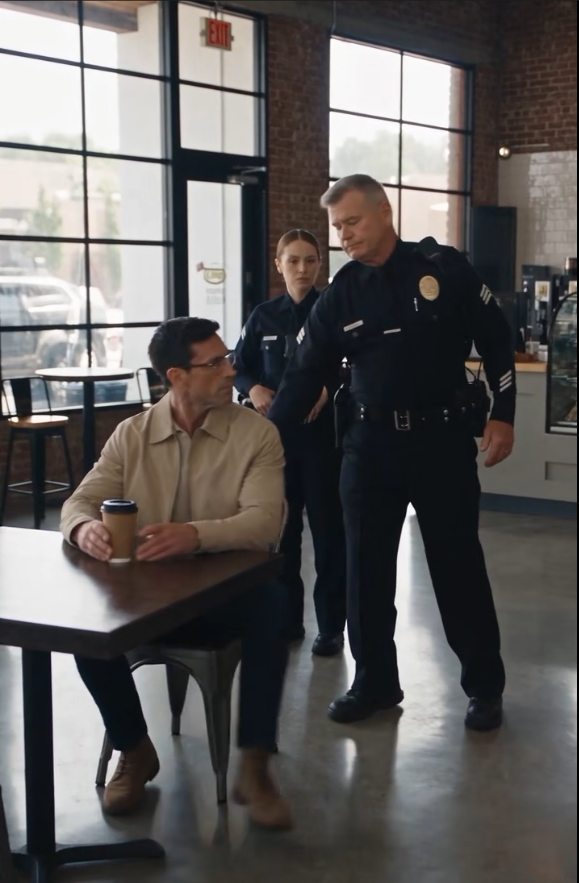
Step away.
Protect the case from claims that I had personally engineered Thornton’s downfall.
My director recommended it.
Counsel recommended it.
Even Ray recommended it.
“You’ve already done your part,” he told me.
We stood outside the hearing room near a window overlooking downtown.
Common Grounds was visible three blocks away.
“I hate that phrase,” I said.
“What phrase?”
“Done your part.”
“You got arrested. I think that qualifies.”
“That’s not what bothers me.”
“What does?”
I watched traffic move below.
“If I disappear now, the story becomes about what happened to me.”
“It already is.”
“That’s the problem.”
Ray leaned against the wall.
“What do you want it to be about?”
“The people who filed complaints before anybody cared who they were.”
He considered that.
“You can’t control the story.”
“I know.”
“You also can’t make yourself unimportant just because being important complicates the case.”
I looked at him.
“That almost sounded wise.”
“I make coffee too.”
The hearing-room doors opened.
People began returning.
I made my choice before going inside.
I would recuse myself from the bureau’s final legal conclusions.
But I would not disappear.
I would testify publicly to the investigative methodology, the evidence, and the institutional failures we documented.
Not because I wanted ownership of the case.
Because Thornton’s defense depended on making the operation itself seem corrupt.
I had authorized part of that operation.
I would answer for it.
The panel returned at 9:03.
Thornton sat beside his lawyer.
Sullivan sat alone along the wall.
Nora was behind me again.
The chairman read for twelve minutes.
Findings regarding conduct unbecoming.
Violation of arrest policy.
Failure to activate body-worn camera as required.
Improper supervisory direction.
Inaccurate official documentation.
Interference with an internal reporting process.
Then the sentence everyone had been waiting for.
Gerald Thornton’s employment as chief of police was terminated effective immediately.
No applause was permitted.
Still, a sound moved through the room.
Not celebration exactly.
Release.
Thornton did not react.
He closed his eyes once.
Then gathered the papers in front of him.
His lawyer whispered.
Thornton shook his head.
As security prepared to escort him through a side exit, he looked toward me.
For one second I thought he would turn away.
Instead he walked over.
The room tensed.
A city officer stepped forward.
I lifted one hand slightly.
Thornton stopped several feet away.
“You happy?”
“No.”
He gave a bitter smile.
“Of course not.”
“I didn’t come here for you to lose your job.”
“That’s what happened.”
“Yes.”
“Because of you.”
“Because of the record.”
He laughed under his breath.
“You still talk like a report.”
I said nothing.
His face hardened again.
“What do you want from me?”
It was the first genuine question he had asked me.
Not who I was.
Not what I was doing.
What I wanted.
I considered it.
“The truth would have helped.”
“About what?”
“Start with the coffee shop.”
His eyes narrowed.
“You think I arrested you because you’re Black.”
“I think you decided I was suspicious before you knew anything about me.”
“That’s not an answer.”
“It’s the one supported by what I can prove.”
“So you won’t say it.”
“I don’t need to claim what I can’t establish.”
For the first time, he seemed confused.
He had expected accusation.
Maybe anger.
Something he could fight.
I continued.
“But I can prove you had no complaint from Nora. I can prove I committed no disturbance. I can prove your report said things the recordings contradict. I can prove you tried to get Nora to adopt a version she said was false. I can prove you told Sullivan to describe resistance she did not see. And I can prove the same assumptions appear in other cases.”
Thornton’s face tightened.
“You think that makes me a monster?”
“No.”
That answer stopped him.
I lowered my voice.
“I think it makes you responsible.”
He looked at me for a long time.
Then turned and walked away.
Part VIII — Aftermath
Systems do not repair themselves because one person leaves.
That was the lesson Ridgemont learned next.
Thornton’s termination made headlines.
Reform took paperwork.
The city reopened dozens of complaints.
Traffic-stop policies changed.
Supervisory review standards changed.
Body-camera deactivation required written justification and automated notification.
Internal-affairs cases involving contested facts could no longer default automatically to officer accounts without documented credibility analysis.
Complaint investigators began reporting outside the direct chain of command in serious cases.
None of those changes were dramatic enough for national television.
They mattered more than the television.
The criminal charges against me were dismissed immediately after my identity became known, but I insisted the dismissal order state why.
No factual basis for trespass.
No evidence supporting failure to comply as charged.
No evidence of physical resistance.
I did not want a quiet administrative disappearance.
Quiet disappearances were part of how Ridgemont had accumulated so many people with stories and so few people with proof.
Thornton’s case continued separately.
I will not pretend every allegation became a conviction or every wrong received a perfect remedy.
That is not how institutions work.
Evidence has standards.
Statutes have elements.
Some conduct can be deeply improper without fitting neatly inside a criminal charge.
The state pursued matters supported by provable facts.
Federal investigators reviewed civil-rights issues.
The city settled several older cases after independent review.
Some residents declined money and asked only that their records be corrected.
Others wanted formal apologies.
A few wanted nothing more to do with the city.
I understood that too.
Brenda Sullivan remained with the department.
Barely.
For months, some officers treated her as a traitor.
Others quietly thanked her.
She was removed from supervisory consideration during the investigation into her own failure to intervene at Common Grounds.
That consequence was appropriate.
She accepted it.
The first time I saw her afterward was six months later.
At Common Grounds.
I was back at my corner table.
She entered alone, wearing civilian clothes.
Jeans.
Dark sweater.
Hair down.
For a moment, she stood just inside the door as though deciding whether to stay.
Nora saw her.
Neither woman smiled.
Sullivan approached the counter.
“Coffee.”
Nora crossed her arms.
“What kind?”
“Whatever doesn’t get me arrested.”
Nora stared at her.
Sullivan looked instantly embarrassed.
“Bad joke.”
“Very.”
“Sorry.”
Nora turned toward the machine.
“Black?”
“Please.”
I lowered my newspaper.
Sullivan noticed me.
She picked up her cup and walked over.
“Seat taken?”
“Depends.”
She looked at the empty chair.
“On?”
“Whether you’re monitoring the register.”
She laughed despite herself.
Then sat.
For a minute, neither of us spoke.
Finally she said, “They offered me a transfer.”
“You taking it?”
“No.”
“Why?”
She turned the coffee cup between her hands.
“I spent years thinking loyalty meant staying quiet about things you could fix internally.”
“And now?”
“Now I think that’s how things don’t get fixed internally.”
I nodded.
She looked at me.
“You ever regret not showing Thornton your badge?”
I thought about it.
“Yes.”
She seemed surprised.
“When?”
“The first night.”
“Why?”
“I was angry.”
“At him?”
“At myself.”
“For what?”
“For being surprised.”