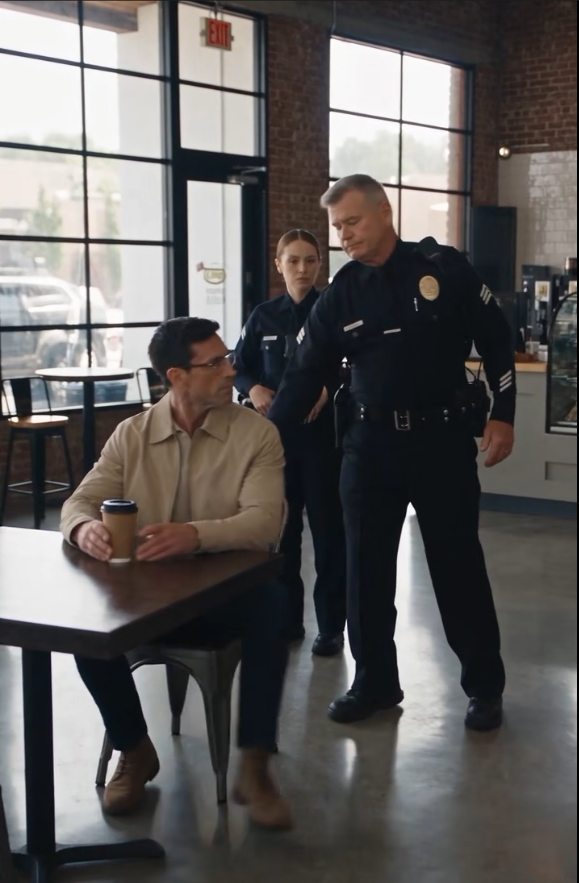
“How often?” I asked.
She looked at the floor.
“Enough that I stopped noticing.”
That sentence stayed with me.
People imagine abusive systems are sustained only by cruelty.
Often they are sustained by adaptation.
People learn which sidewalks to avoid.
Which businesses become uncomfortable at certain hours.
How softly to answer.
When not to complain.
What not to notice.
Ray started the video again.
Thornton grabbed my jacket.
Nora flinched even though she knew what was coming.
Then we reviewed Sullivan’s body camera.
The angle was lower.
Closer.
You could hear Thornton breathing.
You could hear the chair scrape.
You could hear Sullivan say, barely audible, “Chief—”
A warning.
Not strong enough to stop him.
But present.
Then my voice.
“You’re making a mistake.”
Thornton’s answer came moments later, outside the shop.
“No. You made the mistake.”
We watched to the end.
Nobody spoke for several seconds.
Then the investigator asked, “Where’s Thornton’s bodycam?”
The technician looked up.
“Uploaded.”
“Complete?”
A pause.
“Not exactly.”
I turned.
“What’s missing?”
“Seven minutes.”
“From when?”
“Station arrival to approximately seven minutes later.”
Ray stopped wiping the counter.
Nora looked at me.
I said, “System error?”
“Maybe.”
“Maybe?”
“The device was active before. Active after. There’s a gap.”
One investigator asked, “Manual deactivation?”
“We’ll need metadata.”
There was the next problem.
Not proof.
A gap.
Seven minutes.
Seven minutes after Thornton brought me into the station.
I thought back through the sequence.
Booking desk.
His instruction to process me.
The order for an interview room.
The beginning of his questioning.
If the camera had been intentionally disabled, why?
And what else had happened during those minutes?
That afternoon, Sullivan gave her first formal statement.
I was not in the room.
That was deliberate.
I had become both an investigator and a direct witness. From that moment forward, another supervisor handled interviews involving my arrest. I would provide my statement like anyone else.
It was frustrating.
It was also necessary.
Authority has a way of contaminating investigations when people decide rules no longer apply because they believe they are on the right side.
I refused to become part of that problem.
My interview took two hours.
I described the encounter from beginning to end.
No conclusions.
No speculation.
What Thornton said.
What I said.
What he did.
What I observed.
At the end, counsel asked, “Why didn’t you identify yourself at the station immediately?”
“Because the arrest was already complete.”
“And?”
“I needed to know whether the official record would match the event.”
“Did you believe it might not?”
“Yes.”
“Based on what?”
“Three years of complaint files.”
That answer later became important.
So did Sullivan’s report.
She refused Thornton’s wording.
Her written account stated that I had remained seated until Thornton physically directed me to stand. She wrote that Nora had not requested my removal in her presence. She wrote that I did not threaten either officer and did not attempt to strike, flee from, or physically confront them.
She also documented Thornton’s instruction that she characterize my movement as resistance.
That one paragraph changed the case.
Not because Sullivan became a hero.
She had stood beside Thornton at Common Grounds and did not stop the arrest.
She would later admit that.
What mattered was that after the event, when given the chance to convert a bad arrest into a false official story, she refused.
Thornton did not.
His report was finished at 12:43 p.m.
It said officers had responded to “ongoing concerns from business representatives regarding a suspicious male monitoring transactions.”
False.
It said I was “repeatedly instructed by business personnel and law enforcement to leave.”
False.
It said I “became confrontational and physically resisted lawful detention.”
False.
It described Nora as a “complaining business representative.”
She had never complained.
The report transformed a quiet coffee shop into a disturbance that had not existed.
It transformed my questions into confrontation.
It transformed his decision into everyone else’s request.
And because he did not yet know who I was when he began writing it, the document carried something video alone could not.
Intent after reflection.
That evening, I returned to my rental house in Ridgemont.
For months it had been a set.
A believable kitchen.
A few framed photographs chosen carefully enough to suggest a life without revealing one.
Books that matched my cover profession.
Mail in the cover name.
A lawn I intentionally maintained badly enough to look normal.
I sat at the small kitchen table and looked at the faint red marks on my wrists.
I had interviewed people who carried far worse.
People shoved against cars.
People detained in front of their children.
People who lost jobs because a baseless arrest took too long to clear.
People who were never injured physically but learned afterward to become tense whenever a patrol car appeared behind them.
I had always understood the facts of those cases.
That night, I understood something smaller and more personal.
Humiliation has a physical memory.
The scrape of a chair.
The sound of a cup breaking.
People looking at you while someone else defines who you are.
Trespasser.
Problem.
Suspect.
Resisting.
I poured water into a glass.
My phone rang.
Ray.
“You okay?”
“Yes.”
“That wasn’t convincing.”
“I’m fine.”
He waited.
I said, “How’s Nora?”
“Angry.”
“That sounds more convincing.”
“She wants to know if she can reopen tomorrow.”
“She can.”
“She also wants Thornton banned from the shop.”
I rubbed my forehead.
“That’s her decision as owner.”
“She knows.”
“Then why ask?”
“She wants someone official to tell her she’s allowed.”
The sentence bothered me more than it should have.
Nora had owned Common Grounds for twenty years.
Thornton had been chief for nine.
Somewhere during those nine years, a private business owner had begun believing she needed government permission to decide who could enter her own coffee shop.
“Tell her she doesn’t need us to authorize that.”
“I did.”
“What did she say?”
“That she knows.”
I smiled.
“Then why ask?”
“She said she wanted to hear you say it.”
I looked out the dark kitchen window.
“Tell her I said it.”
Part V — Pressure
The investigation did not explode publicly the next morning.
That surprised people later.
They assumed that once my identity became known, the state immediately descended on Ridgemont with cameras, press conferences, and boxes of seized records.
Real investigations rarely work that way.
Noise destroys information.
We moved quietly.
Preservation orders were served.
Relevant personnel were instructed not to delete records.
Body-camera servers were mirrored.
Internal-affairs files were copied under legal authority.
Dispatch logs were secured.
Complaint files that existed in paper form were scanned before anyone could misplace them.
The seven-minute gap in Thornton’s body-camera footage became a technical question.
The answer took four days.
The camera had not malfunctioned.
Thornton had manually deactivated it.
He reactivated it shortly before entering the interview room.
That fact alone did not prove misconduct.
Department policy allowed temporary deactivation in limited circumstances involving privacy, tactical discussions, or legally protected conversations.
None applied.
More important was what had happened during those seven minutes.
The station’s fixed hallway cameras had no audio.