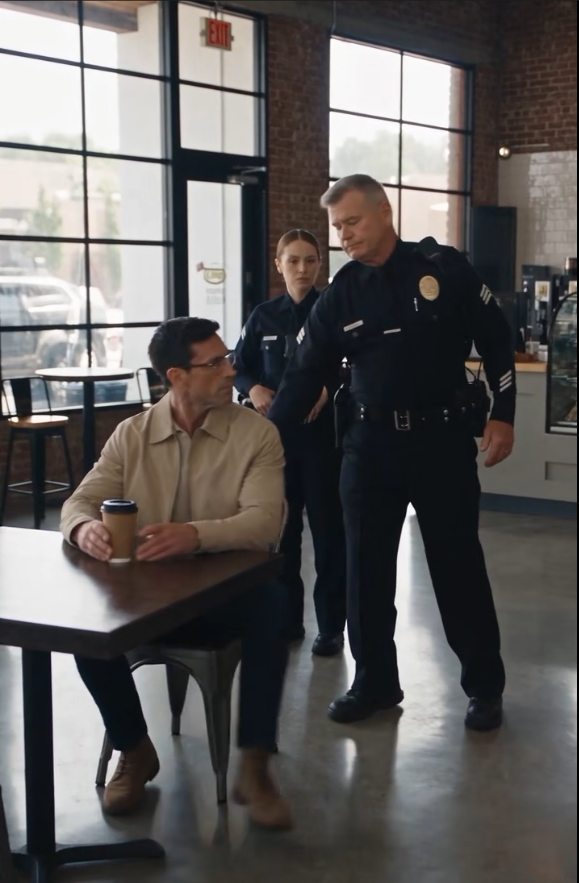
Thornton stopped beside her.
“You put in that he pulled away?”
She did not answer immediately.
“I wrote that he stood after you took hold of his jacket.”
“That’s not what I asked.”
“It’s what happened.”
Thornton’s voice dropped.
“Sullivan.”
She kept her eyes on the screen.
“He didn’t swing at you. He didn’t run. He didn’t threaten anyone.”
“He resisted.”
“He questioned the order.”
“That’s resistance.”
“No, Chief.”
The hallway became quiet.
Not completely.
Phones still rang farther away. A printer fed paper somewhere.
But the people close enough to hear had stopped moving.
Thornton leaned toward her.
“Come into my office.”
Sullivan looked at me.
Then at him.
“I need to finish the booking supplement.”
“Now.”
She stood.
They walked away.
I was returned to the interview room.
Twenty minutes later, the station door opened somewhere beyond the hallway.
A man’s voice asked for the chief.
Another voice answered.
Then more footsteps.
I knew the sound before I saw anyone.
Our agency had arrived.
Not a tactical team.
Not a dramatic raid.
That would have destroyed exactly what we were trying to preserve.
Two investigators and legal counsel had been instructed to come only after sufficient post-arrest conduct had been documented or if my safety became an issue.
Apparently the threshold had been reached.
The interview-room door opened.
Thornton entered first.
His face was different.
Behind him stood one of our investigators.
Thornton had gone pale around the mouth.
The investigator looked at me.
“Mr. Cole.”
I remained seated.
Thornton turned.
“You know him?”
The investigator did not answer.
He reached into his jacket and showed his state credential.
“State Bureau of Professional Standards.”
Thornton’s gaze went from the credential to me.
Then back.
The investigator continued.
“We’re here regarding an active matter involving this department.”
Thornton’s eyes fixed on me.
I had seen realization arrive on people’s faces before.
Sometimes it looked like shock.
Sometimes fear.
Thornton’s looked like calculation.
“How does he factor into it?”
I stood as far as the cuff allowed.
Then I reached into the inner pocket of my jacket slowly.
Thornton’s hand moved instinctively toward his belt.
The investigator said, “Easy.”
I removed my actual credentials and placed them on the table.
Thornton stared.
I opened the case.
“Deputy Director Aaron Cole,” I said. “State Bureau of Professional Standards.”
For several seconds, nobody spoke.
Thornton looked at the credentials.
Then at me.
“You set me up.”
“No.”
“You were undercover in my city.”
“Yes.”
“In that shop.”
“Yes.”
“You baited me.”
“No.”
His voice rose.
“You sat there every morning waiting for me.”
“I sat there as a paying customer.”
“You wanted this.”
“We wanted to observe your conduct.”
“That’s the same thing.”
“It isn’t.”
Thornton looked at the investigator behind him.
“This is entrapment.”
The investigator remained expressionless.
I said, “Entrapment requires inducement. Nobody asked you to approach my table.”
Thornton turned back.
“You lied about who you were.”
“I used an authorized cover identity during a lawful investigation.”
“You should’ve identified yourself.”
“When?”
“The second I approached you.”
“Why?”
His face tightened.
The question landed exactly where I intended.
If I deserved different treatment because of my real title, then the case had explained itself.
Thornton understood that a second later.
His eyes shifted.
I continued quietly.
“If you believed your conduct was lawful toward a retired educator sitting in a coffee shop, my actual job shouldn’t matter.”
He said nothing.
The investigator stepped forward.
“Chief Thornton, preservation notices are being served on the department. You are instructed not to alter, delete, overwrite, or direct anyone to modify any records, recordings, reports, emails, dispatch data, body-camera files, or other material connected to this incident or the broader review.”
Thornton laughed once.
It sounded forced.
“Broader review.”
“Yes.”
“You people think one stunt in a coffee shop proves something?”
“No,” I said. “It doesn’t.”
He looked at me.
“That’s right.”
“It proves what happened in the coffee shop.”
The satisfaction left his face.
I continued.
“The other evidence proves the other things.”
That was the first time I saw fear.
Not panic.
Thornton was too practiced for that.
But something behind his eyes changed.
He turned toward the door.
“I want counsel.”
“That’s your right,” the investigator said.
Thornton opened the door.
Then stopped.
“What happens now?”
I looked at the cuff still attached to my wrist.
“That depends.”
His eyes followed mine.
The room became still.
Slowly, Thornton took the handcuff key from his belt.
He stepped toward me.
I shook my head.
“Officer Sullivan should do it.”
His expression sharpened.
“Why?”
“Because she’s the arresting witness.”
“She didn’t arrest you.”
“She was present.”
He stared at me.
Then called her name.
Sullivan appeared in the hallway.
She saw our investigator.
Then my credentials.
Then Thornton.
Her face drained of color.
“Chief?”
Thornton held out the key.
“Uncuff him.”
She approached.
Her hands were steady.
The cuff opened.
I rubbed my wrist once.
Sullivan whispered, “Who are you?”
I looked at her.
“The same man who was sitting in the coffee shop.”
Part IV — What the Cameras Saw
By noon, Common Grounds was closed to customers.
Nora turned the sign on the door, pulled the blinds halfway down, and made coffee for everyone anyway.
“Habit,” she said.
Ray stood behind the counter wearing the same apron he had worn during my arrest.
One of our technical investigators had already begun securing copies of the shop’s video.
Three independent systems had captured the central encounter.
The café cameras.
Ray’s authorized recording equipment.
The officers’ body cameras.
That redundancy mattered.
In misconduct investigations, one recording often becomes an argument about angle, sound, obstruction, missing context.
Three recordings become harder to dismiss.
We watched them separately.
First the café footage.
Thornton entered at 9:15.
He saw me.
Walked directly over.
No one approached him first.
No employee pointed toward me.
No customer complained.
The exchange lasted less than three minutes.
On silent overhead video, the imbalance looked even more obvious.
I sat.
Thornton stood over me.
I handed him identification.
He dropped it on the table.
I placed my coffee down.
He seized my jacket.
The chair moved.
The cup fell.
Cuffs.
Done.
Next came Ray’s recording.
Clear audio.
“How long have you been sitting here?”
“About an hour.”
“Doing what?”
“Drinking coffee.”
Then Thornton’s line.
“You have sixty seconds to get out of my downtown.”
Nora stopped moving when she heard it again.
She had witnessed it live.
Recorded truth feels different.
It removes the possibility that memory exaggerated something.
Nobody had exaggerated.
Ray paused the video.
“That phrase,” he said.
I looked at him.
“My downtown.”
Ray nodded.
“We’ve got it elsewhere.”
One of the investigators turned.
“Where?”
“Witness statements. Not exact every time. Variations. ‘My street.’ ‘My block.’ ‘My downtown.’”
I remembered.
Three complaints.
One from a delivery driver.
One from a teenager.
One from a bookstore employee.
Each had described Thornton using ownership language.
At the time, it sounded rhetorical.
Now it sounded habitual.
Nora folded her arms.
“He says things like that.”