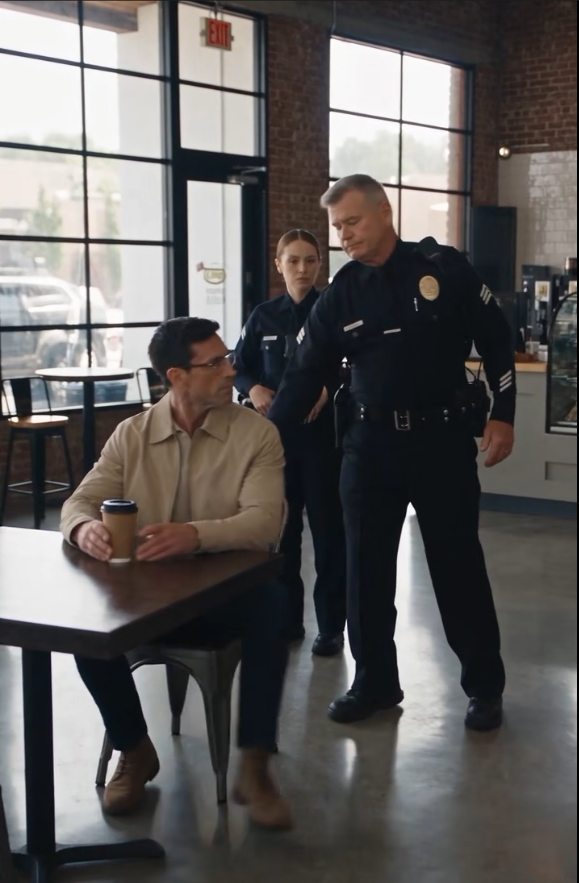
My quiet cover life vanished in an hour.
Neighbors who knew me as a retired educator discovered I had lied about my job.
A man down the street who used to wave while washing his truck stared at me from his driveway.
At Common Grounds, people filled the sidewalk.
Nora called before opening.
“There are cameras outside.”
“Keep the shop closed.”
“I can’t keep it closed forever.”
“I know.”
“What am I supposed to say?”
“Nothing you don’t want to say.”
“They know my name.”
“I’m sorry.”
“No.”
Her voice sharpened.
“Don’t do that.”
“Do what?”
“Make this your fault.”
I leaned against the kitchen counter.
“Nora—”
“I agreed to help because people were being treated badly in my shop and I spent too long pretending I didn’t see the pattern. You didn’t make me do that.”
I said nothing.
She continued.
“I’m opening at ten.”
“You sure?”
“It’s my coffee shop.”
That afternoon, I walked into Common Grounds through a wall of reporters.
Questions came from every direction.
“Deputy Director Cole, were you targeted because of race?”
“Was the chief aware of your investigation?”
“Did you provoke the arrest?”
“Will charges be filed?”
I answered none.
Inside, the shop was packed.
Nora stood behind the register.
Ray was no longer pretending to be a barista. His cover had ended with mine.
His absence behind the counter felt strangely obvious.
I walked to the same corner table.
My table.
Someone had replaced the broken coffee cup.
Nora brought me a fresh one.
Black.
She set it down.
“On the house.”
“I was told paying customers have stronger legal standing.”
She looked at me for a second.
Then laughed.
Not loudly.
But enough to break the tension.
“Fine,” she said. “Three dollars.”
I handed her a five.
She kept it.
Part VI — The Hearing
Three months after the arrest, Gerald Thornton sat at one end of a long hearing table wearing a dark civilian suit.
I sat forty feet away.
The proceeding was not a criminal trial.
Not yet.
It was an administrative public hearing convened after the state completed its first phase of findings and the city moved to determine Thornton’s employment status.
The room was full.
Reporters.
Residents.
Officers.
City officials.
People from Common Grounds.
Nora sat behind me.
Ray sat two rows farther back.
Sullivan had not entered yet.
Thornton’s counsel had spent the morning attacking the investigation.
He questioned our methodology.
Our statistical analysis.
Our use of undercover personnel.
My decision not to identify myself.
He called the coffee-shop operation “a manufactured confrontation disguised as oversight.”
When it was my turn to testify, he approached slowly.
“Mr. Cole—”
“Deputy Director Cole,” counsel for the city corrected.
Thornton’s lawyer smiled.
“Of course. Deputy Director Cole.”
He stood before me.
“You entered Ridgemont under a false identity.”
“An authorized cover identity.”
“You lied to your neighbors.”
“I maintained cover.”
“You lied to Chief Thornton when he asked your occupation.”
“I gave the occupation attached to the authorized identity.”
“So yes.”
“In ordinary language, yes.”
A few people shifted behind me.
The lawyer seemed pleased.
“And you went to Common Grounds every morning hoping Chief Thornton would confront you.”
“No.”
“You expected him to.”
“We considered it possible.”
“You chose the same table.”
“Yes.”
“You watched the door.”
“Sometimes.”
“You observed the chief when he entered.”
“Yes.”
“You were studying him.”
“Yes.”
“And when he told you to leave, you refused.”
“I told him I wanted to finish my drink.”
“So you refused.”
“I did not leave.”
“Because you wanted him to arrest you.”
“No.”
“But an arrest was useful to your investigation.”
“After it occurred, yes.”
Thornton’s lawyer stopped.
“There’s the truth.”
I looked at him.
“That’s part of the truth.”
He turned toward the hearing panel as if the answer helped him.
Then back.
“What’s the rest?”
“We did not control what Chief Thornton chose to do.”
“You knew he might react.”
“We knew from complaints that he had previously questioned Black patrons and residents without clear legal basis.”
“So you placed yourself in his path.”
“I bought coffee.”
“You stayed after a police chief ordered you to leave.”
“Yes.”
“You challenged his authority.”
“I asked whether the owner had requested that I leave.”
“You knew that would aggravate him.”
“No.”
“You’re an experienced investigator.”
“Yes.”
“You know how people react under pressure.”
“Sometimes.”
“You were testing him.”
“We were observing him.”
He leaned closer.
“That is a distinction without a difference.”
“It’s the entire difference.”
He paused.
I continued before he could stop me.
“If I had insulted him, threatened him, interfered with an arrest, created a disturbance, or asked someone to make a false complaint, you could call that provocation. I did none of those things.”
“You refused an order.”
“An order he had no factual basis to give on private property where the owner wanted me present.”
The lawyer’s expression tightened.
“According to Ms. Whitfield.”
“According to the owner.”
He moved on.
For the next forty minutes, he tried to turn procedure into motive.
Why had we investigated Ridgemont?
Why had we focused on Thornton?
Why had we used undercover observation?
Why had we not warned the department?
The answers were all in the record.
Three years of complaints.
Statistical disparities.
Witness interviews.
Internal case closures.
Patterns requiring independent verification.
Finally he returned to the arrest.
“You could have stopped it by showing your credentials.”
“Yes.”
“But you didn’t.”
“No.”
“Why?”
That question had followed me for three months.
Reporters asked it.
Commentators asked it.
Thornton’s supporters asked it angrily.
Some civil-rights advocates asked it critically.
Why allow the arrest to continue?
Why submit to booking?
Why not end the confrontation immediately?
I looked toward the panel.
Then at Thornton.
“Because my credentials should not have been the thing that made me safe.”
The room remained quiet.
I continued.
“If Chief Thornton’s conduct was lawful when he believed I was an ordinary retired educator, then it remained lawful after he learned I was a state official. If it became unacceptable only because of my title, then the problem was not my failure to identify myself.”
Thornton looked down.
His lawyer said, “That sounds rehearsed.”
“It’s been asked a lot.”
A few people laughed softly.
The chairman stopped them.
The lawyer changed direction.
“Let’s discuss resisting arrest.”
“All right.”
“Chief Thornton says you pulled away.”
“I did not.”
“His report says you did.”
“I’ve read it.”
“You’re calling him a liar.”
“I’m saying the report is inconsistent with the recordings.”
“You mean your recordings.”
“Three separate recording systems.”
The lawyer turned toward the video monitor.
The footage played.
Thornton gripping my jacket.
The chair scraping.
My hands moving backward only when he moved them.
No strike.
No shove.
No attempt to flee.
The lawyer stopped the video.
“Video doesn’t capture everything.”
“No.”
“Angles can mislead.”
“Yes.”
“Audio can lack context.”
“Yes.”
He seemed surprised by the agreement.
I said, “That’s why we compared all three systems.”
He returned to his table.
For a moment, I thought my testimony was over.