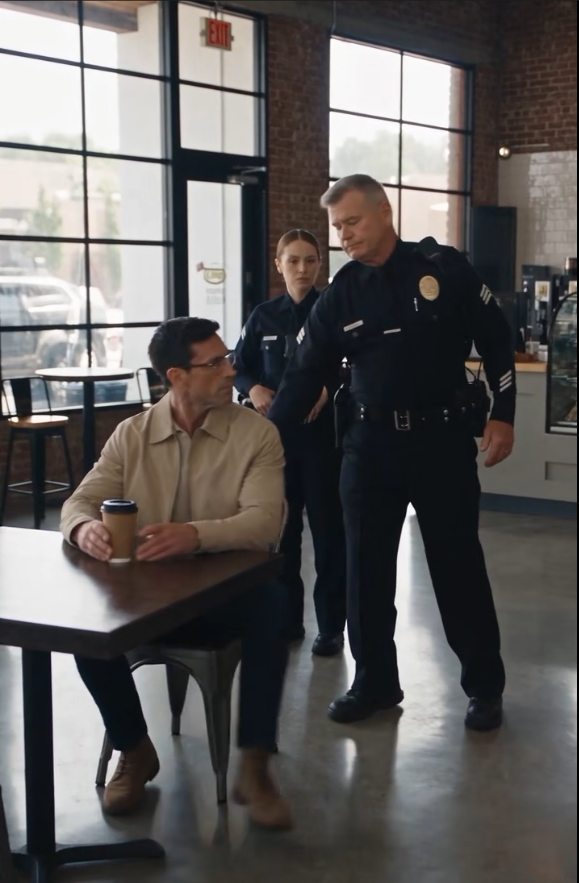
Then Thornton spoke.
Not through counsel.
Directly.
“You knew who I was.”
The chairman looked toward him.
“Chief Thornton, you’ll have your opportunity.”
Thornton ignored him.
He stared at me.
“You sat there knowing exactly who I was.”
His lawyer touched his arm.
“Gerald.”
Thornton pulled away.
“You watched me for months.”
I answered carefully.
“Yes.”
“And you never once came to my office.”
“No.”
“You never asked for my side.”
“We requested records through authorized channels.”
“That’s not the same.”
“No.”
“You decided what I was before you ever met me.”
That accusation carried more weight than the others.
Because investigators can do that.
Evidence can become expectation.
Expectation can become bias.
I had spent years warning younger investigators against falling in love with a theory.
So I answered precisely.
“We opened the investigation because of evidence.”
“That’s not what I asked.”
“No. I had not decided what you were.”
“Bull.”
His lawyer whispered urgently.
Thornton stood.
“You came into my city pretending to be nobody.”
I looked at him.
“I was never nobody.”
The words left my mouth before I planned them.
Thornton stopped.
I continued more quietly.
“Neither were the people in those complaint files.”
No one moved.
For three years, that had been the heart of it.
Not whether I was important.
Whether people became less protected when authority assumed they were unimportant.
Thornton sat.
His lawyer did not ask another question.
Then Brenda Sullivan entered.
Her testimony lasted less than an hour.
It did more damage than mine.
She described Common Grounds.
She described hearing me say Nora had not asked me to leave.
She described Thornton taking hold of my jacket.
She described my behavior as compliant.
Then she described the station.
The disabled body camera.
Thornton’s office.
His instructions about the report.
Thornton’s lawyer attacked immediately.
“You’re protecting your career.”
“I’m probably ending it.”
“You expect this panel to believe you suddenly discovered a conscience?”
Sullivan looked at him.
“No.”
That answer unsettled him.
She continued.
“I should have intervened earlier.”
The lawyer stopped.
Sullivan turned toward the panel.
“I knew the situation was wrong before the cuffs went on. I told myself the chief knew something I didn’t. Then I told myself I was there to support command. Then I told myself I could correct the paperwork later.”
She paused.
“That’s how it works.”
Thornton stared at her.
Sullivan did not look away.
“You make one small excuse because challenging the person above you feels bigger than staying quiet. Then the next excuse is easier.”
The lawyer said, “Officer Sullivan, this is not a therapy session.”
“No.”
Her eyes stayed on Thornton.
“It’s an explanation.”
The chairman allowed her to continue.
Thornton’s lawyer tried one final approach.
“Did Chief Thornton ever explicitly tell you to lie?”
Sullivan thought before answering.
“He told me to write that Mr. Cole resisted.”
“Did he use the word lie?”
“No.”
“Did he order you to fabricate evidence?”
“Not in those words.”
“Did he threaten you?”
“No.”
“Then what exactly are you accusing him of?”
Sullivan looked at the lawyer.
“Knowing what happened and asking me to write something else.”
Nothing about the answer was dramatic.
That was why it landed.
The hearing recessed at 4:10.
We returned forty minutes later for the final evidence presentation.
That was when the last piece emerged.
For months, we had been trying to understand why so many internal complaints reached nearly identical conclusions.
The answer had been hidden in a folder recovered from an old shared drive.
Not deleted.
Not encrypted.
Simply misnamed.
“Training Reference.”
Inside were templates.
Complaint disposition language.
Recommended phrases.
And one document written six years earlier.
Its title:
CONSISTENCY IN OFFICER RESPONSE DOCUMENTATION.
Thornton had authored it.
Most of the document was ordinary supervisory guidance.
Be concise.
Avoid speculation.
Document safety concerns.
Identify lawful basis for stops.
But near the end was a section on contested encounters.
One sentence had been copied, nearly word for word, into multiple complaint dispositions:
Absent independent corroboration contradicting officer observations, command should defer to the trained officer’s articulation of perceived threat, resistance, or suspicious behavior.
It explained the pattern.
Not corruption in the cinematic sense.
No secret payments.
No conspiracy in a dark room.
Something more durable.
A rule.
A presumption.
If an officer said a person had seemed suspicious, the person challenging that description needed independent proof.
If an officer said someone resisted, the person arrested needed a witness.
If body camera was unclear, the officer got the benefit.
If no outside witness existed, the complaint died.
Thornton had built a system where the department’s version began as truth and everyone else’s version began as accusation.
Common Grounds had broken that system because there were witnesses.
There were cameras.
There was Nora.
There was Sullivan.
There was Ray.
And there was me.
Thornton requested permission to speak.
His lawyer objected.
Thornton insisted.
The panel allowed it.
He stood slowly.
For the first time since the arrest, he did not look angry.
He looked tired.
“You’re making a mistake,” he said.
The same words I had said to him.
He looked toward the panel.
“You remove me over this, every officer in this city learns hesitation. They stop questioning people. They stop trusting instincts. They wait until something happens.”
No one interrupted.
“I kept this city safe.”
A man somewhere in the audience muttered something.
The chairman warned the room.
Thornton continued.
“You can take any nine years of police work and find cases that look ugly afterward. That’s easy. Sit in an office. Slow down video. Read reports with lawyers. But out there, decisions happen fast.”
That part was true.
Police work often required fast decisions.
That was why the coffee-shop incident mattered so much.
Nothing about it had been fast.
Thornton had time.
I raised my hand.
The chairman looked at me.
“You’ve already testified, Deputy Director.”
“One clarification.”
Thornton’s lawyer objected.
The chairman thought for a moment.
“Brief.”
I stood.
“Chief Thornton is right that officers often make decisions quickly.”
Thornton watched me.
“But the coffee-shop report was written hours later.”
His expression changed.
I continued.
“The prepared statement given to Nora was written later. The instruction to Officer Sullivan came later. The complaint-review standard was written years earlier.”
I sat.
That was the case.
Not one bad moment.
A sequence of deliberate opportunities to correct a mistake.
Each opportunity rejected.
Part VII — The Choice
The panel did not announce its decision that evening.
They reconvened the following morning.
I barely slept.
Not because I doubted the evidence.
Because another decision waited behind theirs.
State prosecutors had reviewed the record.
Potential charges involving official misconduct and false statements were under consideration.
Federal authorities had requested access to portions of the civil-rights investigation.
The city was preparing to reopen past complaints.
But before any of that, our bureau had to issue its final public findings.
As deputy director and a direct victim of the most visible incident, I had a conflict.
I could recuse entirely.
Or I could participate only as a factual witness while another official signed the findings.
The safer choice for the institution was obvious.