The Price of Four Souls: How a Drifter’s Sacrifice Unveiled a Desert Conspiracy and Forged an Unbreakable Frontier Family.
The Price of Four Souls: How a Drifter’s Sacrifice Unveiled a Desert Conspiracy and Forged an Unbreakable Frontier Family
Chapter 1: The Weight of the Sun
The rope had already been stretched taut between two cedar posts when Caleb Dowd rode his limping gelding over the crest of the blood-red ridge.
Below him, nestled in a basin of cracked earth and sparse mesquite, lay a sprawling Apache village. The air was thick with the suffocating heat of high noon, the kind of heat that baked the moisture from a man’s lungs and made the horizon shimmer like a mirage. But it was not the oppressive climate that made Caleb pull back on the reins. It was the silence.
Dozens of villagers stood in a wide, unbroken circle. They did not speak. They did not chant. They simply watched as four women knelt in the burning, alkaline dust in the center of the gathering. Their wrists were bound tightly behind their backs with raw leather strips.
Nobody cried. Nobody pleaded for mercy. The four condemned women simply waited for death, their backs straight, their chins lifted defiantly toward the merciless sun.
Caleb had heard the whispers three days earlier at a dusty trading post near the border. The traders had spoken of an Apache council passing a harsh, unyielding judgment. Four women, each married to prominent men of the tribe, had been cast out and condemned. The charge was one of profound shame in their culture: they were barren. They had failed to give their husbands children. Their marriages had been abruptly dissolved, their families disgraced, and the tribal council had declared them useless—a burden to their people in a time when resources were scarce and survival demanded growth.
By sunset, the traders had wagered, all four would be dead.
Caleb sat in his worn leather saddle, the creak of the leather loud in the stillness of the ridge. He could have—and by all logic, should have—turned his horse around.
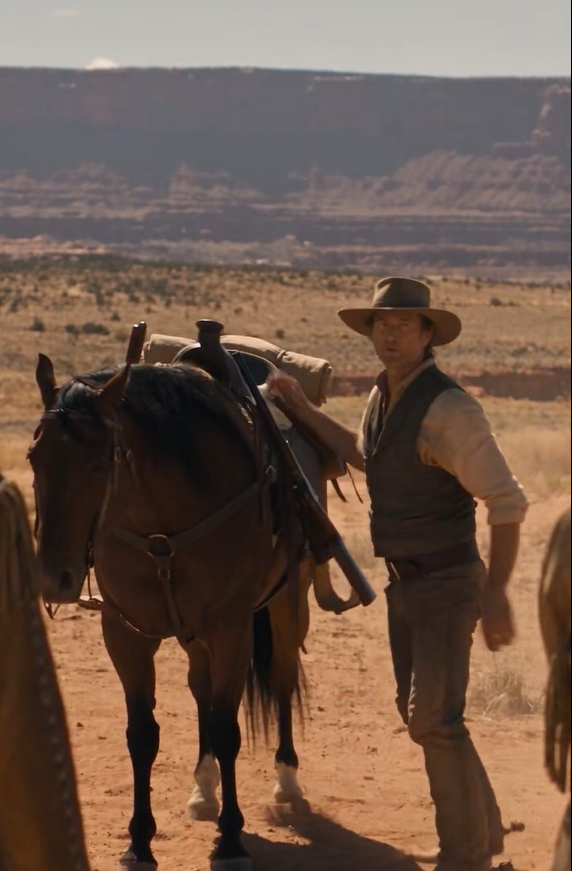
He was thirty-eight years old, his face weathered by years of wind and sun, his eyes carrying the heavy, haunted look of a man who had seen too much and done too little to stop it. He was exhausted to his bones, hungry, and entirely alone. His horse was limping badly from a bruised front hoof, his tin canteen was rattling with only a few drops of warm water, and he possessed absolutely nothing to his name except a Winchester rifle, a Colt revolver, the saddle he sat on, and a few meager trade goods tucked into his saddlebags.
He had no ranch waiting for him. He had no family to return to. He had no permanent home anywhere on God’s earth. Saving four condemned women from their own people's justice was not his responsibility.
But Caleb Dowd had spent entirely too many years carrying the ghosts of his past. During his time as a scout for the U.S. Army, he had witnessed atrocities that still woke him in cold sweats. He had seen cruelty handed down from men of power, and he had chosen, time and time again, to follow orders, to keep his head down, and to keep riding.
He looked down at the four women. He saw the way the youngest one swayed slightly, fighting the exhaustion. He saw the eldest holding her head with an unbreakable pride.
Caleb realized, with a heavy, settling certainty in his chest, that he could no longer bear the weight of doing nothing. If he turned his horse around today, the man he was would die just as surely as those women would.
With a soft click of his tongue, Caleb urged his limping horse down the steep embankment of the ridge, descending into the basin.
Chapter 2: The Trade of a Lifetime
The arrival of a lone rider did not go unnoticed. As Caleb’s horse navigated the rocky descent, the village warriors turned, their hands instinctively dropping to the hilts of their knives and the stocks of their rifles. A ripple of tension swept through the crowd, breaking the solemn silence of the execution grounds.
Caleb kept his hands in plain sight, resting them lightly on the saddle horn. He rode at a deliberate, unthreatening pace until he reached the edge of the circle. The crowd parted slightly, allowing him to approach the gray-haired chief who stood near the cedar posts, a heavy ceremonial lance in his hand.
Caleb halted his horse. He took a deep breath, reaching into the deepest recesses of his memory to pull forward the Apache dialect he had learned during his years as a scout.
“I have come to trade,” Caleb said, his voice carrying clear and steady over the dry wind.
The chief’s dark eyes narrowed. He looked Caleb up and down—assessing the worn clothes, the tired horse, the desperate look of a drifter—before glancing toward the kneeling women.
“You interrupt a matter of our blood,” the chief replied, his voice like grinding stones. “The judgment has already been made. Their wombs are empty. They bring nothing to our future. They return to the earth today.”
“I am not asking you to change your judgment,” Caleb replied, keeping his tone perfectly respectful but unyielding. “Give them to me. They will leave your land today, and I swear on my life they will never return to burden your people.”
The chief studied him carefully, a flicker of curiosity breaking through his stern facade. In the harsh reality of the frontier, no man took on the burden of four outcast women without a motive.
“What do you offer for their lives?” the chief asked.
Caleb did not hesitate. He looked at everything he owned in the world.
“My horse,” Caleb said. “My Winchester rifle. My saddle. And all the goods in my saddlebags.”
A shocked, collective murmur spread through the crowd like wildfire. In this unforgiving landscape, a good horse and a repeating rifle were the difference between life and death. The horse alone, even with a bruised hoof, was worth more than most working men earned in two years. To offer all of it—a man’s entire means of survival—was an act of sheer madness.
A young warrior pushed his way to the front of the crowd. His face was twisted in a mask of wounded pride and furious anger. Caleb recognized the posture; this was one of the former husbands.
“No!” the warrior shouted, pointing an accusing finger at Caleb. “They are cursed! They are a shame upon us! You cannot buy our shame with a crippled horse!”
The chief slammed the butt of his lance into the hard earth. The sound cracked like a gunshot, silencing the young warrior instantly. The chief looked at the angry husband, then back to Caleb, weighing the unprecedented offer. To execute the women brought no material gain to the tribe. To take the white man’s horse and weapons brought immense value.
The chief nodded once. “The trade is accepted. Leave your possessions. Take the empty women. If they are seen on our lands again, you will all die.”