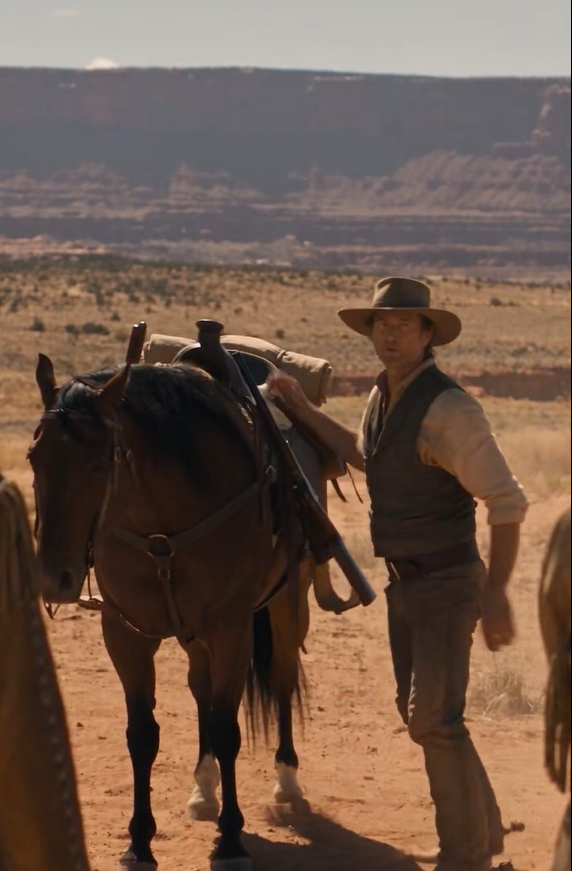
Caleb swung his leg over the saddle and climbed down. His boots hit the dust with a soft thud. With methodical slowness, showing he was no threat, he pulled the Winchester from its scabbard and laid it on the ground. He uncinched the heavy leather saddle and pulled it off the horse’s back, setting it beside the rifle. He removed the saddlebags and laid them down.
He stood up, possessing absolutely nothing but the clothes on his back and the hunting knife strapped to his thigh.
He walked slowly toward the center of the circle, where the four women knelt. The warriors tensed as Caleb drew his blade, but he knelt in the dust behind them and began slicing through the thick rawhide bindings that secured their wrists.
As he cut the final cord, the eldest woman rubbed her raw wrists and looked up at him. Her eyes were fierce, intelligent, and completely lacking in fear.
“You have no horse now,” she said.
Caleb blinked in surprise. She had spoken in perfect, unaccented English.
“No, ma’am,” Caleb answered quietly, sheathing his knife. “I suppose I don’t.”
She rose to her feet, brushing the dust from her woven skirt. “I am Nasha.”
The other three women slowly followed her lead, standing up to face the man who had just purchased their lives.
There was Doli, the youngest of the group, barely twenty years old. She winced as she stood, favoring her left foot, which was bleeding from a deep gash caused by the rocky terrain during her forced march to the execution posts.
Beside her stood Luli, a tall, incredibly stoic woman with broad shoulders and the balanced, deliberate movements of a skilled hunter. She watched Caleb with a guarded, analytical gaze.
Finally, there was Sikino. She was smaller than the rest, a northern woman who had been brought into the village through a complex marriage arrangement. The tribal politics had left her isolated, treated as an outsider even before her condemnation. She kept her eyes lowered, clutching her bruised wrists.
Caleb looked at the four of them. He did not call them his wives. He did not claim ownership over them, nor did he order them to follow him or serve him.
“My name is Caleb,” he said simply. “We need to walk.”
He turned and began walking toward the vast, empty expanse of the desert, away from the village.
For a moment, the women remained frozen. Then, without a word, Nasha stepped forward to follow him. Luli supported the limping Doli, and Sikino fell into step behind them.
Together, the five of them walked out into the scorching wasteland with no food, no horses, barely a canteen of water, and no destination certain enough to call a future.
Chapter 3: The Crucible of the Painted Desert
The first forty-eight hours were a brutal, agonizing crucible that tested the absolute limits of human endurance.
The desert was a merciless ocean of cracked clay, towering saguaros, and jagged red rock formations that reflected the sun’s heat like a convection oven. Caleb led them on foot, his eyes constantly scanning the horizon for any sign of a dust trail that might indicate the village had changed its mind and sent a hunting party.
By the first night, the temperature plummeted, replacing the suffocating heat with a bone-chilling cold. They huddled beneath an overhang of sandstone, shivering in the dark. Caleb passed his nearly empty canteen to Nasha. She took a tiny sip, barely wetting her cracked lips, and passed it to the others. When it returned to Caleb, he realized with a pang of guilt that none of them had taken more than a drop.
It was during this first, agonizing night that Caleb realized a profound truth. He had not rescued four helpless, fragile women. They were, in every measurable way, rescuing him.
When dawn broke, hunger gnawed at their stomachs like a physical beast. Caleb, stripped of his rifle, had no way to hunt the sparse game. But Nasha did not wait for him to provide. Drawing on a lifetime of indigenous knowledge, she led them to a cluster of unassuming scrub brush. With a sharpened rock, she unearthed thick, tuberous roots that held vital moisture and nutrients. She harvested mesquite pods, showing Caleb how to chew the sweet pulp to stave off exhaustion.
Later that afternoon, as dehydration threatened to cause Caleb to collapse, it was Luli who stopped walking, closing her eyes and sniffing the arid breeze. She altered their course, leading them two miles off Caleb’s intended path, directly into a hidden, shaded ravine where a tiny, trickling spring wept from the limestone rock. Caleb would have walked right past it.
Sikino, despite her isolation and silence, proved to be the eyes of the group. She read the desert floor like an open book. On the morning of the third day, she suddenly dropped to her knees, examining a series of faint impressions in the hard-packed earth. She stood up and pointed urgently toward the northern canyon. In broken Spanish, she warned Caleb that a party of six riders had crossed their path just hours earlier. Thanks to her warning, they took a higher, concealed route, completely avoiding a band of ruthless outlaws who were making camp in the valley below.
But the hardest trial belonged to young Doli. The wound on her foot had worsened, leaving a faint, damning trail of blood on the rocks. She never complained. She bit her lip and kept walking, her face pale with pain.
Finally, seeing her stumble for the third time, Caleb halted the group.
“Sit down,” he ordered gently.
Doli looked at him, fear flashing in her eyes, perhaps expecting to be abandoned now that she was a liability. But Caleb knelt in the dirt, took off his only bandanna—a prized possession that kept the sun off his neck—and used his hunting knife to tear it into long strips.
With surprising tenderness, he cleaned her wound with the last drops of their spring water and bound her foot tightly in the makeshift bandage.
When he looked up, the women were watching him. The look in their eyes had shifted. The guarded, terrified suspicion of the condemned was fading. They were beginning to see him not as an opportunistic white man who had bought them for labor or servitude, but as a partner. A man who bled, thirsted, and fought right alongside them.
Chapter 4: The Sanctuary of Dust and Silver
On the evening of the third day, staggering and delirious from the sun, Caleb led them to a small, fortified adobe structure sitting at the crossroads of a dry riverbed.
It was the way station of an old Mexican freighter named Mateo Ruiz.
Years ago, during a brutal winter storm, Caleb had found Ruiz pinned beneath an overturned wagon and had saved his life, losing two fingers to frostbite in the process. Ruiz had sworn a blood debt to the drifter.
When Ruiz opened his heavy wooden door and saw Caleb standing there—sunburned, emaciated, and accompanied by four exhausted Apache women—he stared in absolute disbelief.
He ushered them inside, providing bowls of hot beans, tortillas, and blessed, endless pitchers of cool water. After the women had eaten and fallen into an exhausted sleep in the back room, Caleb sat at the wooden table with Ruiz and explained the events at the village.