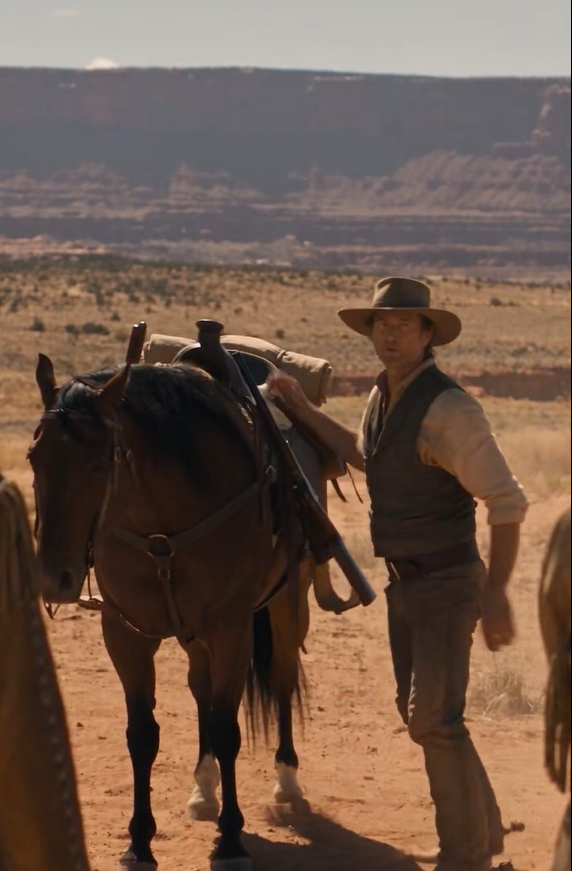
Ruiz listened in silence. When Caleb finished, the old freighter leaned back in his chair and laughed. It wasn't a mocking laugh, but a deep, booming sound of sheer incredulity until tears filled his dark eyes.
“You are a madman, Caleb Dowd,” Ruiz chuckled, shaking his head. “You traded your horse, your Winchester, your saddle, and everything you owned for four women you did not even know? In this country? That is not bravery, my friend. That is a death sentence.”
“I didn't do it to be brave, Mateo,” Caleb said quietly, staring into his empty wooden bowl. “I traded it to stop four innocent people from dying. I’ve watched too many people die while I stood by. I couldn't do it again.”
Ruiz’s laughter faded, replaced by a look of profound respect. He reached across the table and gripped Caleb’s shoulder. “You saved my life once, Caleb. Today, I help you save theirs.”
The next morning, Ruiz gave them four sturdy pack mules, heavy canvas tents, mining tools, sacks of flour, beans, and coffee, and enough supplies to travel deep into the northern mountains.
But Caleb had a destination in mind. It was a secret he had carried for five years.
Deep in the rugged foothills near a small, lawless frontier settlement called Bardau, there was an abandoned silver mine. The original prospectors had exhausted the primary vein, abandoning the shaft when the silver ran dry and moving on to California.
But years ago, while seeking shelter from a storm inside the abandoned shaft, Caleb had noticed something the previous owners had overlooked. Behind a false wall of crumbled shale on the eastern face, a second, incredibly rich seam of silver ore lay hidden in the rock.
Caleb had never possessed the money to file the claim, nor the manpower to work the mine alone. He had kept the secret, waiting for a day that he thought would never come.
Now, looking at Nasha, Luli, Sikino, and Doli, he realized he finally had partners.
Chapter 5: The Bardau Claim
When they arrived in the rough, timber-built town of Bardau, their presence immediately drew stares. A lone white man accompanied by four indigenous women leading loaded mules was an anomaly that sparked whispers in every saloon and general store.
Caleb ignored the stares. He walked straight into the local land agent’s office.
He slammed his remaining trade silver—a loan from Ruiz—onto the counter and filed the legal paperwork for forty acres of land surrounding the abandoned mine.
As the land agent filled out the deed, Caleb made a decision that caused the man to drop his pen.
“List the ownership in five equal shares,” Caleb instructed, his voice echoing in the quiet office. “Twenty percent to me, and twenty percent to each of these four women.”
The agent, a sweating, balding man in a tight waistcoat, looked at Caleb as if he had lost his mind. He glanced nervously at the four women standing quietly near the door.
“Mr. Dowd,” the agent stammered, “you can’t be serious. You bought these women. They’re property. Or at best, your wards. Why on earth would you give them legal ownership of a silver claim?”
Caleb leaned over the counter, grabbing the agent by the lapels of his coat and pulling him close.
“I didn’t buy them,” Caleb said, his voice dropping to a dangerous, icy whisper. “I bought their way out. They are free women, and they are my partners. Now write the damn names on the deed.”
The agent swallowed hard and hastily drafted the paperwork. Nasha, Luli, Sikino, and Doli stepped forward, each placing a thumbprint on the legal document, binding them to the land and to Caleb in a way no tribal council or white man’s law could easily undo.
Over the next six months, the five of them transformed the barren patch of dirt above the mine into a thriving homestead.
They built a sturdy, multi-room cabin from timber and adobe. Doli, whose foot healed beautifully under Nasha’s care, possessed a miraculous green thumb. She diverted a small stream and planted a massive garden of corn, squash, and beans, ensuring they never went hungry.
Luli proved to be a revelation. Down in the dark, suffocating depths of the mine, she possessed an uncanny, instinctual ability to read the rock. She could feel the vibrations of the silver seam, guiding Caleb’s pickaxe with a precision that left experienced miners in town baffled. Together, they began extracting high-grade ore, turning the hidden seam into real, tangible wealth.
Sikino, surrounded by people who finally treated her with respect, blossomed. She had an incredible ear for language. Within months, she had mastered English and Spanish, becoming the group’s primary negotiator. When they rode into Bardau to sell their silver and buy supplies, Sikino did the talking, her sharp mind outmaneuvering the greedy merchants.
And Nasha—wise, fierce, and unbreakable—became the matriarch and the manager of their operation. She kept the account books, managed the supply lines, and stood shoulder-to-shoulder with Caleb through every storm, every collapsed beam in the mine, and every hardship.
They were no longer a drifter and four condemned outcasts. They were a family. An unbreakable frontier syndicate forged in dust and silver.
Chapter 6: Shadows on the Horizon
But success breeds envy, and in a town like Bardau, envy quickly turned to violence.
The men in the saloons began spreading vicious, ugly rumors. They claimed Caleb Dowd was running a harem, that he had stolen four brides from the Apache, and that the silver he was pulling from the mountain was cursed. The town’s prejudice festered, fueled by the fact that these four indigenous women were walking the streets in tailored clothes, paying for goods with pure silver, and holding their heads higher than the local gentry.
The boiling point was reached on a moonless Tuesday night in late autumn.
Caleb and the women were sitting around the large wooden table in their cabin, counting the latest yield of silver, when the unmistakable sound of approaching horses echoed through the valley. It wasn't just a few riders; it was a small army.
Caleb immediately blew out the oil lamps, plunging the cabin into darkness.
He crept to the window. In the moonlight, he saw over twenty heavily armed riders surrounding the unfinished perimeter fence of their homestead. They carried torches, rifles, and ropes.
And leading them, sitting atop a massive black stallion, was the angry young warrior from the village—the former husband who had vehemently protested the trade.
The warrior rode forward, holding a torch high. Beside him rode several unsavory men from Bardau, mercenaries hired to bolster his numbers.
“Dowd!” the warrior shouted, his voice echoing off the canyon walls. “Come out!”
Caleb looked back into the darkness of the cabin. He saw the silhouettes of the four women. He checked the cylinder of his Colt revolver. He only had six bullets left; their supply run was scheduled for the next morning. Six bullets against twenty men.
“Stay inside,” Caleb whispered to Nasha. “Bar the door.”
“We do not hide, Caleb,” Nasha replied, her voice steady and resolute.