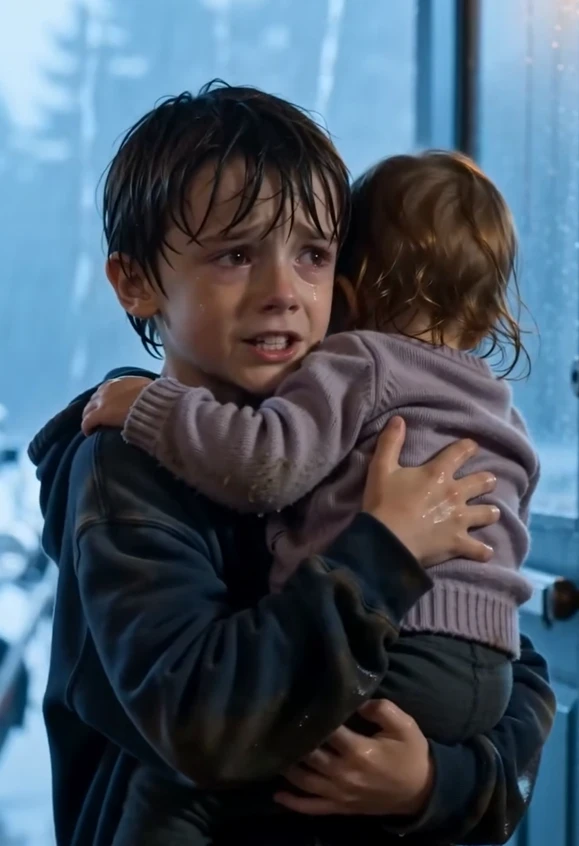
The Rain Would Not Break Him. But What Waited Behind That Door Would Change Everything.
The storm began before sunset, but by nightfall it had become something cruel.
Rain slashed across the empty streets of Briar Glen in icy sheets, turning sidewalks into slick mirrors and alleys into rivers of mud and trash. The wind howled through bare trees and rattled old shop signs, and anyone with sense had already gone inside, locked their doors, and drawn the curtains tight against the cold. It was the kind of November night that made the whole town feel smaller, darker, and less forgiving.
Yet through that storm walked **a twelve-year-old boy carrying his three-year-old sister in his arms**.
His name was Eli Mercer.
He was too thin for his age, with hollow cheeks and dark hair plastered to his forehead from rain. His sweatshirt was soaked through, his jeans heavy with water, and his sneakers squished with every exhausted step. But he kept moving because Daisy, curled tightly against his chest, was shivering so badly he could feel it in his bones.
“Almost there,” he whispered, though he had no idea if that was true.
Daisy’s tiny arms circled his neck. “I’m cold.”
“I know.” His lips trembled as he spoke. “I know, bug. I got you.”
He had been saying that all day.
Ever since social services had come to the apartment again.
Ever since their mother hadn’t answered the door.
Ever since the landlord had finally let the woman from the county in.
Ever since Eli had heard one sentence he knew he would never forget: **“She left sometime last night.”**
Their mother had been drifting for months—sometimes kind, sometimes absent, sometimes locked in her room for hours while Eli fed Daisy crackers and cereal and pretended everything was normal. But this time she was simply gone. No note. No phone call. No money. Just an apartment with the power on borrowed time, a nearly empty cupboard, and two children who suddenly belonged to no one.
The woman from the county had tried to sound gentle. There were procedures. Temporary placement. Emergency housing. They would “figure something out.”
Eli had heard enough.
He knew what happened to kids people had to “figure something out” for. He’d heard stories at school. Brothers separated from sisters. Foster homes in different towns. Phone calls promised and never made. Daisy crying for him in a strange room while nobody understood the way she needed the nightlight angled toward the closet or how she got scared if she woke up and couldn’t hear his voice.
So when the woman stepped outside to make a call, Eli took Daisy’s coat, grabbed the last clean blanket, and ran.
Now hours later, that decision felt heavier than Daisy herself.
He had gone first to their neighbor Mrs. Hargrove, but no one answered. Then to the church, but it was locked. Then to the bus station, where the clerk told him they couldn’t let children stay overnight. At the diner, a waitress gave Daisy hot water in a cup to warm her hands, but the manager told them they had to leave after ten minutes.
Everywhere he turned, there were rules.
No place for children. No overnight loitering. No liability. No space.
And then he remembered a story.
A mechanic near the apartment once said, half joking and half serious, “If you’re ever in real trouble in this town, the Iron Vale Riders may look rough, but they’re the only men who still know what loyalty means.”
Eli had held onto that sentence all evening.
So he walked to the edge of Briar Glen, through the industrial district and past the train tracks, until he saw the old brick building with a carved wooden sign and rows of motorcycles lined like silent animals in the rain.
The Iron Vale Riders Clubhouse.
Light poured through the windows.
Music thumped faintly.
For one terrified second, Eli almost turned around.
Then Daisy coughed against his neck.
So he pushed the door open.
Inside, the room was loud—until it wasn’t.
Conversations stopped mid-word. A game flickered on the television, forgotten. Nearly a dozen men turned at once, leather vests creaking as they moved.
Eli stood there dripping on the floor, Daisy in his arms, his entire body shaking from cold and strain.
“Please don’t send us away,” he said.
Nobody laughed.
Nobody cursed.
Nobody told him to get out.
A man near the door rose from his chair. He was broad and weathered, with gray at his temples and eyes that missed nothing. This was Huck Darnell, president of the Iron Vale Riders.
He looked at Daisy’s bare feet first.
Then at Eli.
“You’re not leaving tonight,” Huck said. “Come inside.”
The room exhaled.
Everything after that happened fast.
Someone brought towels. Someone else tossed another log into the iron stove in the corner. A woman from the attached kitchen—Marlene, Huck’s widowed sister—appeared with a blanket still warm from the dryer. A younger biker named Rooster crouched in front of Daisy with two pairs of fuzzy socks in his giant hands, looking so absurdly careful that Daisy blinked at him instead of crying.
Eli stood frozen until Huck said quietly, “Kid, you can put her down now. She’s safe.”
That was almost enough to make him break.
But he didn’t. He let Marlene take Daisy, and only then did his arms start shaking so hard he had to grip the back of a chair.
Huck guided him toward the stove. “Name?”
“Eli.”
“And your sister?”
“Daisy.”
“Anybody looking for you?”
That question made Eli go still.
He should have lied. He knew that. But those eyes made lying feel useless.
“County services,” he admitted. “Maybe by now.”
A murmur moved through the room.
Huck said, “Why’d you run?”
“Because they’ll separate us.”
No one spoke for a moment.
Then Eli, exhausted and raw and too far gone to protect himself, told them everything. About their mother disappearing for days even before this. About packing Daisy lunches from school leftovers. About telling her stories at night so she wouldn’t hear the shouting from the apartment next door. About the county worker saying “temporary placement” like it wasn’t a blade sliding between two children.
When he finished, the room felt different.
Not softer. Heavier.
Huck rubbed a hand over his jaw. “You did all that yourself?”
Eli stared into the stove. “There wasn’t anybody else.”
Across the room, Rooster turned away and swore under his breath.
Marlene emerged again. “Daisy’s asleep on the couch. She ate half a grilled cheese before passing out.”
For the first time all night, Eli let out a breath that sounded almost like pain.
Huck noticed. “You eat?”
Eli shook his head.
Ten minutes later he sat at a scarred wooden table with tomato soup, two grilled cheese sandwiches, and a mug of hot chocolate. He tried to eat slowly, politely. By the third bite, hunger won. He devoured everything while pretending not to notice the men watching him.
Not judging.
Just watching.
Like none of them had expected to witness **a boy trying so hard to be a man that he had forgotten how to be a child**.