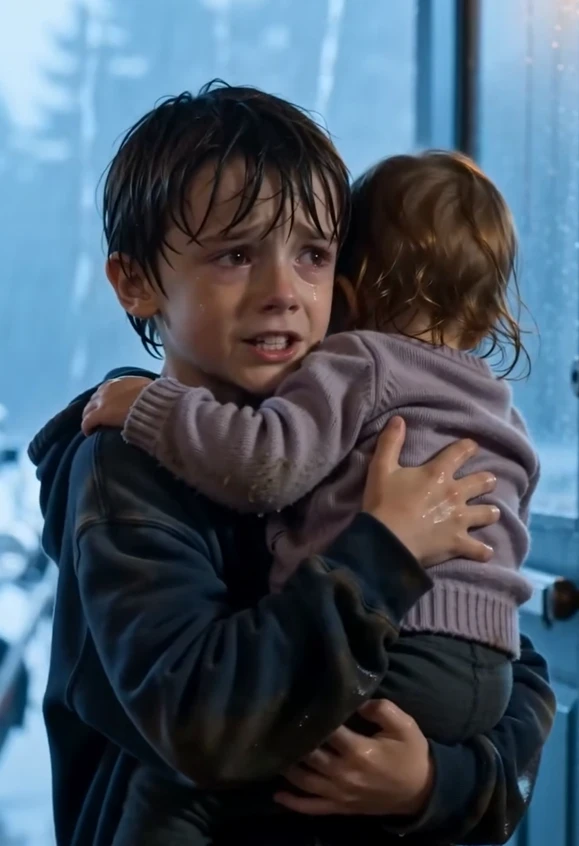
Around midnight, headlights flashed across the windows.
Everyone went still again.
A car door slammed.
Then came a knock.
Not timid. Official.
Huck looked toward the curtained front window and muttered, “County.”
Eli shot to his feet so fast his chair crashed backward. “No.”
“It’s okay,” Huck said.
“No, you don’t understand—they’ll take her. They’ll put us somewhere different. Please.” His breath came short and fast. “Please don’t let them.”
The raw terror in his voice hit the room harder than any threat could have.
Huck stood.
Then so did every other Rider.
Chairs scraped back. Boots hit the floor. One by one, the men formed a quiet line between Eli and the front door.
It was not aggression.
It was presence.
The knock came again, sharper this time.
Huck opened the door halfway. A county caseworker stood under an umbrella beside a sheriff’s deputy. Rain sprayed in around them.
“We’re looking for two minors,” the caseworker began. “A twelve-year-old male and a younger female child. We have reason to believe—”
“You found them,” Huck said.
The woman peered past him, saw Eli, and visibly relaxed with relief. “Thank God. Son, you had everyone worried. We need to take you in now.”
Eli’s fingers dug into the table edge.
Huck didn’t move aside.
“Before you do,” he said, “I’ve got a few questions.”
The deputy frowned. “Sir—”
“You can call me Huck. And my question is simple: where exactly are they going tonight?”
The caseworker hesitated. “Emergency foster intake.”
“Together?”
A pause.
“We can’t guarantee that until placement is confirmed.”
Something in the room changed at those words.
Rooster swore again, louder this time.
Marlene folded her arms. “So your plan is to separate them after this boy kept that little girl alive?”
The deputy shifted uncomfortably.
The caseworker tried again. “This is standard procedure.”
Huck stepped fully into the doorway now, rain misting his shoulders. “Maybe that’s the problem.”
He turned and looked back at Eli.
“What you said earlier,” Huck asked, voice steady, “about there being nobody else. Is that true?”
Eli swallowed hard. “Yes.”
Huck nodded once, like he’d just made a decision somewhere deep and final.
Then he looked at the caseworker and said, “Not anymore.”
The woman blinked. “Excuse me?”
Huck reached into the inside pocket of his vest and pulled out his wallet. From it, he removed an old folded photograph and stared at it for one brief second before showing it to her.
“This was my daughter,” he said. “She was eleven when a drunk driver killed her. If she’d lived, she would’ve looked a lot like that little girl asleep on my couch.”
Nobody in the clubhouse moved.
No one, perhaps, had ever heard Huck say that aloud.
His voice stayed calm, but the grief beneath it was old and ocean-deep.
“I couldn’t save my child,” he said. “But I can damn well stand up for these two.”
The caseworker softened, but procedure still held her spine upright. “Mr. Darnell, unless you’re licensed for emergency kinship or foster—”
“Then tell me what I need,” Huck said. “Tonight.”
Silence.
The deputy glanced at the caseworker. The caseworker looked at Eli, at the couch where Daisy slept under Marlene’s blanket, at the line of Riders standing silent behind their president.
Then she asked the question that changed everything.
“Are you offering temporary guardianship placement pending emergency review?”
Huck answered without hesitation.
“Yes.”
Marlene stepped beside him. “And I live in the attached residence with two spare bedrooms and a legal background in child advocacy.”
Rooster added, “And six of us have already done community mentoring through the veterans outreach program.”
Another Rider spoke up. “The club funds the winter shelter downtown.”
Another: “We can cover clothes, food, school transport.”
Another: “Whatever paperwork you need.”
The caseworker stared at them as if the room itself had become unrecognizable.
Men with scarred knuckles. Leather cuts. heavy boots. Faces that townspeople crossed streets to avoid.
And every one of them standing there, ready to build a wall around two abandoned children.
The deputy cleared his throat. “Given the weather, and given that the child appears stable here... we may have discretionary hold until morning review.”
The caseworker looked at him, then at Huck. “I can authorize an overnight emergency stay pending home assessment at eight a.m. But if anything is out of compliance—”
“It won’t be,” Marlene said.
The woman nodded slowly. “Then the children remain here tonight.”
Eli made a sound—not a sob, not quite—but something breaking open after too much pressure.
His knees buckled.
Huck caught him before he hit the floor.
For the first time in what may have been years, Eli let someone hold him up.
Morning brought social workers, forms, inspection checklists, legal calls, and one deeply stunned family court judge who knew Huck Darnell by reputation but knew Marlene by record. Within seventy-two hours, temporary emergency placement was approved. Within three months, after hearings and testimony and the confirmed disappearance of their mother, **Huck and Marlene became the children’s legal guardians**.
The town talked.
At first they called it surprising.
Then strange.
Then, slowly, beautiful.
Daisy thrived first. She stopped waking from nightmares. She gained weight. She laughed easily. She followed Rooster around the garage and called every biker “Uncle” until no one bothered correcting her.
Eli took longer.
Children who become protectors too soon do not return to childhood in a single season.
But Huck never pushed. He taught Eli how to repair engines, how to throw a proper punch, how to breathe through anger instead of letting it own him. Marlene taught him how to trust quiet, how to ask for help, how to leave some burdens on the table and still sleep at night.
Years passed.
The Iron Vale Riders began sponsoring school drives, foster support funds, and youth emergency housing. It started because of Eli and Daisy, but it did not end there. **That one rainy night transformed an entire club into something the town had never expected: a refuge.**
At nineteen, Eli stood on a stage in Briar Glen High School’s auditorium as valedictorian and scholarship recipient. Daisy, now ten, sat in the front row between Huck and Marlene, swinging her legs and grinning so hard she looked ready to burst.
When Eli stepped to the microphone, the room hushed.
He looked out at the teachers, the judge, the deputy, the old mechanic from the apartment block, the Riders in their dress blacks standing awkwardly proud along the back wall.
Then he found Huck.
“There was a night,” Eli said, voice steady, “when I thought the world had run out of places for us.”
Huck lowered his head.
“I knocked on a door I was supposed to be afraid of.” Eli smiled faintly. “But it turned out fear and goodness don’t always wear the clothes people expect.”
There were tears in the audience now.
Eli’s own eyes glistened, but he didn’t look away.
“You saved my sister,” he said. “And you saved me from becoming a ghost while still alive. Everything I am from that night forward exists because a group of men decided we would not face the storm alone.”
After the ceremony, Huck stood outside beneath a clear spring sky while students flooded the parking lot. Eli walked over in his graduation gown, taller now, broader, stronger. No longer the boy from the doorway. Not entirely.
Huck handed him a small box.
Inside was a silver keychain with a worn metal plate engraved with three words:
**You came inside.**
Eli stared at it, throat tight.
Huck shrugged gruffly. “Most important thing you ever did.”
Eli looked up. “No. The most important thing was that you opened the door.”
And for once, the old biker had no answer.
Only tears he didn’t bother hiding.
Because some families are born.
And some are forged in cold rain, desperation, and one impossible act of mercy that changes every life it touches forever.