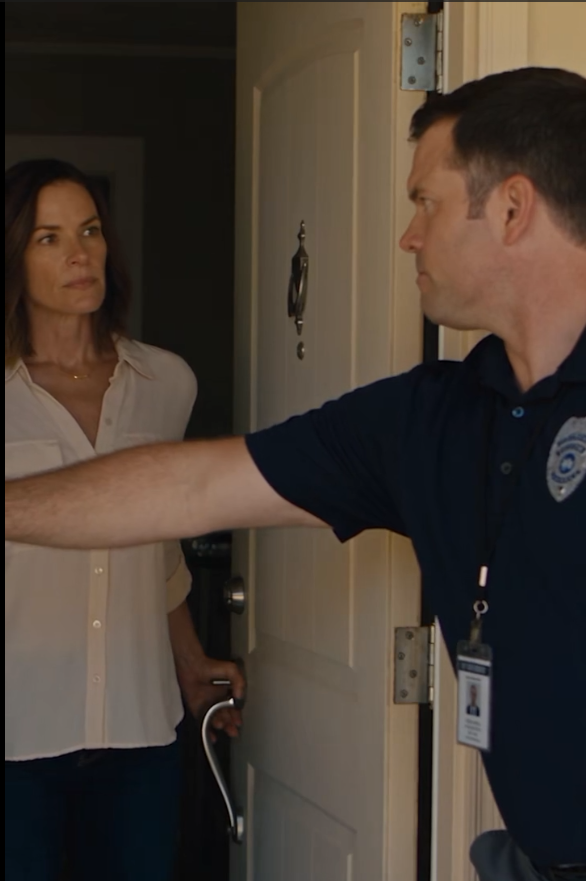
“Ms. Bennett, what happened here and whatever dispute you have with the association are two different things. I can address what happened here. I can’t decide their inspection policy.”
“But if they told him to enter—”
“Then keep your records.”
He looked toward my phone.
“Keep that recording too.”
I nodded.
He started toward the cruiser.
“Deputy?”
He turned.
“Thank you.”
Ruiz gave a small nod.
“Lock your door.”
Part IV — The Original Work Order
For the next four hours, nothing happened.
That was almost worse.
I locked the door.
Checked it twice.
Made coffee I forgot to drink.
My daughter came downstairs around noon.
“Are they gone?”
“Yes.”
“Are they coming back?”
“No.”
I hoped that was true.
She stood in the kitchen doorway.
“Did that guy actually try to come in?”
I looked at her.
“He tried to stop me from closing the door.”
“That’s not what I asked.”
She had inherited that habit from somebody, and I knew exactly who.
“He said they were coming in.”
Her expression hardened.
“Why?”
“I don’t know.”
“You always know.”
“Not this time.”
I opened my laptop.
There were already two new emails.
The first was from Sentinel.
SUBJECT: INSPECTION INTERRUPTION.
The message stated that an authorized inspection had been “disrupted by law enforcement involvement following homeowner objection.”
I read that sentence three times.
Then the next one.
Sentinel reserved the right to return following clarification from the association.
I forwarded it to Deputy Ruiz.
Then I opened the second email.
It was from the Cedar Ridge association.
They had received notice of the incident and were reviewing the matter.
No one from Sentinel was authorized to enter my residence without my consent.
I sat very still.
There it was.
Again.
Not my interpretation.
Not my argument.
Their words.
I replied.
Please provide the original work order issued to Sentinel for today’s inspection, including the scope of work and any instructions concerning interior access.
No answer came that afternoon.
At 4:17, Sentinel called.
I let it go to voicemail.
At 4:24, they called again.
Voicemail.
At 4:33, an unfamiliar number appeared.
I answered.
“Claire Bennett?”
“Yes.”
“This is Sentinel Community Security regarding this morning’s incident.”
“Who is this?”
A pause.
“I oversee field operations.”
“Name?”
Another pause.
Then he gave it.
I wrote it down.
“We’d like to clarify what occurred.”
“You can send it in writing.”
“I think a phone conversation would be more productive.”
“I don’t.”
“Ms. Bennett—”
“Send it in writing.”
I hung up.
My hands were shaking afterward.
Not much.
Enough that I noticed when I put the phone down.
I hated that.
Derek had already left.
The deputy had already come.
The door was locked.
And still my body was behaving as though someone had a hand on it.
At 5:02, Sentinel emailed.
Their account was careful.
Derek had attended pursuant to a valid inspection assignment.
He had attempted to explain that interior verification might be necessary.
A misunderstanding arose concerning access.
At no point, the email said, did Sentinel intend to enter the residence unlawfully.
I read the sentence out loud.
My daughter, doing homework at the other end of the table, looked up.
“What?”
“Nothing.”
“That didn’t sound like nothing.”
I turned the laptop toward her.
She read the paragraph.
“They’re blaming you.”
“They’re avoiding saying what he did.”
“Same thing.”
I started typing.
Then stopped.
Deleted it.
Started again.
Deleted that too.
My daughter watched.
“You’re doing the thing.”
“What thing?”
“The email thing where you write a whole angry paragraph and then delete it.”
“I’m editing.”
“You’re furious.”
“I am editing furiously.”
She almost smiled.
Then she pointed at the screen.
“Send them the video.”
I looked at her.
“No.”
“Why?”
“Because they already know what happened.”
“Then why are they pretending they don’t?”
That was a better question than anything I had typed.
I closed the draft.
At 5:38, the association finally replied.
Attached was a PDF.
ORIGINAL FIELD WORK ORDER.
I opened it.
The first page listed my address.
Complaint type: exterior architectural modification.
Assigned company: Sentinel Community Security.
Assigned inspector: Derek Holt.
Scope:
Photograph privacy screen.
Measure visible dimensions.
Confirm attachment status from exterior.
Document adjacent patio area.
No interior inspection listed.
No interior photographs.
No interior verification.
I kept reading.
At the bottom was a note entered two days after Derek’s first visit.
Inspector reports possible need for interior confirmation.
Association response:
Exterior documentation sufficient. Interior access not authorized or required at this time.
I stopped breathing for a second.
Then I scrolled.
There was another entry.
Derek had requested “discretion to obtain homeowner cooperation for supplemental verification.”
The association had answered:
May request voluntary cooperation. No authority granted for nonconsensual interior access.
I read it again.
Then again.
Marcus had told me to ask for the original work order.
Now I understood why.
The argument had never been about a confusing policy.
Derek had asked for permission.
He had been denied.
Then he had come to my house and told me he had it anyway.
My phone rang.
Deputy Ruiz.
I answered immediately.
“I got your email,” he said. “The one from Sentinel.”
“I just got something else.”
“What?”
“The original work order.”
He was quiet.
“What does it say?”
I told him.
Ruiz didn’t interrupt.
When I finished, he said, “Send it to me.”
“Does this matter?”
“Yes.”
“How much?”
“That depends.”
“On what?”
“On whether the document is authentic, whether the association confirms it, and what Mr. Holt represented to you and to me.”
“He told you the association authorized the inspection.”
“He did.”
“He told me the same thing.”
“I know.”
I looked at the PDF on my screen.
“He knew they didn’t.”
Ruiz didn’t answer that.
Police officers had a way of not stepping into conclusions before they had to.
Instead he said, “Send the document.”
I did.
Ten minutes later, the association called.
This time I answered.
The same woman I had spoken with earlier in the week was on the line.
Her voice sounded strained.
“Ms. Bennett, I wanted to confirm that the work order you requested was sent.”
“I have it.”
“We are conducting a review.”
“Did you ever authorize Derek Holt to enter my house?”
“No.”
“Did you ever tell him interior inspection was required?”
“No.”
“Did you tell him he could ask me?”
“Yes.”
“And when I said no?”
“That should have ended the interior request.”
I closed my eyes.
“Then why didn’t it?”
“I can’t answer that yet.”
“Can you answer whether Sentinel told you this morning’s inspection was disrupted by me?”
Another pause.
“They submitted an incident report.”
“What does it say?”
“I can’t provide that without reviewing our disclosure process.”
“Does it say I refused an authorized inspection?”
Silence.
That was enough.
I stood up from the table.
“They’re building a record against me.”
“I wouldn’t characterize it that way.”
“What would you call it?”
“I would say there are conflicting accounts.”
“There’s a recording.”
“I understand.”
“There’s your work order.”
“I understand.”
“There are emails.”
“I understand.”
“Then what exactly is conflicting?”
She had no answer.