I looked through the kitchen window toward the patio screen that had started all of it.
A four-foot panel.
Gray composite slats.
Six screws.
For three weeks I had believed I was arguing about whether someone could inspect it.
I finally understood that wasn’t the argument anymore.
The argument was whether a record could be created around me faster than I could prove what had actually happened.
“Please preserve everything,” I said.
“Excuse me?”
“All emails. Work orders. internal notes. Messages. Inspection reports. Everything related to my address.”
“Ms. Bennett—”
“I’m asking you to preserve the records.”
She was quiet.
Then she said, “I’ll note your request.”
After the call, I opened a new folder on my laptop.
I named it CEDAR RIDGE — SENTINEL.
Inside, I created subfolders.
Emails.
Policies.
Work orders.
Video.
Sheriff.
Association.
I saved everything.
Then I made two backups.
That evening, for the first time since the cruiser had pulled away, I felt something other than anger.
Clarity.
Part V — Pressure
Two days later, the association suspended the patio violation review.
They did not dismiss it.
They suspended it.
Pending clarification of inspection procedures.
Sentinel, meanwhile, sent another letter.
Derek had been removed from my property assignment.
The company regretted any misunderstanding.
That word again.
Misunderstanding.
I replied with the video transcript.
Not the video.
Just the transcript.
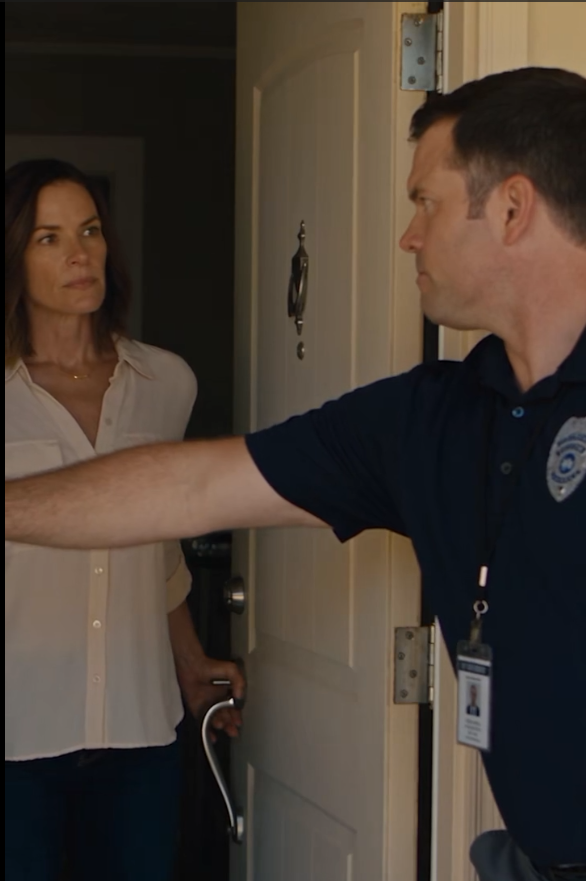
Let go of my door.
You do not have permission to enter my house.
Watch me. We’re coming in.
Then I added one question.
Which portion of this exchange does Sentinel believe was misunderstood?
They did not answer.
Three days later, Deputy Ruiz called again.
He had spoken with the association.
They confirmed the work order.
They confirmed the limitation.
They confirmed Derek had not been given authority to enter.
“What happens now?” I asked.
“I’m documenting the statements.”
“That sounds like nothing.”
“It isn’t nothing.”
“It feels like nothing.”
Ruiz paused.
“Ms. Bennett, I understand why you want a clean answer. Real situations don’t always give you one immediately.”
“He lied.”
“He made statements that conflict with the written authorization.”
“That is a very deputy way of saying he lied.”
“Yes.”
I smiled despite myself.
Ruiz continued.
“What matters is what we can establish, not what either of us calls it.”
“Fine. What can you establish?”
“That he was told interior access was not authorized. That you denied permission. That he physically prevented you from closing the door for a period of time. That he told you they were coming in. That he told me he had association authorization. And that the association says it did not grant that authorization.”
Hearing the sequence aloud changed something.
Not because any part was new.
Because it sounded different in another person’s voice.
Clean.
Simple.
No jargon.
No “verification protocols.”
No “scope discretion.”
No “homeowner cooperation.”
Just actions.
“What do I do now?”
“That depends what you want.”
“I want them to stop.”
“Then don’t lose sight of that.”
It was good advice.
I ignored it for forty-eight hours.
Instead, I read everything.
Association bylaws.
Sentinel contract language that the association provided after I requested it.
Inspection policies.
Property access provisions.
Complaint procedures.
By Sunday night, I had thirty-two pages of notes and a headache.
My daughter found me at the dining table again.
“You know you don’t have to become a lawyer because one guy touched our door.”
“I’m not becoming a lawyer.”
“You have tabs.”
“I always have tabs.”
“You have seventeen tabs.”
I counted.
Nineteen.
I closed three.
She sat across from me.
“Are you scared he’s coming back?”
The question caught me off guard.
“No.”
She waited.
I looked toward the front hallway.
“Maybe a little.”
She nodded.
“Me too.”
That did more to me than anything Derek had said.
Until then, the entire dispute had lived inside my head as a problem to solve.
A record to organize.
A boundary to defend.
I had not let myself think about what it looked like from upstairs.
A man’s voice at the door.
My voice getting louder.
A siren.
A patrol car.
Her mother telling her to stay inside.
I closed the laptop.
“Come here.”
She didn’t.
She was too old for that reflex.
Instead, I moved around the table and sat beside her.
“He isn’t coming back.”
“How do you know?”
“Because he was formally told not to.”
“And if he does?”
“Then I call again.”
She looked at me.
“You knew to call before.”
“Yes.”
“Why?”
I thought about the email.
Obtain access.
“Because sometimes the wording tells you what someone plans to do.”
She absorbed that.
Then said, “That sounds creepy.”
“It was enough for me to be careful.”
We sat quietly.
Eventually she said, “Can we stop talking about the patio now?”
“Yes.”
“Forever?”
“I can promise tonight.”
“That works.”
We ordered pizza.
For two hours, I didn’t look at my email.
At 9:16, my phone buzzed.
Association board meeting notice.
Special session.
Subject: Sentinel contract compliance and homeowner access procedures.
I stared at it.
My daughter looked over.
“No.”
I put the phone face down.
“Tomorrow.”
The special meeting was held three evenings later.
I had not planned to attend.
Then I read the agenda.
The incident at my house was not identified by address, but the language was obvious.
Review of contractor conduct during compliance inspection.
Clarification of homeowner consent requirements.
Consideration of corrective action.
I went.
Not because I wanted to relive what happened.
Because Sentinel had submitted an incident report.
And I wanted to hear what version of me existed inside it.
The meeting room was small.
Folding chairs.
Fluorescent lights.
A projector at the front.
Derek was not there.
Marcus was.
He sat near the side wall in a plain button-down shirt rather than a Sentinel polo.
When I entered, he looked at me.
Then away.
The association representative opened with procedure.
No public argument.
No interruptions.
The contractor would present its report.
Then I would have an opportunity to respond.
Sentinel’s field operations supervisor spoke first.
He described the original exterior complaint accurately.
He described Derek’s first visit accurately.
Then the language began to shift.
“Following the initial inspection, field personnel identified a potential need for supplemental verification.”
Potential.
“Subsequent communications reflected disagreement concerning the appropriate scope of that verification.”
Disagreement.
“On the date of the incident, Sentinel personnel attended the property intending to explain the inspection requirements and seek resolution.”
Seek resolution.
I sat with my hands folded.
The supervisor continued.
“When the homeowner objected, the interaction became contentious.”
I looked at Marcus.
His face was still.
“Law enforcement arrived, and the inspection was terminated without further incident.”
Without further incident.
The supervisor concluded by saying Sentinel believed the matter resulted from unclear communication regarding the distinction between “requesting access” and “requiring verification.”
The association representative turned to me.
“Ms. Bennett?”
I stood.
I brought no speech.
Only four pages.
The first was the work order.
The second was the association’s instruction that interior access was not authorized or required.
The third was my written refusal and Sentinel’s acknowledgment.
The fourth was Derek’s message saying he would “obtain access.”