Maybe Derek had some financial incentive.
Maybe Sentinel had quotas.
Maybe the association secretly encouraged aggressive inspections.
Maybe there was some hidden reason my patio mattered.
The documents showed nothing like that.
The truth was more ordinary.
Derek had been told no.
He believed he could turn it into yes.
And when he couldn’t, he wrote the paperwork as though my refusal were the problem.
No conspiracy.
No grand plan.
Just a person who had become too comfortable treating a request as authority.
Two weeks later, the association called another meeting.
This one was larger.
Several homeowners attended.
I recognized none of them.
That bothered me.
Not because I expected to know everyone in Cedar Ridge.
Because two of them carried folders that looked exactly like mine.
One man described an inspector asking to enter his garage after an exterior parking complaint.
A woman said Sentinel had requested photographs from inside her sunroom.
Another homeowner said he had allowed an inspector into his home because he believed he was required to.
“Were you told it was optional?” the board chair asked.
“No.”
“Were you told you could refuse?”
“No.”
The Sentinel supervisor sat at the front table.
Derek was absent.
Marcus was there again.
This time, when he spoke, he had records.
Internal training slides.
One contained a phrase:
Secure homeowner cooperation whenever expanded verification is operationally useful.
The board’s attorney asked, “What does ‘secure cooperation’ mean?”
The supervisor answered, “Obtain voluntary consent.”
Marcus looked down.
The attorney noticed.
“Mr. Cole?”
For the first time, I learned Marcus’s last name.
He raised his head.
“That’s what it’s supposed to mean.”
“What did it mean in practice?”
Marcus hesitated.
The room waited.
“It meant don’t come back without what you were sent for.”
The supervisor objected immediately.
“That is not company policy.”
“I didn’t say it was written policy.”
“Then you’re describing individual interpretation.”
Marcus nodded.
“Yes.”
“Your interpretation?”
“No.”
The supervisor’s face tightened.
Marcus continued.
“We were judged on completion rates. If homeowners refused something inspectors believed would close a file, the expectation was to keep asking.”
The attorney said, “Keep asking is not the same as entering without consent.”
“No.”
Marcus looked toward me.
“But when you reward closed files and treat refusal as incomplete cooperation, some people stop hearing the difference.”
That sentence stayed with me longer than anything else said that night.
The board voted.
The Cedar Ridge association terminated Sentinel’s contract.
Not because the company had performed exterior inspections.
Not because every inspector had behaved like Derek.
Because the review found that Sentinel’s reporting, training, and oversight did not adequately distinguish between requesting voluntary access and representing access as mandatory.
Derek’s employment status was not discussed publicly.
I found out the next day.
Sentinel sent me a formal letter.
He was no longer employed by the company.
The letter also withdrew every internal notation describing me as resistant, uncooperative, or obstructive.
Then came the line I had been waiting for.
The patio inspection was complete.
The privacy screen was compliant.
No interior inspection had ever been necessary.
I laughed when I read it.
One short breath.
Then another.
My daughter looked up from the sofa.
“What?”
I turned the laptop around.
She read the last paragraph.
“All this over that stupid screen?”
“Apparently.”
She stared toward the patio.
“So we won?”
I thought about the question.
The easiest answer was yes.
Derek was gone.
Sentinel was gone.
The violation was gone.
The record had been corrected.
But winning was the wrong word.
I closed the laptop.
“We finished it.”
She considered that.
“Less exciting.”
“More accurate.”
“Your favorite.”
“Unfortunately.”
She smiled.
Then she went back to what she was doing.
I carried the laptop to the dining table.
There was one more thing I needed to decide.
The association had asked whether I wanted the video from the porch included in a homeowner training presentation about contractor access.
Faces blurred.
Names removed.
Audio preserved.
My first reaction had been no.
I was tired of hearing my own voice in that doorway.
Tired of Derek’s.
Tired of the sentence.
Watch me.
We’re coming in.
I wanted the whole thing to become old files on a hard drive I never opened.
Then I remembered the man at the meeting who had let an inspector into his house because he thought he had no choice.
I remembered Marcus saying people say no in email and change their minds at the door.
I remembered my daughter asking why I had known to call before Derek arrived.
The wording tells you what someone plans to do.
I opened the association’s message.
I typed:
You may use the recording if the context is clear.
Then I added:
Please begin with the written refusal, not the confrontation. People should understand that the problem did not begin when he touched the door. It began when a clear no was treated as something temporary.
I sent it.
Three months later, the association replaced Sentinel with a different compliance process.
Exterior inspections stayed exterior unless homeowners voluntarily agreed otherwise.
Every inspection notice contained a new sentence in plain language:
Entry into your residence requires your consent unless otherwise authorized by law.
No jargon.
No footnote.
No “expanded verification.”
Just consent.
One Saturday morning, I replaced the weather stripping around my front door.
My daughter came downstairs and found me kneeling beside it with a screwdriver.
“What are you doing?”
“Fixing this.”
“Did they break it?”
“No.”
The strip had been worn before Derek ever came.
I just hadn’t noticed.
She leaned against the wall.
“You know what’s weird?”
“What?”
“I barely think about that day anymore.”
I pressed the new strip into the channel.
“That’s good.”
“Do you?”
I considered lying.
“No.”
She waited.
“But not the way I used to.”
That was true.
For weeks, whenever the doorbell rang, I had looked through the window before moving.
Whenever I saw a dark polo shirt on the porch, even a delivery driver, my shoulders tightened before my mind caught up.
That faded.
Slowly.
Ordinarily.
The way most things heal when no one is watching.
I stood and tested the door.
It closed smoothly.
My daughter opened it again.
“Seems normal.”
“It is normal.”
She stepped outside to get the mail.
I watched her walk down the path.
The same walkway Derek had stood beside.
The same curb where Deputy Ruiz’s cruiser had stopped.
Nothing about the house looked different.
That mattered too.
A week later, an envelope arrived from the association.
Inside was the final review summary.
I nearly threw it away.
Instead, I read it once.
The findings were dry.
Contractor exceeded authorized inspection scope.
Homeowner refusal was clear.
Internal controls were insufficient.
Incident reporting omitted material context.
Corrective measures implemented.
At the end was a copy of the revised inspection policy.
I put it in the folder with everything else.
Then I noticed one final attachment.
A corrected copy of Sentinel’s original incident report.
The first version had described what happened as:
Inspection disrupted following homeowner objection and law-enforcement involvement.
The corrected version read:
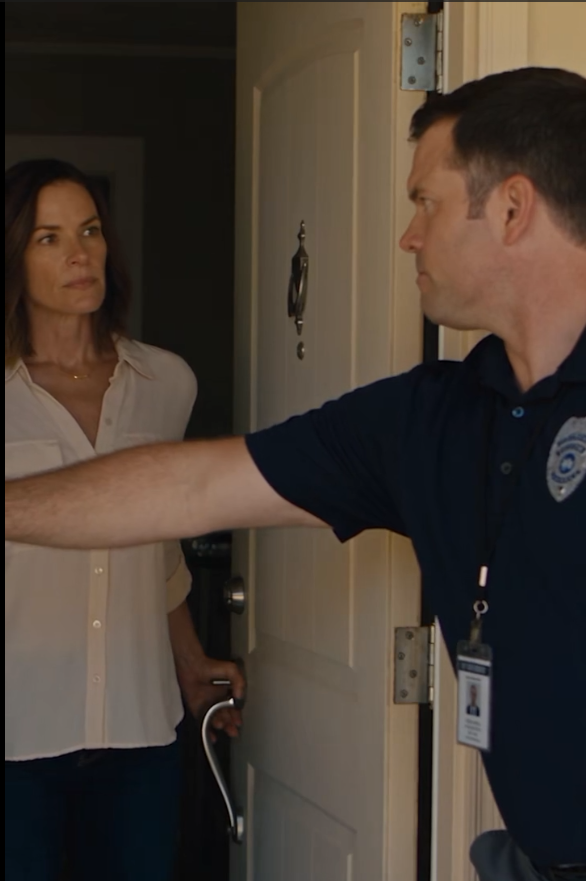
Inspector continued seeking interior access after homeowner expressly denied consent. Inspector prevented closure of the front door while stating intent to enter. Law enforcement arrived before any entry occurred.
I read it twice.
For months, I had thought the most important thing was keeping Derek out of my house.
It wasn’t.
He had never crossed the threshold.
The most important thing was what came after.
Making sure the record crossed back toward the truth.
I closed the folder.
Then I carried it upstairs and placed it in the cabinet where I kept tax documents, warranties, and things I hoped not to need again.
Before shutting the drawer, I looked at the label.
CEDAR RIDGE — SENTINEL.
Three weeks of emails.
One morning on the porch.
Seventy-eight pages of records.
A patrol report.
A video.
All because I had said no and somebody had decided that no was merely the beginning of a negotiation.
I closed the drawer.
Downstairs, the doorbell rang.
For a second, I stood still.
Old reflex.
Then I walked down.
I checked the window.
A delivery driver stood on the porch holding a cardboard box.
I opened the door.
“Claire Bennett?”
“Yes.”
“Package for you.”
He handed it over.
“Have a good one.”
“You too.”
He turned and walked away.
I looked down at the box.
Then at the door.
There was no fear.
No anger.
No memory rushing forward.
Just a door.
Mine.
I stepped inside and pulled it closed.
The latch clicked softly into place.
And this time, no one tried to stop me.