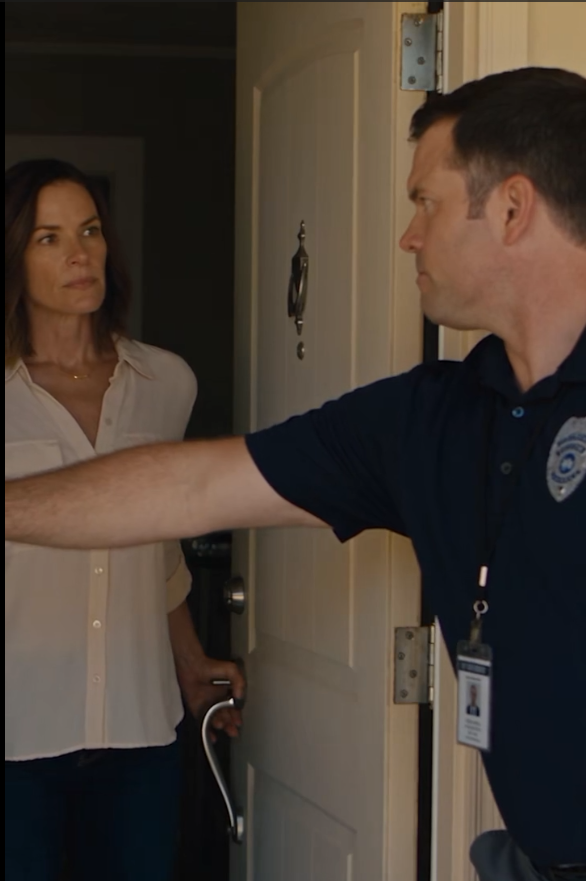
I placed copies on the table.
Then I took out my phone.
“I don’t think the communication was unclear.”
The field supervisor shifted.
I looked at the board.
“I’m going to play twenty-one seconds.”
I pressed the screen.
My own voice filled the room.
Let go of my door.
Then Derek’s silence.
You do not have permission to enter my house. I’m telling you clearly. Do not cross this doorway.
A pause.
Then his voice.
Watch me. We’re coming in.
I stopped the recording.
No one spoke.
I did not need them to.
I looked at the supervisor.
“Which part was unclear?”
He glanced down.
The association representative asked, “Was Mr. Holt aware at that time that interior access had not been authorized?”
The supervisor answered carefully.
“He was aware that homeowner consent had not been obtained.”
“That wasn’t my question.”
The words came from Marcus.
Every head turned.
He was still sitting by the wall.
The supervisor stared at him.
Marcus stood.
“He knew.”
The room remained quiet.
The supervisor said, “Marcus, this is not—”
“He knew the association denied interior authorization.”
The representative leaned forward.
“How do you know?”
Marcus lifted his tablet.
“Because the note was in the work order.”
My skin prickled.
He continued.
“And because he showed it to me in the vehicle before we went to the door.”
The supervisor’s face hardened.
“Why are you raising this now?”
Marcus looked at him.
“I raised it that morning.”
The supervisor said nothing.
Marcus turned toward the board.
“When we parked, I asked why we were going back if the interior wasn’t approved. He said the homeowner would cooperate once we were standing there.”
I remembered Marcus behind Derek.
Quiet.
Uncomfortable.
Holding the tablet.
“He told me my job was to document the inspection and not interfere.”
The association representative asked, “Did Mr. Holt tell you he intended to enter without consent?”
“No.”
Marcus paused.
“Not in those words.”
“What did he say?”
Marcus looked toward me.
“He said, ‘People say no in email. They change their mind at the door.’”
Something inside me went cold.
Not because it was dramatic.
Because it was ordinary.
A sentence someone might say casually.
A habit disguised as experience.
The supervisor spoke.
“This is being presented without context.”
Marcus looked at him.
“What context fixes it?”
The board chair intervened before the conversation could turn into an argument.
She asked Marcus whether there were records supporting what he was saying.
Marcus tapped the tablet.
“The work order history should show the access note.”
“We have that.”
“There should also be an internal field comment.”
The Sentinel supervisor went very still.
The chair noticed.
“What field comment?”
Marcus answered.
“After the association denied interior authorization, Derek added a note saying he would attempt direct resolution onsite.”
The supervisor said, “That doesn’t mean forced access.”
“No,” Marcus said. “It doesn’t.”
He looked at me.
“But after she told him no at the door, we weren’t resolving anything.”
The board chair turned to Sentinel’s supervisor.
“Was that internal comment provided with the incident report?”
He didn’t answer immediately.
“No.”
“Why not?”
“It was considered operational metadata rather than part of the incident narrative.”
I almost admired the sentence.
Almost.
The chair did not.
“Provide it.”
The supervisor said he would need approval.
“Then get approval.”
That was the first moment I understood the meeting was no longer about my patio.
Part VI — The Record
The Sentinel contract was temporarily suspended from performing residential access-related inspections in Cedar Ridge the next morning.
Not canceled.
Suspended.
The association announced an external review of inspection procedures and contractor reporting.
Derek was placed on administrative leave by Sentinel.
Marcus sent me an email that afternoon.
Only two sentences.
I’m sorry I didn’t say something sooner. I should have.
I stared at it for a long time.
Then I replied.
You said something when it mattered.
I almost left it there.
Then I added:
But next time, say it sooner.
He answered five minutes later.
Fair.
The story could have ended there.
For a while, I believed it had.
Then the association sent me the complete inspection file.
Not because they suddenly became generous.
Because after the board meeting, they decided every homeowner involved in an active Sentinel compliance matter would receive the contractor records related to their property.
My file was seventy-eight pages.
Most of it was boring.
Photographs.
Measurements.
Automatic timestamps.
Copies of emails I already had.
Then I reached page sixty-four.
FIELD NOTE — FIRST VISIT.
Entered by Marcus.
Exterior screen appears freestanding. No visible structural attachment. Homeowner declined interior access. Exterior documentation appears sufficient.
Below it was another note.
Entered twelve minutes later.
Derek Holt.
Supplemental interior verification recommended due to incomplete homeowner cooperation.
I stared at those words.
Incomplete homeowner cooperation.
Not incomplete inspection.
Not insufficient evidence.
My cooperation.
I kept reading.
There were internal notes after almost every email I sent.
Homeowner resistant to expanded verification.
Homeowner continues to restrict access.
Homeowner disputes inspection scope.
Each statement was technically true.
Together, they created a different story.
Then I reached the morning of the incident.
7:02 a.m.
Association instruction confirmed: no interior authorization. Request voluntary access only.
7:11 a.m.
Derek:
Will attempt direct resolution onsite.
7:14 a.m.
The email to me:
Interior verification remains required. We will attend this morning and obtain access as permitted under association authority.
Seven minutes between the association telling him he did not have authority and Derek telling me that he did.
I sent the page to Deputy Ruiz.
His reply came twenty minutes later.
Received.
Then nothing for two days.
On the third morning, he called.
“We need to talk.”
I stepped outside onto the back patio.
The privacy screen stood beside me in bright sunlight.
“What happened?”
“Sentinel provided additional records.”
“Voluntarily?”
A pause.
“After request.”
“What do they show?”
Ruiz exhaled.
“There were other complaints.”
I leaned against the patio table.
“About Derek?”
“About access disputes.”
“How many?”
“I can’t discuss other people’s cases in detail.”
“Were they like mine?”
“Some involve allegations that inspectors continued pressing for access after homeowners declined.”
I said nothing.
Ruiz continued.
“Your recording is the clearest documentation we have.”
There it was.
The reason the entire thing mattered beyond my front door.
Not because mine was the worst incident.
Because mine was recorded.
“What happens?”
“Sentinel is conducting its own review. The association is cooperating. We’re looking at whether any conduct rises beyond policy violations.”
“That sounds uncertain.”
“It is.”
“Did Derek do this before?”
“I’m not going to tell you something I can’t prove.”
I closed my eyes.
“What can you prove?”
“In your case?”
“Yes.”
“That he received explicit instructions. That he sent you a contradictory representation afterward. That he physically interfered with your attempt to close the door. That he stated an intention to enter after consent was denied. That he then represented to me that he had association authorization.”
I looked at the privacy screen.
“Why would he do that?”
“I don’t know.”
That answer stayed with me.
I had spent weeks trying to find a larger explanation.