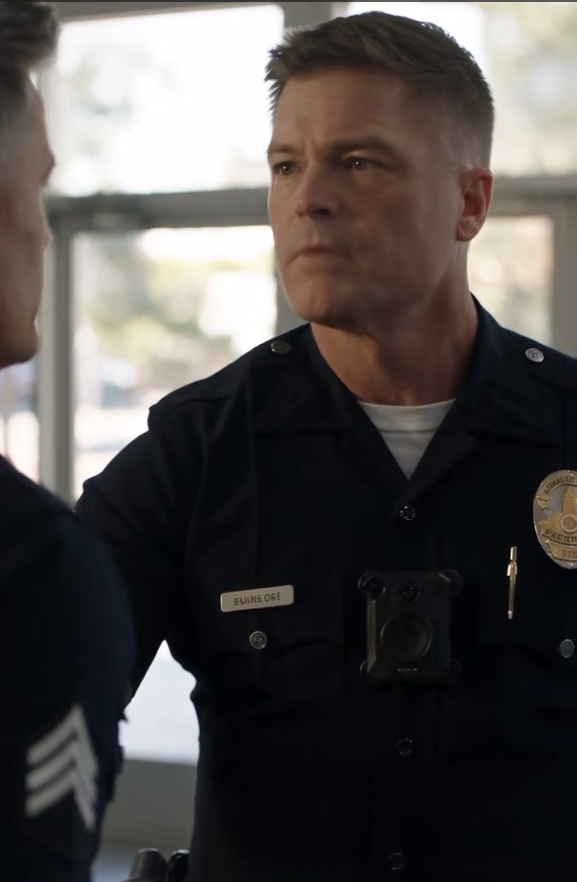
Part I — Before Roll Call
The first sound Marcus Reed heard as the handcuffs closed around his wrists was not the click of steel.
It was the silence behind him.
A police station was never truly quiet. Even before seven in the morning, there were radios murmuring from belts, keyboards tapping behind the desk, phones ringing in distant offices, boots crossing tile, paper sliding from printers, someone laughing too loudly at something that was not very funny.
But as Sergeant Garrett Caldwell pulled Marcus’s wrists together and locked the cuffs, all of that seemed to recede.
Marcus stood facing the polished front counter of Riverside Police Station with both hands behind his back and thought, with almost clinical clarity, So this is how the morning begins.
He had entered the building less than five minutes earlier.
That was all it had taken.
Five minutes for an ordinary observation to become something else.
Marcus had planned the morning carefully.
He had arrived before his official introduction because he did not want a ceremony waiting for him. He did not want balloons taped around the front desk or commanders standing in a polished line. He did not want a speech about tradition from people who had spent the previous evening warning everyone to straighten their desks.
He wanted the station before it knew it was being watched.
So he had come early.
No escort.
No announcement.
No commissioner beside him.
Only a slim leather folder tucked beneath one arm and the dark command uniform he had put on at five-thirty that morning.
The uniform still felt slightly unfamiliar.
Not because Marcus had never worn command insignia before. He had spent most of his adult life in law enforcement, moving through patrol, investigations, supervision, and executive assignments one responsibility at a time.
The unfamiliarity came from what the insignia represented now.
Chief of Police.
Not acting.
Not interim.
Not candidate.
Chief.
He had stood in front of the mirror that morning longer than he normally would, checking a collar he knew was straight.
Then he had told himself to stop staring at the title and start earning it.
That was why he was at Riverside before roll call.
The appointment had gone through late the previous week. Internal notice had been distributed, but the department photograph had not yet been circulated. A formal introduction had been scheduled for eight.
Marcus had asked that no one make a production out of his arrival.
Commissioner Helen Ward had replied, “You know asking cops not to make a production out of a new chief is like asking reporters not to ask questions.”
He had almost smiled.
“I’ll survive.”
“You planning to come in early?”
“Maybe.”
There had been a pause.
Helen knew him well enough not to ask again.
Now, as Sergeant Caldwell tightened one cuff a notch, Marcus wondered whether she would later accuse him of engineering the entire thing.
He had not.
But he had also refused to stop it.
That distinction would matter.
“Too tight?” Caldwell asked.
His tone suggested that he did not especially care.
Marcus tested his fingers once.
“No.”
Caldwell moved to his side.
“You picked the wrong station for this stunt.”
Marcus looked at the counter in front of him.
Someone had left a coffee ring beside a stack of visitor forms.
A handwritten note on yellow paper said CALL MAINTENANCE—DOOR STICKS AGAIN.
Behind him, someone shifted his weight.
Marcus recognized the sound of discomfort.
Not outrage.
Not yet.
Just people realizing that what had seemed entertaining thirty seconds ago might become difficult to explain.
Caldwell began searching him.
Professional in sequence.
Less professional in attitude.
Marcus remained still while the sergeant checked the outer pockets of his uniform.
He had learned long ago that there were moments when cooperation was not surrender.
Sometimes it was evidence.
Caldwell found the department-issued equipment already visible on Marcus’s belt.
Nothing concealed.
Nothing suspicious.
Then he removed the leather folder Marcus had been carrying.
Marcus turned his head a few degrees.
“I would suggest you open that carefully.”
Caldwell gave a short laugh.
“What, another fake credential?”
He tossed the folder onto the counter.
He did not open it.
That told Marcus more than almost anything else that had happened.
A younger patrol officer near the desk shifted again.
He had been the only one to speak up.
Twice.
The first time, he had said, “Sergeant, maybe we should just check his credentials.”
The second time: “I really think we should call upstairs.”
Both times Caldwell had ignored him.
Marcus did not know the young officer’s name yet.
But he remembered his face.
That was another habit learned over decades.
Remember the person who asks the reasonable question when everyone else is watching the unreasonable thing happen.
Caldwell leaned closer.
“You want to tell me who you really are?”
Marcus looked at the reflection of the room in the darkened glass behind the front desk.
“I already did.”
“No. You told me you had business with the commissioner.”
“I do.”
“And you expect me to believe you just walk in here dressed like command staff and go upstairs?”
“I expected you to verify my identity.”
Caldwell’s mouth tightened.
“You expect too much.”
Marcus finally turned his head enough to look directly at him.
“No, Sergeant. I expect procedure.”
That landed badly.
Marcus saw it immediately.
The muscles around Caldwell’s mouth changed. Not much, but enough.
Some people heard the word procedure as a protection.
Others heard it as a challenge to authority.
Caldwell seemed to belong to the second group.
“You don’t tell me how to do my job.”
Marcus’s voice stayed level.
“I haven’t.”
“You’ve been doing it since you walked in.”
“No. I answered your questions.”
Caldwell glanced toward the officers gathered nearby.
Marcus followed the movement.
There were more of them now.
A cluster had formed near roll call.
No one wanted to appear as though they were staring.
Everyone was staring.
Caldwell seemed to notice the audience too.
And Marcus saw the moment the interaction stopped being about identity.
It became about backing down.
That was always the more dangerous moment.
A person who could still change course privately might refuse once others were watching.
Marcus had seen officers do it on traffic stops.
Supervisors do it in disciplinary meetings.
Commanders do it in budget hearings.
Pride loved witnesses.
Caldwell picked up the folder and turned it over once.
Marcus said nothing.
The sergeant looked at him.
“You think this is funny?”
“No.”
“You’ve got some kind of problem with me?”
“I met you five minutes ago.”
That drew the smallest reaction from one of the officers near the desk—a breath that might have been a suppressed laugh.
Caldwell heard it too.
His shoulders stiffened.
Marcus did not need another sign.
He had already made his decision.
Do not rescue him from his own choices.
Not because Marcus wanted revenge.
Because the truth of an organization was rarely visible when everyone was given time to prepare.
Sometimes it arrived by accident.
Sometimes it handcuffed the new chief before breakfast.
The front doors opened.
Cool September air entered first.