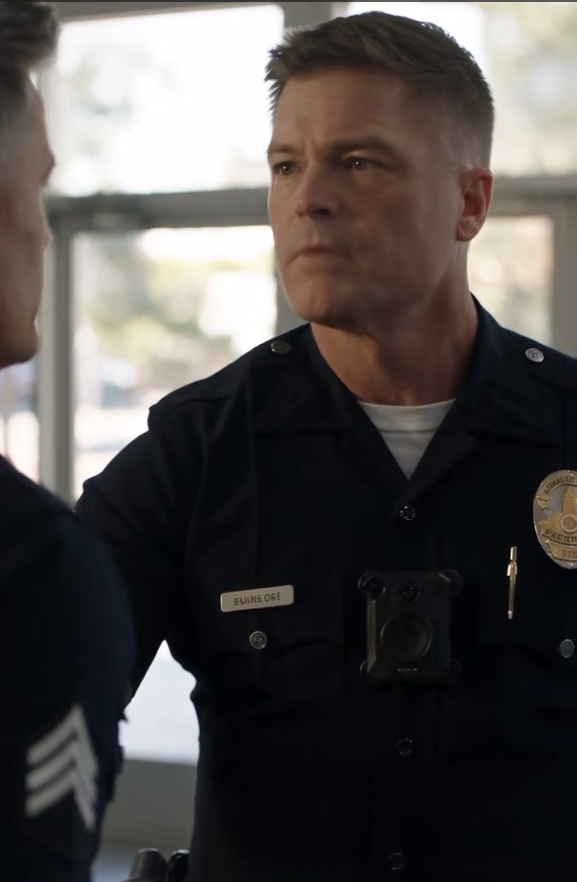
Then Commissioner Helen Ward walked through with two senior commanders beside her.
She was speaking quietly about something Marcus could not hear.
All three made it several steps before noticing the room.
The commissioner stopped.
Her eyes moved across the officers standing too still.
Then toward the counter.
Then to Marcus.
Marcus watched her expression change.
Not dramatically.
Helen Ward was not a dramatic person.
But her face became completely unreadable.
“Why is he in handcuffs?”
No one answered.
Caldwell stepped away from Marcus.
For the first time that morning, he looked less certain.
He cleared his throat.
“Commissioner, this man entered wearing unauthorized command insignia and claimed he had business upstairs. I detained him until we could establish who he really is.”
Helen looked at him.
Then at Marcus.
Marcus said nothing.
He did not need to.
The leather folder sat on the counter between them.
Closed.
Untouched.
Helen’s eyes dropped to it.
Then returned to Caldwell.
“How long has he been here?”
“Just a few minutes.”
“And you verified his credentials?”
Caldwell hesitated.
“I was in the process.”
The younger officer looked down.
Marcus noticed.
So did Helen.
Her voice dropped.
“Sergeant Caldwell.”
“Yes, ma’am.”
“Do you honestly not know who that is?”
Something changed in Caldwell’s face.
Not understanding yet.
But the first crack in certainty.
“No, ma’am.”
Helen looked across the lobby.
At the officers.
At the counter.
At Marcus.
Then back at Caldwell.
And when she spoke, she did not raise her voice.
She did not need to.
“Who handcuffed Riverside’s new Chief of Police?”
For several seconds, no one moved.
Caldwell stared at Marcus.
His face lost color in stages.
Marcus saw recognition arrive not because he suddenly remembered a photograph, but because the title rearranged every previous moment.
The command insignia.
The calm.
The request to verify his identity.
The commissioner.
The folder.
The body camera.
Caldwell’s eyes flicked toward the device clipped to his chest.
Marcus saw that too.
“Sergeant,” Helen said.
Caldwell swallowed.
“I did, ma’am.”
Helen turned to one of the senior commanders.
“Remove the restraints.”
Marcus spoke before the commander moved.
“No.”
Everyone looked at him.
Caldwell stared.
Helen’s eyes narrowed slightly.
Marcus turned enough to face her as much as the cuffs allowed.
“Sergeant Caldwell put them on.”
He looked back at Caldwell.
“He can take them off.”
There was no triumph in his tone.
That made the moment worse.
Caldwell stepped forward.
For the first time, his hands were unsteady.
He took out the key.
The lock released.
Then the second.
Marcus brought his arms forward and rubbed one wrist once.
Nothing more.
Caldwell opened his mouth.
“Chief, I—”
Marcus looked at him.
Not coldly.
Not angrily.
Just directly.
“Don’t explain it yet.”
Caldwell stopped.
Marcus nodded toward the body camera.
“Preserve the recording.”
Then he looked at the leather folder on the counter.
“Open that.”
Caldwell did.
Inside, under a copy of Marcus Reed’s appointment order, was a letter signed by the commissioner.
The first line identified him as Riverside’s incoming Chief of Police.
Caldwell read enough.
He closed the folder.
No one spoke.
Marcus picked it up.
Then he looked across the morning shift.
Every face had changed.
Before, they had been spectators.
Now they were witnesses.
That was different.
Marcus turned to Helen.
“Is the conference room open?”
“Yes.”
“Good.”
He glanced at the officers gathering for roll call.
“Let them finish their shift briefing.”
Helen studied him.
“And Caldwell?”
Marcus looked at the sergeant.
Garrett Caldwell stood beside the counter with his hands at his sides.
For the first time since Marcus had entered the building, he looked like a man who understood that authority and control were not the same thing.
Marcus said, “He comes upstairs.”
Then he walked toward the administrative hallway.
No one tried to stop him.
Part II — What the Camera Saw
The conference room smelled faintly of dry-erase marker and old coffee.
Marcus stood by the window while Helen closed the door behind them.
Caldwell remained near the far end of the table.
One of the senior commanders had taken custody of the body-camera recording and the station’s lobby footage.
Marcus had insisted on that immediately.
Not because he expected anyone to alter it.
Because good procedure mattered most when the facts appeared obvious.
Especially then.
Helen placed both hands on the back of a chair.
“You want him present?”
Marcus nodded.
“For now.”
Caldwell looked from one to the other.
“Chief, I apologize.”
Marcus did not respond immediately.
He removed his leather folder from beneath his arm and placed it on the table.
“You apologized for what?”
Caldwell blinked.
“For the misunderstanding.”
Marcus pulled out a chair.
“Sit down.”
They sat.
Helen remained standing for another second, then took the chair beside Marcus.
Caldwell sat across from them.
His posture had changed completely since the lobby.
Earlier, he had occupied space.
Now he seemed determined not to.
Marcus folded his hands loosely on the table.
“What was the misunderstanding?”
Caldwell looked at him.
“I didn’t know who you were.”
“That’s true.”
“I thought you were impersonating command staff.”
Marcus nodded once.
“Also true.”
Caldwell seemed encouraged by the agreement.
“The department photo hadn’t been circulated. I’d never met you.”
“That’s true too.”
Marcus waited.
Caldwell waited with him.
After several seconds, the sergeant realized there was more expected.
Marcus said, “None of those things are the problem.”
Caldwell’s jaw tightened.
Helen said nothing.
Marcus continued.
“You had an unidentified person inside a police facility wearing command insignia. You were entitled to stop him.”
Caldwell nodded quickly.
“Yes, sir.”
“You were entitled to request identification.”
“Yes, sir.”
“You were entitled to verify the insignia, credentials, name, purpose of entry, and access level.”
“Yes, sir.”
Marcus leaned back slightly.
“What did you actually do?”
Caldwell’s mouth opened.
Then closed.
Marcus did not fill the space.
It was one of the first lessons he had learned as an investigator: people rushed to escape silence.
Supervisors did too.
Finally Caldwell said, “I detained you.”
“You grabbed my wrist when I reached for the identification you requested.”
Caldwell looked down at the table.
“Yes.”
“A patrol officer suggested checking my credentials.”
“Yes.”
“You ignored him.”
Caldwell said nothing.
“He suggested calling upstairs.”
“Yes.”
“You ignored him again.”
“Yes.”
“I told you to verify my name before making another decision.”
Caldwell’s face tightened.
“Yes.”
“You arrested the problem before you investigated it.”
The sentence settled between them.
Caldwell shifted in his chair.
“I was trying to control the situation.”
Marcus nodded.
“I know.”
The sergeant looked up.
Marcus said, “That’s what concerns me.”
Helen folded her arms.
Caldwell looked toward her.
“Commissioner, with respect, a man came into the station wearing command insignia—”
Helen cut him off.
“Your problem is not that you stopped him.”
“I understand that.”
“I don’t think you do.”
Caldwell’s eyes moved back to Marcus.
Marcus opened the leather folder.
He removed the appointment letter and slid it across the table.
“Where was this?”
Caldwell looked at the page.
“In the folder.”
“When did you open the folder?”