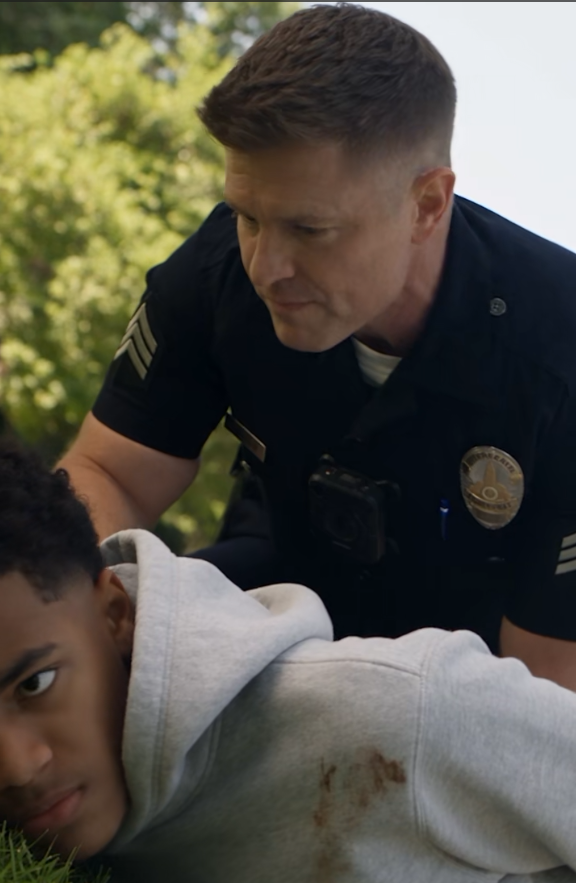
“You always do that.”
“What?”
“Make the sentence smaller than the suspicion.”
Nathan nodded.
“It’s my job.”
“No, it’s your personality.”
This time Nathan smiled.
Jordan continued.
“What if he’s done this before?”
Nathan’s smile disappeared.
“That’s the right question.”
By noon, reporters had begun asking it too.
Three prior complaints against Mercer surfaced.
None had resulted in discipline.
One alleged unnecessary force during a traffic stop.
Another claimed Mercer threatened to add charges when a driver questioned a search.
The third involved a teenager stopped outside a convenience store after someone reported “suspicious behavior.”
Nathan read summaries but refused to ask for privileged information.
Jordan read everything.
That worried Rachel.
“You’re feeding it,” she said that night.
“I’m learning.”
“You’re marinating.”
Jordan looked up from his laptop.
“That’s disgusting.”
“You know what I mean.”
Nathan entered carrying three takeout containers.
Rachel pointed at their son.
“Tell him.”
Nathan set down the food.
“Tell him what?”
“To stop reading comments.”
Nathan looked at Jordan’s screen.
“Stop reading comments.”
Jordan glared at both of them.
“That was cheap.”
Rachel took a container.
“Parenting is mostly collaboration.”
Jordan closed the laptop.
Then Nathan’s phone rang.
Dana.
He answered.
Her first sentence changed the room.
“They found the caller.”
Nathan set his food down.
“Who?”
“Department investigator traced the 911 number. Prepaid line, but purchased with a credit card.”
Jordan came closer.
“Whose?”
Nathan put it on speaker.
Dana said, “A woman named Linda Mercer.”
No one spoke.
Jordan looked at Nathan.
Nathan’s face had become unreadable.
Rachel said, “Mercer?”
Dana answered.
“Sergeant Mercer’s sister.”
Jordan sat slowly.
Nathan said, “That doesn’t make sense.”
“No,” Dana said. “It doesn’t.”
“What did she say?”
“She claims her phone was stolen two weeks ago.”
“The prepaid phone?”
“Yes.”
Nathan walked toward the window.
“Purchased when?”
“Three weeks ago.”
“Used for anything else?”
“We don’t know yet.”
Jordan said, “So his sister bought the phone that made the call that sent him to me.”
Nathan turned.
“Allegedly.”
Jordan gave him a look.
Nathan held up one hand.
“We stay careful.”
Dana continued.
“There’s something else.”
Nathan closed his eyes.
“Of course there is.”
“The prepaid number called Mercer’s personal cell eleven minutes before the 911 call.”
Jordan stared.
Rachel put down her fork.
Nathan said, “How long?”
“Thirty-seven seconds.”
Jordan whispered, “He knew.”
Nathan did not answer.
The room seemed smaller.
Dana said, “Internal affairs requested Mercer’s phone records. He’s been placed on administrative leave.”
Nathan asked, “Does he know they traced the call?”
“Probably by now.”
Jordan stood.
“Why me?”
Nobody had an answer.
Not yet.
The answer came forty-eight hours later.
And it was worse because it was almost ordinary.
Linda Mercer had not been targeting Jordan specifically.
She had been targeting someone else.
Her seventeen-year-old son, Tyler, had been arrested the previous month for vandalism after a confrontation with a group of students. One of the witnesses was a Black teenager named Jamal Reeves who often wore a gray sweatshirt and spent afternoons near the east picnic area.
Linda believed Jamal had “set Tyler up.”
She called her brother.
Mercer promised to “have a talk with the kid.”
On the morning Jordan entered the park, Linda drove past and believed she saw Jamal near the benches.
She called Mercer.
Then 911.
Mercer arrived before the assigned unit had fully processed the call.
He saw Jordan first.
Gray hoodie.
Young.
Black.
Close enough.
Jordan sat on the edge of his bed reading the investigative summary twice.
Nathan stood near the door.
Jordan finally looked up.
“He didn’t even know me.”
“No.”
“He was looking for another kid.”
“Yes.”
“And when he realized I wasn’t him?”
Nathan did not answer.
Jordan looked down again.
The timeline suggested Mercer knew within the first minute.
Jordan had given his name.
His ID had been found during the search.
The age did not match.
The face did not match a photo Linda had previously texted Mercer.
Yet Mercer continued.
That was the turn.
Not the mistaken identification.
The decision after the mistake.
Jordan closed the laptop.
“He could have stopped.”
Nathan leaned against the doorframe.
“Yes.”
“Why didn’t he?”
Nathan took a breath.
“Because stopping would have required admitting he was wrong.”
Jordan looked at him.
“That’s it?”
“Sometimes that’s enough.”
Jordan shook his head.
“No.”
Nathan waited.
Jordan stood.
“It wasn’t just pride.”
“What do you think it was?”
“He threatened me after he knew.”
Nathan said nothing.
“He told witnesses to back away. He lied about the call. He lied about me resisting. He turned off his camera.”
Nathan’s expression changed.
Jordan continued.
“He wasn’t trying to figure out what happened anymore.”
Nathan nodded slowly.
“No.”
“He was building a version he could survive.”
That sentence stayed with Nathan.
Because it was precise.
And because it sounded like something Nathan himself might have said in an investigative briefing.
Jordan was no longer only processing what had happened.
He was understanding it.
That was both good and terrible.
Three days later, federal civil-rights investigators opened a formal inquiry.
Nathan recused himself completely.
Jordan was interviewed for four hours.
He hated every minute of it.
The agents were professional.
Careful.
Polite.
But they asked the same questions repeatedly from different directions.
Did you pull away?
Did you raise your voice?
Did Sergeant Mercer identify himself?
Were you told you were detained?
Did you hear any command before physical contact?
Were you injured?
Did you threaten him?
Did you know the witnesses?
Had you ever met Linda Mercer?
Had you ever met Tyler Mercer?
Had you ever met Jamal Reeves?
No.
No.
No.
Again and again.
When it ended, Jordan walked out of the federal building and found Nathan waiting across the street with two coffees.
Jordan took one.
“You said you weren’t coming inside.”
“I didn’t.”
“You’re across the street.”
“Yes.”
“That’s technically annoying.”
Nathan handed him the coffee.
Jordan drank.
They walked.
After half a block Jordan said, “They asked if I wanted him prosecuted.”
Nathan looked straight ahead.
“What did you say?”
“I said I wanted them to do their jobs.”
Nathan nodded.
“That was a good answer.”
“I stole it from you.”
“I noticed.”
Jordan looked at him.
“What would you want?”
Nathan took several steps before answering.
“If it were only about what he did to you?”
“Yes.”
“I’d want him nowhere near a badge again.”
Jordan absorbed that.
“And jail?”
Nathan looked toward traffic.
“I don’t know.”
Jordan seemed surprised.
Nathan continued.
“I know what anger wants. That’s different.”
Jordan stopped walking.
Nathan stopped too.
“Then how do you decide?”
Nathan looked at his son.
“You decide what outcome protects people, proves the truth, and doesn’t turn your pain into permission to stop thinking.”
Jordan stood there for a moment.
Then nodded.
They kept walking.
Part V — The Choice
The strongest evidence did not come from the park video.
It came from Mercer’s own phone.
Investigators recovered deleted text messages between him and his sister.
Three days before the incident: