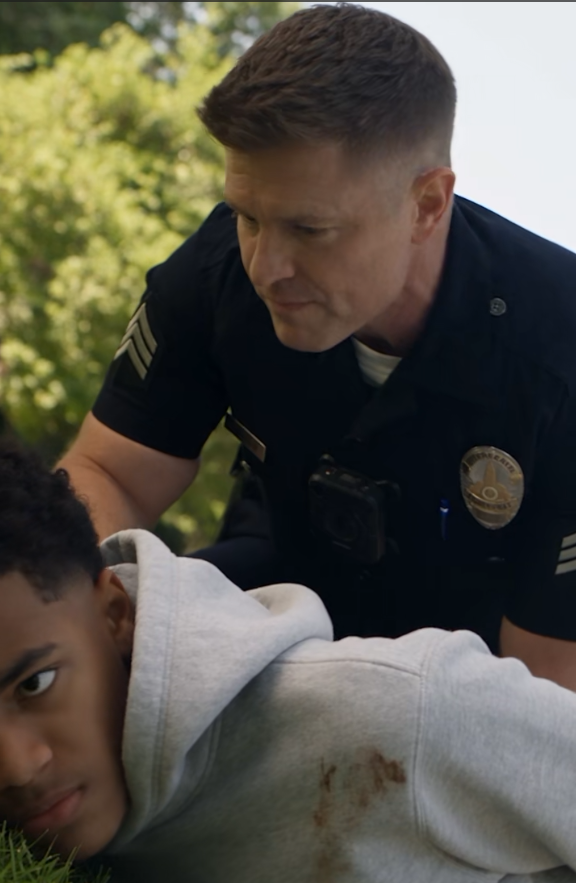
Linda: He keeps hanging around that park like he owns it.
Mercer: Which one?
Linda: Reeves kid.
Mercer: I’ll deal with it.
That morning:
Linda: Think I see him.
Mercer: Where?
Linda: West side now maybe moving east.
Mercer: Calling it in?
Linda: Already did.
Mercer: Don’t use your regular phone.
That was the first major revelation.
The second was worse.
At 10:16, after Jordan had already given his name, Mercer texted Linda from the park.
Wrong kid.
Linda replied:
Then let him go.
Mercer never did.
Investigators recovered the deleted exchange from cloud data.
Jordan read it in a conference room six weeks later.
Wrong kid.
Two words.
He stared at them.
Nathan sat beside him but did not speak.
Across the table, Assistant U.S. Attorney Helen Ward closed the file.
“We believe that message establishes that Sergeant Mercer knew Mr. Ellis was not the person he expected to encounter before the detention escalated.”
Jordan looked at her.
“How long before he put me down?”
“Approximately forty-two seconds.”
Jordan looked back at the page.
Forty-two seconds.
Less than a minute.
Long enough to choose.
Ward continued.
“We also have evidence he intentionally deactivated his body camera after realizing the misidentification.”
Nathan leaned forward.
“Intentional?”
Ward nodded.
“The manufacturer’s diagnostic log records a manual two-button shutdown.”
Jordan’s face changed.
“So he turned it off.”
“Yes.”
“And the missing minute?”
“The export had been altered.”
Nathan asked, “By Mercer?”
“We believe so. He accessed the evidence system under his credentials before the supervisor lock activated.”
Jordan looked at Nathan.
That threat came back again.
Whatever else I need to bury you.
Now it had structure.
A complaint.
A stop.
A mistake.
A decision.
A camera shutoff.
A story rewritten.
Evidence altered.
Not a moment of temper.
A chain.
Ward folded her hands.
“There’s a complication.”
Nathan’s eyes narrowed.
“What?”
“Sergeant Mercer is willing to plead.”
Jordan sat back.
“To what?”
“Federal deprivation of rights under color of law, obstruction related to the body-camera evidence, and a state-level false-reporting conspiracy count tied to the original call.”
Jordan stared at her.
“What does he get?”
“His counsel is seeking a reduced custodial sentence in exchange for a full factual admission, resignation, permanent surrender of law-enforcement certification, and cooperation in the investigation of evidence-handling practices inside the department.”
Nathan’s expression shifted.
Jordan noticed.
“What evidence-handling practices?”
Ward looked toward Nathan.
Then back to Jordan.
“Mercer says he was not the first officer to alter body-camera exports before internal review.”
The room went still.
Jordan looked at his father.
Nathan said nothing.
Ward continued.
“He claims there is an informal practice among a small number of supervisors. Not routine. Not department-wide. But enough to require investigation.”
Jordan leaned back.
“So now he’s useful.”
Ward did not flinch.
“Yes.”
The answer was too honest to resent.
Jordan looked down at his hands.
“What do you need from me?”
“Legally? Nothing. The charging decision is ours.”
“But you’re asking.”
“I’m informing you because your views matter to how we assess resolution.”
Nathan spoke.
“Jordan doesn’t owe the government a recommendation.”
Ward nodded.
“I agree.”
Jordan turned toward his father.
“Stop.”
Nathan stopped.
Jordan looked at Ward.
“If he pleads, does he have to say what he did?”
“In open court.”
“Everything?”
“The material facts.”
“Does he have to say he knew I was the wrong person?”
“Yes.”
“That he turned off the camera?”
“Yes.”
“That he altered the file?”
“Yes.”
Ward slid a draft factual statement across the table.
Jordan did not pick it up.
“And if I say I want trial?”
Ward answered carefully.
“We may still accept a plea if we believe it serves the public interest.”
Jordan nodded.
“So this isn’t my decision.”
“No.”
“But you want to know what I think.”
“Yes.”
Jordan looked through the glass wall toward the hallway.
Officer Megan Ruiz sat outside waiting for a separate interview.
She had become a cooperating witness.
Her decision had cost her.
Other officers stopped speaking to her.
Someone had left a dead battery on the hood of her car with the words CHECK YOUR POWER scratched into the plastic.
Internal investigators had opened a separate retaliation case.
Jordan had learned about it from Ward twenty minutes earlier.
He looked at Ruiz through the glass.
Then at the document.
Mercer could go to trial.
Maybe receive more prison time.
Maybe less.
Maybe a jury would believe the video.
Maybe they would not.
A plea meant certainty.
But certainty came with compromise.
Nathan watched him.
Jordan noticed.
“You think I should take the deal.”
Nathan’s face remained still.
“I think you should decide what matters most to you.”
“That’s not an answer.”
“It’s the only one I’m giving.”
Jordan looked at him for a long moment.
Then something in his expression softened.
Because six weeks earlier, Nathan would have answered.
He would have analyzed.
Directed.
Protected.
Now he was letting Jordan own the choice.
Jordan finally picked up the factual statement.
He read.
The language was dry.
On or about...
knowingly...
under color of law...
without lawful justification...
He reached the paragraph describing the body-camera deletion.
Then another describing the text message.
Wrong kid.
Jordan stopped there.
Ward said nothing.
After a while Jordan asked, “If he cooperates, can the department investigation use what he gives you?”
“Subject to the agreement, yes.”
“Could it expose other cases?”
“Yes.”
“How many?”
“We don’t know.”
Jordan looked at Nathan.
Then at Ruiz outside.
Then back at Ward.
“I don’t want the biggest sentence.”
Ward waited.
Jordan continued.
“I want the biggest record.”
Nathan looked at him.
Jordan’s voice remained calm.
“If he pleads, I want the facts public. I want the texts in the record. I want the camera shutdown in the record. I want it clear he knew I was the wrong person and kept going anyway.”
Ward nodded slowly.
“That can be negotiated.”
“And his cooperation?”
“Yes?”
“If he knows about other altered footage, he gives all of it.”
“That would be required.”
“No selective memory.”
Ward almost smiled.
“No selective memory.”
Jordan set the paper down.
“Then I can live with a plea.”
Nathan did not react outwardly.
But Jordan saw something in his face.
Relief, perhaps.
Or pride.
He did not want either.
Not yet.
The court hearing took place three months later.
Jordan almost did not attend.
Then he changed his mind that morning.
Rachel sat beside him.
Nathan sat on his other side.
Ruiz sat two rows back.
Mercer entered without a uniform.
That mattered more than Jordan expected.
No badge.
No duty belt.
No radio.
Just a dark suit that did not fit especially well.
He looked smaller.
Jordan disliked himself for noticing.
The judge reviewed the plea.
Mercer answered each question.
Yes, Your Honor.
Yes.
I understand.
Then came the factual admission.
Mercer stood.
His attorney beside him.
He looked toward the judge, not Jordan.
“At approximately ten fourteen on the morning in question, I approached Jordan Ellis believing he might be another individual I intended to contact.”
His voice was steady.
Jordan listened.
“After Mr. Ellis identified himself and I recovered identification confirming his identity, I knew he was not the person I expected to encounter.”