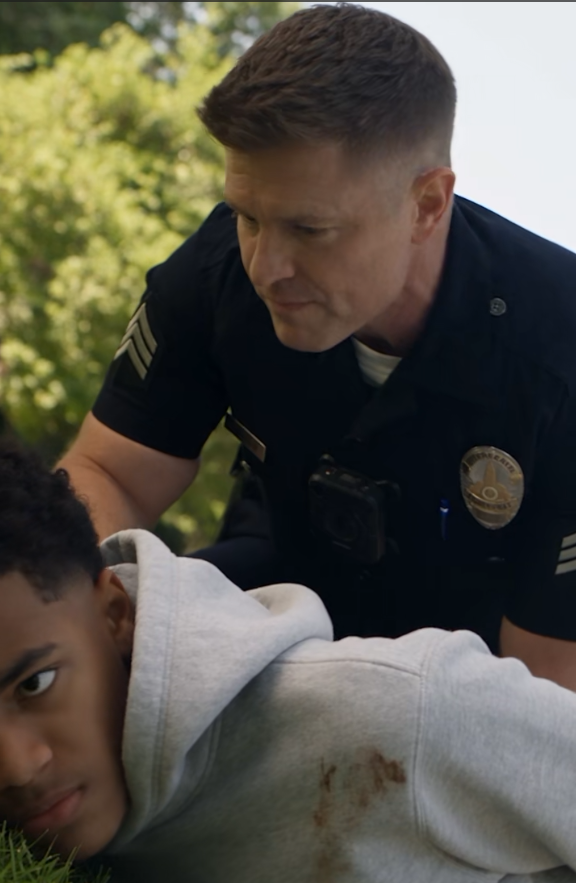
Rachel’s hand moved toward Jordan’s.
He let her take it.
Mercer continued.
“I did not terminate the detention.”
A pause.
“I escalated it.”
The word sat heavily in the courtroom.
“I made statements suggesting Mr. Ellis had resisted commands that had not, in fact, been clearly given. I later deactivated my body-worn camera and altered an exported video file to conceal part of the encounter.”
Mercer stopped.
The judge waited.
His attorney whispered something.
Mercer swallowed.
“I also made false statements to my supervisor about information received from dispatch.”
The prosecutor asked about the text.
Mercer looked down.
“Yes.”
“What did you send?”
Mercer’s voice changed.
Barely.
“I wrote, ‘Wrong kid.’”
Jordan’s mother tightened her grip.
“And when did you send that?”
“Before I forced Mr. Ellis to the ground.”
Jordan stared at Mercer.
There it was.
Not in an investigative summary.
Not in an attorney’s explanation.
From him.
Mercer finally looked toward Jordan.
Only once.
Jordan met his eyes.
Mercer looked away first.
The sentencing arguments came later.
The government recommended a term lower than the maximum because of cooperation.
Mercer’s attorney spoke about twenty-two years of service.
No prior criminal record.
Family obligations.
Loss of career.
Jordan listened.
He did not feel rage.
That surprised him.
He felt tired.
Then the prosecutor read a victim-impact statement Jordan had written but chosen not to deliver himself.
The words were simple.
He had worked on them for days.
“I used to think the worst part was being on the ground while strangers watched. It wasn’t. The worst part was learning how fast a person with authority can decide that protecting his version of events matters more than the truth.”
Nathan looked down.
The prosecutor continued.
“My father’s position changed what happened afterward. It did not change what happened before. I do not want this case remembered because my father works for the FBI. I want it remembered because no nineteen-year-old should need a powerful father to make evidence matter.”
Jordan did not look at Mercer.
He looked at Ruiz.
She was staring straight ahead.
The judge imposed a custodial sentence.
Less than prosecutors originally contemplated.
More than Mercer’s attorney requested.
Permanent surrender of law-enforcement certification.
Supervised release.
Mandatory cooperation.
The precise number of months mattered less to Jordan than he expected.
What mattered was what came next.
Mercer’s cooperation reopened eleven internal cases involving suspicious body-camera gaps.
Three had innocent explanations.
Four showed policy violations without criminal alteration.
Two resulted in discipline.
And two became federal investigations.
One involved a man who had spent nine months under charges that were later dismissed after restored footage contradicted an officer’s report.
The case grew.
Not into a scandal consuming the whole department.
Reality was less clean than that.
Most officers had never altered evidence.
Most had never met Mercer.
But a smaller failure had been allowed to hide inside a larger institution because supervisors assumed technical glitches, investigators accepted incomplete files, and people below Mercer’s rank learned that questioning him carried a price.
Ruiz testified.
She was transferred temporarily.
Then promoted the following year after an outside review cleared her conduct and recommended new reporting protections.
Jordan sent her one message.
You spoke when it cost something.
She replied:
Eventually.
Jordan wrote back:
Eventually still counts.
Part VI — Aftermath
Six months after the incident, Jordan returned to Brookfield Park alone.
Spring had replaced late summer.
The trees were thinner than he remembered.
Children chased one another across the grass.
Someone had moved the green bench several feet closer to the path.
Jordan carried coffee.
He had deliberately bought it from the same shop.
That felt slightly ridiculous.
But he did it anyway.
He sat.
For several minutes nothing happened.
That was what he wanted.
No cameras.
No uniforms.
No black SUV.
No father arriving from nowhere.
Just coffee cooling in a paper cup.
His phone buzzed.
Dad.
Jordan answered.
“You tracking me?”
“No.”
“That sounded suspiciously fast.”
“I was calling about dinner.”
“Sure.”
Nathan paused.
“Where are you?”
“The park.”
Silence.
Jordan smiled.
“Dad.”
“I’m not coming.”
“I didn’t ask you to.”
“I know.”
Another pause.
Then Nathan said, “How is it?”
Jordan looked across the grass.
“Normal.”
Nathan exhaled softly.
“Good.”
Jordan took a sip.
“You know what bothered me most?”
“What?”
“That day you told me I did everything right.”
Nathan waited.
Jordan continued.
“I hated that.”
“I know.”
“No, you know now.”
“Fair.”
Jordan leaned back against the bench.
“Because it made it sound like there was some perfect set of moves I could make that would guarantee a good outcome.”
Nathan said nothing.
“There wasn’t.”
“No.”
“I could stay calm and still get hurt.”
“Yes.”
“I could have witnesses and still not be believed.”
“Yes.”
“I could know my rights and still have somebody ignore them.”
“Yes.”
Jordan watched a father lift a little girl onto his shoulders near the playground.
“So what do you tell people?”
Nathan took his time.
“That systems need rules because individual perfection is impossible.”
Jordan smiled faintly.
“That is the most FBI answer ever.”
“It’s also true.”
Jordan looked toward the path where Mercer had forced him down.
The grass had long since grown back.
There was no mark.
He expected that to bother him.
It did not.
Nathan asked, “Dinner at seven?”
“Yeah.”
“Your mother is making pasta.”
“She actually making it?”
“Ordering counts.”
“It absolutely does not.”
“I’ll tell her you said that.”
“Coward.”
Nathan laughed.
Then his voice softened.
“I’m proud of you.”
Jordan looked down at the coffee cup.
“For what?”
“For not letting me decide what justice was supposed to look like.”
Jordan did not answer immediately.
Then he said, “You almost did.”
“I know.”
“But you stopped.”
“I’m learning.”
Jordan smiled.
“Eventually still counts.”
Nathan recognized the line.
“Ruiz?”
“Maybe.”
They said goodbye.
Jordan remained on the bench.
A few minutes later, a patrol car rolled slowly through the park entrance.
His shoulders tightened before he could stop them.
The reaction irritated him.
Then he let it pass.
The cruiser continued toward the east side without slowing.
Jordan watched until it disappeared behind the trees.
He drank his coffee.
Across town, Nathan Ellis stood in his office looking at a framed photograph Rachel had placed there years earlier.
Jordan at thirteen, holding a fishing rod incorrectly.
Nathan beside him, pretending not to notice.
Dana Pierce knocked once on the open door.
“You heading out?”
“In a minute.”
She placed a thin report on his desk.
“What’s that?”
“Final policy review.”
Nathan glanced at the title.
BODY-WORN CAMERA EVIDENCE PRESERVATION AND SUPERVISORY ACCESS CONTROLS.
He opened it.
The recommendations were technical.
Automatic upload locking.
Independent audit trails.
Mandatory notification when cameras were deactivated during active encounters.
Protection for officers reporting supervisory misconduct.
Nothing cinematic.
Nothing viral.
No sweeping promise that human judgment would stop failing.
Just barriers.
Friction.
Records.
Ways to make lying harder.
Nathan closed the report.
Dana leaned against the doorframe.
“You know what’s strange?”
“What?”
“If you hadn’t been in that park that day, none of this happens.”
Nathan looked at her.