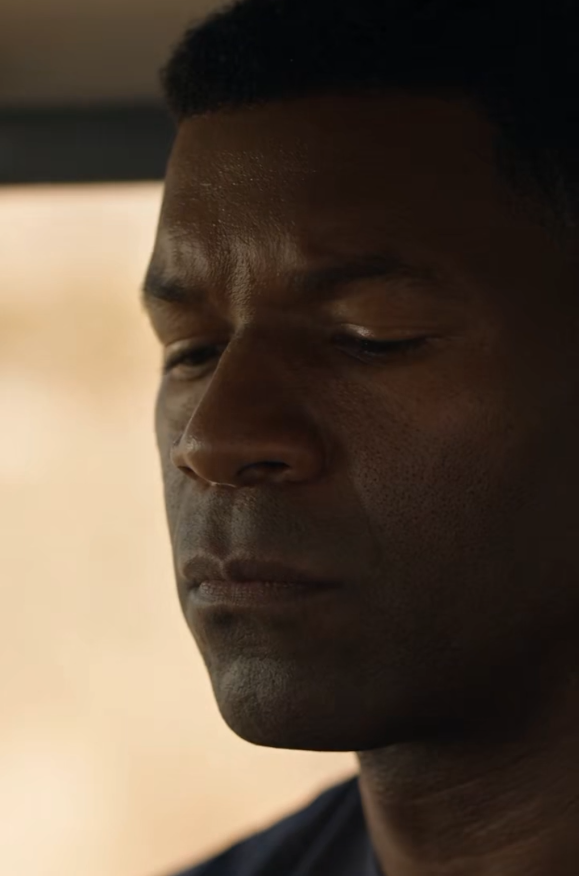
Isaiah almost threw it away.
He set it on his kitchen table instead.
Left it there for three days.
On the fourth morning, he opened it.
The handwriting was blocky.
Mr. Brooks,
I have been told I should explain what I did. I don’t know if explanation is useful.
Isaiah nearly stopped there.
He continued.
Cleary wrote that he had been sheriff for fourteen years and a deputy for seventeen before that. He wrote about arrests that began with small inconsistencies. Drivers lying about names. Fake military stickers. Fraudulent badges. People who seemed calm until they were not.
None of it excused Isaiah’s stop.
Cleary said that too.
Then came the sentence Isaiah read twice.
I spent so many years believing instinct kept me alive that I stopped noticing when instinct became pride.
Isaiah sat back.
Outside, morning traffic moved beyond the apartment complex.
Cleary wrote about the moment he saw the retirement papers in the truck.
He admitted they looked real.
That detail mattered.
I remember thinking that if they were real, then I had already made a serious mistake.
So I decided they weren’t.
Isaiah rested the letter on the table.
There it was.
Not a conspiracy.
Not a grand hatred.
Something smaller and, in certain hands, more dangerous.
A man had reached the point where being wrong felt more threatening than doing wrong.
Cleary continued.
When your call came back, I knew. Not all at once, but I knew enough. I kept going anyway because by then stopping meant admitting I had done it to myself.
Isaiah read the final paragraph slowly.
I don’t expect forgiveness. I’m not asking. I am writing because the question at the hearing has stayed with me: what evidence would have convinced me I was wrong? At the time, the answer was none. I understand now what that says about me.
The letter ended with a simple signature.
Arthur Cleary.
Isaiah folded it.
Naomi called that afternoon.
“You get the letter?”
“How do you know?”
“County attorney emailed victims.”
“I got it.”
“What did he say?”
Isaiah looked at the envelope.
“He finally answered the question.”
“What question?”
“What would’ve changed his mind.”
“And?”
“Nothing.”
Naomi was quiet.
“That’s awful.”
“It was.”
“Was?”
Isaiah looked toward his desk.
The broken retirement card still sat in the same envelope where he had kept it for months.
He walked over and removed the pieces.
The replacement card was in his wallet.
Valid.
Unremarkable.
The broken one no longer needed to prove anything.
“I think people can learn after consequence,” he said.
“You forgiving him?”
“No.”
The answer came easily.
Naomi waited.
Isaiah placed the pieces side by side on the desk.
“I’m just not carrying him.”
Months later, the Army invited Isaiah to a retirement event for another soldier he had served with.
He almost declined.
Then went.
The ceremony was held in a plain auditorium.
Flags.
Folding chairs.
Families dressed better than the soldiers.
At the end, the retiring master sergeant received his certificate, flag, and identification card.
Isaiah watched the man look down at the card for a second longer than expected.
Forty-eight hours after Isaiah had received his own, someone had broken it and told him the life behind it was fake.
For months, Isaiah thought that was what still bothered him.
The insult.
The erasure.
Standing in the auditorium, he realized it was not.
A plastic card had never contained twenty-two years.
No sheriff could snap deployments in half.
No accusation could erase cold mornings, missed birthdays, lost friends, friendships that survived continents, his sister waiting through every deployment, or the quiet relief of finally waking without orders.
The card had only been proof for people who did not know him.
That was all identification ever was.
Proof for strangers.
After the ceremony, the retiring master sergeant found him near the exit.
“Brooks.”
Isaiah smiled.
“Ramirez.”
They shook hands.
Ramirez held up the new retirement card.
“Feels weird.”
“It is.”
“Like I’m nobody now.”
Isaiah looked at him.
“No.”
Ramirez laughed.
“You know what I mean.”
“I do.”
They walked toward the parking lot.
Ramirez asked, “You still carrying that broken card?”
Isaiah stopped.
“How do you know about that?”
“Everybody knows about that.”
Isaiah shook his head.
“So much for privacy.”
Ramirez grinned.
Then became serious.
“Why keep it?”
Isaiah thought about the question.
For months, he might have said evidence.
Then reminder.
Now neither answer felt right.
“I don’t anymore.”
Ramirez nodded.
They stepped outside.
The afternoon was hot.
Not unlike the day on County Road 44.
Isaiah’s silver F-150 waited across the lot.
Same truck.
Same dents.
Same driver.
Not the same life.
He reached into his wallet as they walked and briefly touched the edge of his replacement retirement ID.
Then left it there.
That evening, back at his apartment, Isaiah opened the desk drawer one last time.
The two broken halves rested inside.
He picked them up.
His photograph on one side.
His name split across the other.
For months, he had kept the pieces aligned as if they might someday belong together again.
Now he separated them.
Not angrily.
Not ceremonially.
He placed them in a small box with his retirement papers, old unit photographs, and the folded flag from his ceremony.
Then he closed the lid.
His phone buzzed.
Naomi.
Dinner?
He typed back.
On my way.
Isaiah grabbed his keys and stepped outside.
The sky over Mobile was turning gold at the edges.
He climbed into the truck, started the engine, and rested both hands on the steering wheel for a moment.
The posture brought back County Road 44 so clearly that he could almost see mirrored sunglasses approaching the window.
Then the memory passed.
He shifted into reverse.
For twenty-two years, his life had been shaped by orders.
For nine months, part of it had been shaped by one man’s refusal to admit he was wrong.
Now neither man had authority over the next mile.
Isaiah pulled onto the road.
At the first open stretch, he set the cruise control beneath the speed limit.
Then he laughed.
And turned it off.