No consent.
No warrant.
No probable cause stated.
Sarah leaned back against the seat.
The afternoon had become something else.
Not because of who she was.
Because of who Ryker thought she wasn’t.
And Sarah had already decided that distinction would matter later.
Part II — Cell Four
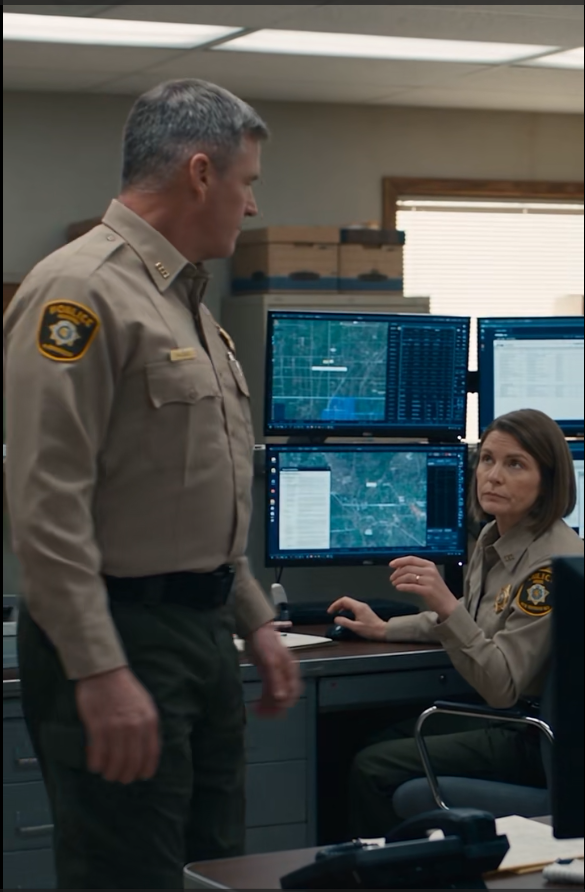
The Oak Haven sheriff’s office was a low brick building with tinted windows and an American flag moving lazily above the parking lot.
Sarah entered through a side door.
Ryker walked behind her.
Miller came in last.
The lobby smelled faintly of floor cleaner, old coffee, and warm electronics.
A woman at the dispatch desk looked up.
Late forties.
Shoulder-length brown hair.
A county badge clipped to her shirt.
A plastic nameplate on the desk read BRENDA LAWSON.
Sarah filed away the name.
Ryker removed the cuffs long enough for booking.
“Name?”
“Sarah Reynolds.”
“Date of birth?”
She answered.
“Address?”
She gave the temporary travel address associated with her rental paperwork rather than any government location.
Ryker sat at a computer.
Miller stood near the wall.
Brenda watched from the dispatch position while pretending not to.
Ryker typed slowly.
“Occupation?”
Sarah paused.
“Federal employee.”
That was true.
Ryker glanced up.
“Doing what?”
“Government work.”
He gave a short laugh.
“Everybody’s important somewhere.”
Sarah said nothing.
He entered something into the system.
“What am I being charged with?”
“Disorderly conduct.”
“You said that roadside.”
“Resisting.”
“I did not resist.”
Ryker kept typing.
“And reckless driving.”
Miller looked over.
Sarah saw it.
Only for half a second.
But she saw it.
“Reckless driving was never mentioned during the stop.”
Ryker stopped typing.
He looked at her.
“Want to tell me how to write my reports too?”
“No.”
“Good.”
Sarah looked toward a camera mounted high in the corner.
Black dome housing.
Likely video, possibly audio.
Another camera faced the hallway.
She counted both.
Ryker finished entering information.
Sarah said, “I want to contact an attorney.”
“You’ll get your call.”
“When?”
“When booking is finished.”
“You’ve finished booking.”
Ryker leaned back.
“You in a hurry?”
“Yes.”
He smiled again.
“Should’ve thought about that before acting up roadside.”
Sarah looked at Miller.
He looked away.
That mattered.
She turned back to Ryker.
“I am formally requesting access to counsel.”
“You made the request.”
“And your response?”
“My response is you’ll get your call when I say.”
Sarah held his eyes for another moment.
Then she nodded once.
“All right.”
Ryker seemed disappointed.
He had wanted argument.
He wanted something he could name disrespect.
Sarah denied him that.
He stood.
“Take her to four.”
Miller stepped forward.
Ryker shook his head.
“I got her.”
He led Sarah down a concrete corridor.
Three metal doors lined the wall.
Cell four was at the end.
The room beyond it was small and bare except for a steel bench and stainless toilet.
Ryker opened the door.
Sarah stepped inside.
Before he closed it, she turned.
“I am again requesting an attorney.”
Ryker leaned against the doorframe.
“You don’t get to control the schedule in my house.”
Sarah looked directly at him.
“Understood.”
That answer unsettled him.
She could tell.
He wanted defiance because defiance justified him.
Composure left him alone with his decisions.
The door shut.
Metal locked.
Sarah sat on the bench.
Her wrists carried red marks from the cuffs.
She flexed her hands slowly.
The room was cool.
A vent hummed above her.
Somewhere down the hall, a printer started and stopped.
Sarah closed her eyes.
Not to rest.
To reconstruct.
Deputy Miller’s first statement: crossed center line.
Question about alcohol.
Question about medication.
Request to search.
Her refusal.
His radio call.
Ryker’s arrival.
Search of her person.
Arrest.
Vehicle search.
Booking.
Added reckless driving.
Denied counsel.
She replayed each phrase.
Precise wording mattered.
Memory was a discipline.
Years earlier, as a young officer, she had learned that stress distorted sequence before it erased content. People remembered what frightened them but confused when it happened.
So she built anchors.
3:31.
Sun angle west.
Traffic light.
Miller’s unit two-one-four.
Ryker arrived roughly eight minutes later.
Booking before four.
She opened her eyes.
A camera dome sat above the door.
Sarah almost smiled.
Not because she felt safe.
Because evidence existed.
That was different.
She glanced at her watch.
3:55.
A secure briefing was scheduled at 4:00.
Her executive officer would expect her on the call.
She had planned to join remotely before continuing to Savannah.
When she did not appear, the first assumption would be technical trouble.
Then someone would call.
Her secure government phone had been removed during booking.
Property box, likely front office.
Her personal phone was there too.
Sarah considered whether to tell Ryker who she was.
She rejected the idea.
Not yet.
If her rank transformed bad treatment into good treatment, then rank would conceal what needed to be seen.
The Constitution did not come with insignia requirements.
She leaned back against the wall.
At precisely 4:00, somewhere hundreds of miles away, people would notice an empty seat on a secure line.
Sarah waited.
The waiting lasted less than five minutes.
Then she heard the front desk phone ring.
Once.
Twice.
A third time.
A chair rolled.
Brenda answered.
“Oak Haven Sheriff’s Office, Lawson speaking.”
Pause.
Sarah could not hear the caller.
Brenda’s tone changed.
“Yes, sir.”
Another pause.
“No, sir, I—one moment.”
Sarah stood.
Footsteps moved outside.
Not toward the cell.
Toward Ryker’s office.
Brenda called, “Sheriff.”
Ryker’s voice came back.
“What?”
“There’s a colonel on the phone.”
“So?”
Another pause.
Then Brenda said the sentence that changed the building.
“He says he’s calling from the Pentagon.”
Silence.
Sarah moved closer to the door.
Ryker spoke again, louder now.
“What does he want?”
Brenda’s chair creaked.
“He’s asking to speak with Major General Sarah Reynolds.”
Nothing moved for two full seconds.
Then boots crossed the hallway quickly.
Sarah pictured Ryker looking toward cell four.
She was correct.
A moment later his shadow passed beneath the gap of the door.
He did not open it.
He walked back toward dispatch.
Sarah heard the receiver move.
“This is Sheriff Ryker.”
The voice on the other end was too faint to make out.
Ryker answered, “Yes, she’s here.”
Pause.
“She was arrested during a traffic stop.”
Longer pause.
“No, I don’t discuss active cases with—”
He stopped.
The caller spoke longer this time.
Sarah could hear only rhythm.
Measured.
Controlled.
Professional.
Then Ryker said, “I understand who you said you are.”
Another pause.
The caller’s voice rose just enough for individual words to reach the hallway.
“…lawful grounds…”
Ryker responded too quickly.
“Disorderly conduct, resisting, reckless driving.”
The caller said something.
Ryker’s face was not visible, but Sarah heard his chair scrape.
Then the voice from Washington became clearer.
“What lawful grounds do you have for detaining the general?”
A long silence followed.
Sarah looked up at the camera above the door.
And for the first time that afternoon, she allowed herself a single thought that had nothing to do with documentation.
Now he knows.
Part III — The Call
Sheriff Ryker opened cell four less than two minutes later.