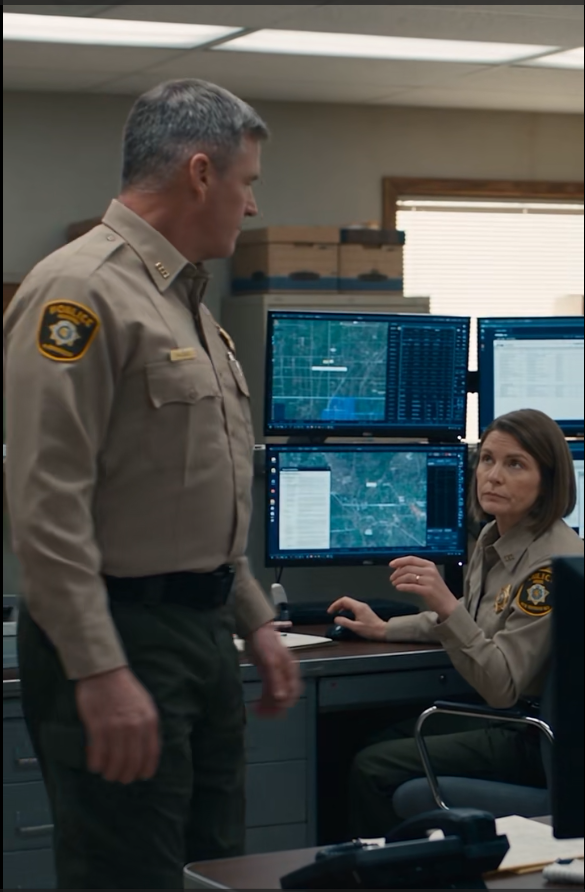
She had prepared notes.
She did not use them.
She stood at the podium.
The room waited.
“I want to begin with something simple,” she said. “My military rank should have had no bearing on whether I was treated lawfully.”
No one moved.
“I did not identify myself as a general during the stop because I did not believe constitutional protections should depend on whether the person invoking them has stars on her shoulders.”
Ryker looked down.
Sarah continued.
“If the arrest had ended differently because I said, ‘I am a major general,’ that would not have made the arrest less troubling. It would have made the system more troubling.”
She looked toward Miller.
“Deputy Miller initiated a stop I dispute. He asked for consent to search my vehicle. I declined. He then called the sheriff. Those choices deserve scrutiny.”
Miller listened without flinching.
“But when asked to change what he had seen, he refused.”
Sarah looked toward Brenda.
“Dispatcher Lawson preserved professionalism when circumstances changed.”
Then back to the commission.
“This case is not about finding one villain and everyone else innocent. Institutions fail when small decisions begin supporting larger ones.”
Ryker’s lawyer shifted.
Sarah continued.
“Sheriff Ryker had many chances to stop.”
Her voice remained level.
“He could have accepted my refusal to consent. He could have chosen not to arrest me. He could have allowed counsel. He could have reviewed the footage after the Pentagon called. He could have released me and acknowledged an error. He could have preserved an accurate report.”
She paused.
“He chose instead to add allegations.”
Now Ryker looked at her.
“He chose to pressure a deputy.”
Silence.
“He chose to describe later what the cameras show did not happen.”
Sarah’s hands rested lightly on the podium.
“That is why this became larger than one traffic stop.”
Ryker’s attorney rose.
“Madam Chair, this is becoming prosecutorial.”
The chair said, “Sit down.”
Sarah waited.
Then came the question she had been anticipating.
A commissioner leaned forward.
“General Reynolds, if the Pentagon had not called, what do you believe would have happened?”
Sarah looked at him.
She could have answered dramatically.
She did not.
“I don’t know.”
The commissioner seemed surprised.
Sarah continued.
“And that is the problem.”
She looked across the room.
“I know what happened after they called. My treatment changed. The sheriff’s tone changed. My access changed. My release followed. What I cannot know is how long I would have remained in cell four if nobody in Washington had noticed I was missing.”
The room stayed quiet.
“A lawful system cannot depend on whether someone important calls.”
Sarah stepped away from the podium.
She had said what mattered.
Ryker asked to speak.
His lawyer looked reluctant.
But he stood.
He approached the same microphone.
For several seconds he said nothing.
Then:
“I have served this county twenty-seven years.”
His voice was lower than Sarah remembered.
“I have made thousands of traffic stops and arrests.”
He looked toward the commissioners.
“One bad afternoon does not erase twenty-seven years.”
No one responded.
Ryker continued.
“I did not arrest her because she was Black.”
Sarah watched him carefully.
“I did not arrest her because she was a woman.”
His voice strengthened.
“I arrested her because she challenged my authority at a roadside stop.”
The sentence came out before he understood what it admitted.
His attorney’s face changed instantly.
Ryker stopped.
The room registered it.
Sarah did too.
He had finally told the truth.
Not the truth he intended.
The deeper one.
She challenged my authority.
Not broke the law.
Not endangered anyone.
Not resisted.
Challenged authority.
Ryker looked at his lawyer.
Too late.
The commission chair spoke.
“Sheriff, would you like to clarify that statement?”
Ryker’s face had gone pale.
“I mean she was noncompliant.”
Sarah spoke from her seat before she could stop herself.
“With what lawful order?”
Every head turned.
The chair looked at Sarah.
Then at Ryker.
Ryker had no answer.
His lawyer rose.
“We are done.”
But the hearing was not.
Outside counsel introduced one final exhibit.
The sheriff’s body-camera system audit.
Ryker’s camera had not malfunctioned during the twenty-seven-minute gap.
It had been manually disabled.
From the device itself.
At 3:44 p.m.
Two minutes after Sarah’s arrest.
Reactivated during booking.
The technician’s report was unambiguous.
Manual stop.
Manual restart.
Ryker stared at the screen.
Sarah felt the entire case lock into place.
He had known.
Not after the Pentagon call.
Before.
He had turned the camera off when he began searching her vehicle.
The missing folder.
The unsupported search.
The later report.
The witness pressure.
All of it connected.
The final clue had been present from the beginning.
Sarah had noticed the body camera.
She had assumed it was recording.
It had been.
Until Ryker decided he did not want it to.
The commission recessed for forty minutes.
When members returned, the vote was unanimous.
The county formally requested Ryker’s resignation and referred all evidence to state and federal prosecutors.
Ryker remained seated after the vote.
His attorney whispered something.
He shook his head.
Then he stood.
He looked toward Sarah.
She expected anger.
Instead he looked tired.
“Was it worth it?” he asked.
The question was quiet.
Only people nearby heard.
Sarah stood.
“What?”
“All this.”
He gestured vaguely toward the room.
“The investigations. Cameras. Federal people. Destroying a career.”
Sarah studied him.
There it was again.
The belief that consequence had been imposed from outside rather than built by his own decisions.
She answered quietly.
“I didn’t turn off your camera.”
Ryker’s eyes shifted.
“I didn’t write your report.”
He looked away.
“I didn’t call Miller.”
His face hardened.
Sarah took one step closer, not threatening, simply clear.
“You keep asking why this happened to you. You should be asking why you kept choosing it.”
Ryker said nothing.
For the first time since Route 119, Sarah did not need him to.
Part VIII — Aftermath
Thomas Ryker resigned three days later.
The resignation did not end the criminal investigation.
Several months afterward, he entered a plea related to falsifying official records and attempting to influence a subordinate’s account of an arrest.
The county settled Sarah’s civil claims.
She did not keep most of the money.
A portion covered legal fees.
Another portion went to a statewide legal-aid fund supporting people arrested on low-level charges who could not afford immediate representation.
The rest funded body-camera retention and public-records training through an independent nonprofit.
Daniel objected mildly.
“You know you’re allowed to keep damages.”
“I know.”
“They are literally damages.”
“I know.”
“You’re impossible.”
“I pay you well.”
“That is true.”
Deputy Miller returned to duty under a new interim sheriff.
Not immediately.
There were reviews.
Retraining.
A formal reprimand for escalating the original stop unnecessarily.
Sarah thought that was appropriate.
Accountability did not require pretending he had done everything right.
It required precision.
Months later, Miller sent a short letter through Daniel.
No request.
No apology repeated.
Just a statement.
I understand now that refusing consent was not a challenge to me. I treated it like one. I’m working on that.