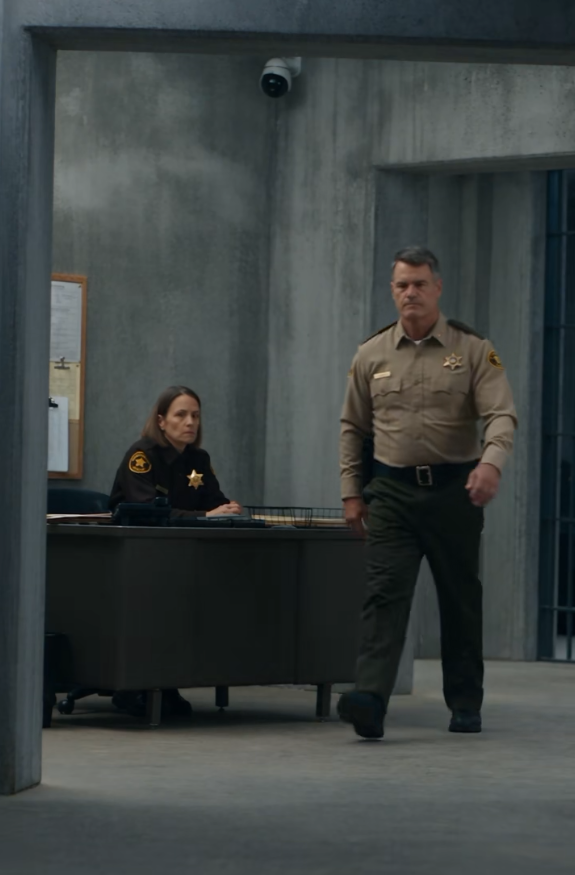
Miller had not answered.
He had not deleted it either.
When Shaw read the text aloud to Sarah over the phone, Sarah closed her eyes.
“Authenticated?”
“Yes.”
“Ryker’s number?”
“Yes.”
“Any claim it was taken out of context?”
“His attorney says ‘consistent’ meant factually consistent.”
Sarah almost admired the attempt.
“What happens now?”
“State prosecutor decides.”
The decision came three weeks later.
Sheriff Thomas Ryker was charged with falsifying public records, obstruction related to evidence preservation, and official misconduct.
He was not charged for arresting Sarah.
That distinction mattered.
The arrest had exposed the record.
The record created the criminal case.
Ryker appeared before a judge and was released pending trial.
His attorney called the prosecution political.
Sarah made no comment.
The county commission suspended him from administrative control while the criminal case proceeded.
Ryker refused to resign.
Oak Haven appointed an interim sheriff from outside the department.
Then Sarah faced the choice she had avoided since the beginning.
The state prosecutor called.
“We want you at trial.”
Sarah sat in her Pentagon office.
“I assumed so.”
“Defense strategy is clear.”
“What is it?”
“They’re going to argue you weaponized your rank after the stop.”
Sarah looked through the window toward the corridor.
“How does that answer a false record charge?”
“It doesn’t directly. But it gives motive for why everyone around Ryker supposedly panicked, overdocumented, and reinterpreted ordinary corrections as criminal falsification.”
“And you want me to rebut it.”
“Yes.”
Sarah was silent.
The prosecutor continued.
“They’ll ask why you didn’t identify yourself. Why the Pentagon called. Why military counsel got involved. Why preservation requests moved so quickly.”
“All answerable.”
“Yes.”
“But?”
“They may try to make you angry on the stand.”
Sarah almost smiled.
“People have tried.”
“This is different.”
“No. It really isn’t.”
The trial began four months after the traffic stop.
Sarah entered the Oak Haven courthouse through the same public doors as everyone else.
No uniform.
No military escort.
No visible security.
Inside, the courtroom smelled faintly of old wood and floor wax.
Ryker sat at the defense table in a dark suit.
Without the sheriff’s uniform, he looked smaller.
Not weak.
Just ordinary.
He saw Sarah.
His expression barely changed.
Jared Miller testified first.
He admitted he had called Sarah argumentative.
Admitted he had extended the stop longer than necessary.
Admitted he failed to intervene when Ryker began searching the car.
The defense attorney pressed him hard.
“You’re blaming Sheriff Ryker to save yourself.”
“No.”
“You violated policy.”
“Yes.”
“You were afraid you’d lose your job.”
“Yes.”
“So you gave investigators what they wanted.”
Miller looked toward the jury.
“No.”
“What did you give them?”
“The video.”
“You didn’t create the video.”
“No.”
“So what did you give them?”
Miller paused.
“The truth about what I did.”
It was not a perfect answer.
That made it stronger.
Brenda testified next.
She explained the systems.
The timestamps.
The upload.
The retention lock.
The access audit.
Defense counsel suggested she resented Ryker.
Brenda agreed.
“I did by the time this was over.”
“You expect the jury to believe that resentment did not affect you?”
“No.”
Counsel blinked.
Brenda continued.
“I expect them to look at the timestamps.”
Sarah testified on the third day.
The prosecutor kept her examination narrow.
Name.
Occupation.
Travel purpose.
Stop.
Arrest.
Counsel request.
Release.
Pentagon contact.
Then the prosecutor asked, “General Reynolds, did Sheriff Ryker know your rank when he arrested you?”
“No.”
“Did he know it when he wrote his first report?”
“By then, yes.”
“Did you ever tell him what to write?”
“No.”
“Did anyone from the Department of Defense instruct him to alter any document?”
“Not to my knowledge.”
“Did anyone from the Pentagon direct Oak Haven to dismiss charges?”
“No.”
The prosecutor sat.
Defense counsel stood.
His name was Grant Mercer, and he had the controlled warmth of a man who understood juries better than witnesses.
“General Reynolds, you are a powerful person.”
“Professionally, I hold significant authority.”
“You command thousands.”
“In certain structures, yes.”
“You have direct access to senior military leadership.”
“Yes.”
“And when you missed a meeting, Washington started making calls within minutes.”
“Yes.”
“That doesn’t happen for ordinary people, does it?”
Sarah looked at him.
“No.”
Mercer nodded as if she had helped him.
“So from Sheriff Ryker’s perspective, one moment he had an uncooperative motorist, and the next he had the Pentagon on the phone.”
“Objection.”
“Overruled. She may answer if she can.”
Sarah said, “You would have to ask Sheriff Ryker about his perspective.”
Mercer smiled faintly.
“You’re careful.”
“Yes.”
“You were careful roadside too, weren’t you?”
“I tried to be.”
“You asked whether you were detained.”
“Yes.”
“You asked for legal grounds.”
“Yes.”
“You denied consent to search.”
“Yes.”
“You asked whether cameras were recording.”
“Yes.”
“That sounds like someone building a case.”
“No.”
“No?”
“It sounds like someone aware that words matter.”
Mercer approached the witness stand.
“You knew exactly what you were doing.”
“I knew what I was saying.”
“You knew your rights.”
“I knew some of them.”
“You knew officers dislike roadside legal debates.”
Sarah waited.
Mercer said, “But you kept pressing.”
“I asked why I was being detained.”
“You challenged the sheriff.”
“I asked questions.”
“You could have told him, ‘I’m Major General Sarah Reynolds, United States Army.’”
“Yes.”
“But you didn’t.”
“No.”
“Because you wanted to see what he would do.”
Sarah looked at the jury.
Then back at Mercer.
“No.”
“You expect us to believe that?”
“I expected to receive a traffic citation if Deputy Miller believed I committed a traffic violation.”
“That wasn’t my question.”
“No. Your question assumes a motive I did not have.”
Mercer paused.
Then shifted.
“When the Pentagon called, things changed.”
“Yes.”
“You were released.”
“Yes.”
“You gained access to military lawyers.”
“Not because of the arrest. Military legal personnel were already available to my office.”
“You gained immediate access to state officials.”
“State operations contacted the sheriff before I spoke with them.”
“Because you were a general.”
“Yes.”
“And then records were preserved quickly.”
“Yes.”
“And within days Sheriff Ryker’s career was collapsing.”
The prosecutor stood.
“Objection. Argumentative.”
“Sustained.”
Mercer changed direction.
“General, you told a reporter the law should protect you before anyone knew your rank.”
“Yes.”
“That was a memorable line.”
“I suppose.”
“You knew it would be.”
“No.”
“You’re media trained.”
“Yes.”
“So you understand messaging.”
“Yes.”
“You understand public pressure.”
“Yes.”
“And you knew that statement would increase it.”
Sarah was quiet for a moment.
“I knew it might.”
Mercer spread his hands slightly.
“There we are.”
Sarah looked at him.
“You asked whether my rank helped me.”
Mercer stopped.
Sarah continued.
“It did. That was my answer then too.”
He did not interrupt.
“My missed meeting was noticed. Calls were made. Records were preserved quickly. I had access to counsel. Those are advantages.”
Mercer nodded.
“Exactly.”
Sarah’s voice stayed even.
“But none of those advantages created Sheriff Ryker’s words on Deputy Miller’s camera. They did not create his first report. They did not create the later edits. They did not create the backdated rights notification. And they did not send the text message to Deputy Miller.”